Truthout is an indispensable resource for activists, movement leaders and workers everywhere. Please make this work possible with a quick donation.
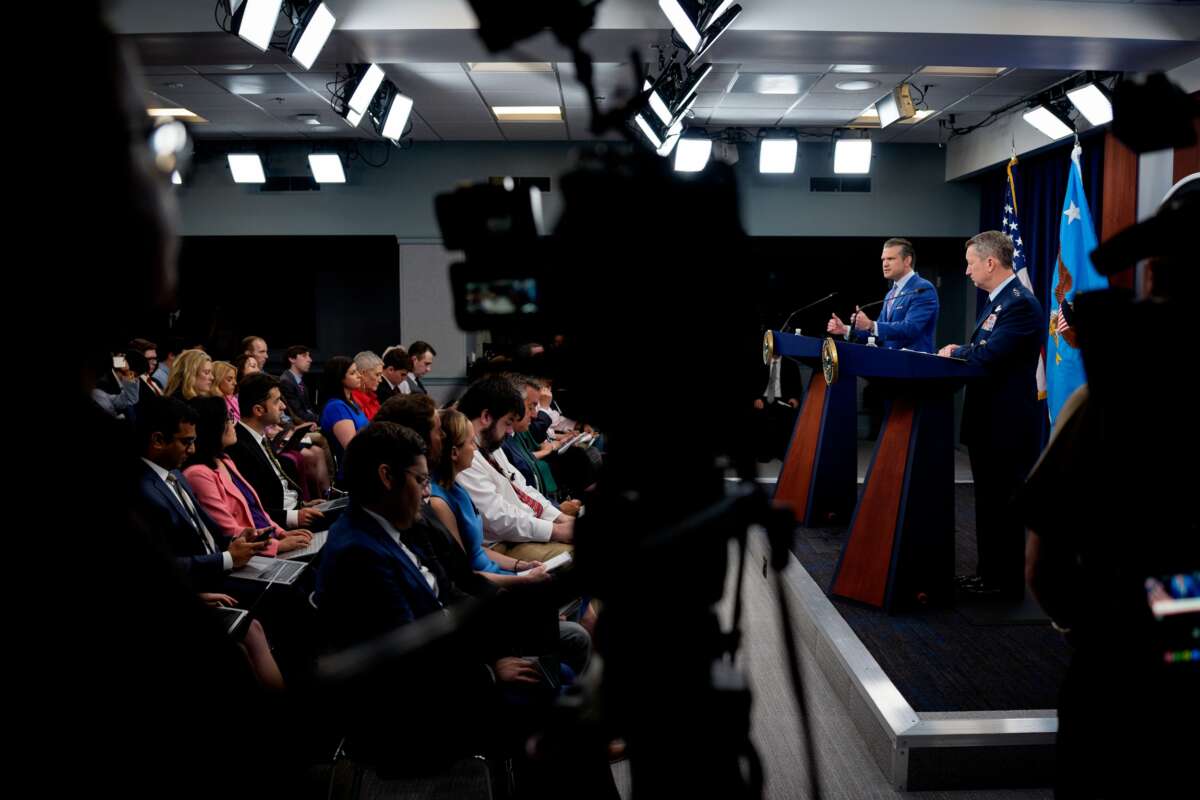
The United States Department of Defense (DOD) has established a new policy that essentially boots journalists out of the Pentagon building — less than a week after a federal judge ruled that a separate attempt by the agency to restrict journalists was unconstitutional.
The DOD announced on Tuesday that it is closing the workspace in the Pentagon that has for years been used by journalists with credentials to cover the military. Under the new policy, journalists will be moved to an annex outside the Pentagon, and can only enter the building if they are escorted by a department official. The new policy also seeks to make the credentialing process more prohibitive.
The announcement comes less than a week after U.S. District Judge Paul Friedman ruled in favor of several media organizations that sued the DOD over a separate policy seeking to restrict media access to the Pentagon. That policy sought to bar credentialed journalists from publishing information on the military unless it was sanctioned for release by agency heads, claiming that journalists seeking information outside of official government channels — such as insights from sources off the record — posed a “security risk.” (Such reporting has historically exposed systemic government lies to the American public, most famously through the publication of the Pentagon Papers during the Vietnam War.)
In his March 20 ruling, Friedman noted that, while the department had the right to try to prevent certain information from leaking, it could not do so by restricting the press. Friedman added that it was “more important than ever that the public have access to information from a variety of perspectives about what its government is doing,” especially within the DOD, in light of the U.S.’s invasion of Venezuela and its ongoing war on Iran.
The DOD is seeking to appeal Friedman’s ruling.
The New York Times, which was part of the lawsuit against the first policy, said it also plans to challenge the new policy, stating that the two are essentially the same.
“The new policy does not comply with the judge’s order. It continues to impose unconstitutional restrictions on the press. We will be going back to court,” said Charlie Stadtlander, a spokesperson for the paper.
Indeed, the language of the new policy echoes much of the language of the old policy. While the old policy bars journalists from trying to “solicit government employees to violate the law by providing confidential government information,” the new one bars “intentional inducement of unauthorized disclosure.”
“We used more words to say the same thing and to foreclose creative misinterpretations,” said Tim Parlatore, a special adviser to Defense Secretary Pete Hegseth.
The Pentagon Press Association (PPA), which represents reporters covering DOD-related issues, condemned the new policy as “a clear violation of the letter and spirit of last week’s ruling.”
“At such a critical time, we ask why the Pentagon is choosing to restrict vital press freedoms that help inform all Americans,” the PPA said.
Freedom of the Press Foundation (FPF) Chief of Advocacy Seth Stern also blasted the new policy, saying in a statement:
As the Supreme Court has repeatedly held, journalists are entitled to publish what their sources tell them. If the Pentagon has a constitutional basis to restrict what its employees tell the press, that’s a matter between the Pentagon and its employees. The press doesn’t work for the government and any policy that purports to require the press to help the government keep secrets from the American public is unconstitutional.
The revised policy continues to threaten journalists’ access “if they publish information obtained through ‘unauthorized’ disclosures,” Stern went on, adding that “the closure of the workspace for the press further demonstrates the government’s censorial and retributive motives.”
“The revised policy is not a good faith effort to comply with Judge Friedman’s order,” Stern explained. “It adds mostly meaningless window dressing while retaining the core constitutional violation — subjecting journalists to punishment for doing their jobs.”
An urgent appeal for your support: 24 Hours to raise $15,000
Truthout relies on individual donations to publish independent journalism, free from political and corporate influence. In fact, we’re almost entirely funded by readers like you.
Unfortunately, donations are down. At a moment when independent journalism is urgently needed, we are struggling to meet our operational costs due to increasing political censorship.
Truthout may end this month in the red without additional help, so we’ve launched a fundraiser. We have 24 hours to hit our $15,000 goal. Please make a tax-deductible one-time or monthly donation if you can.