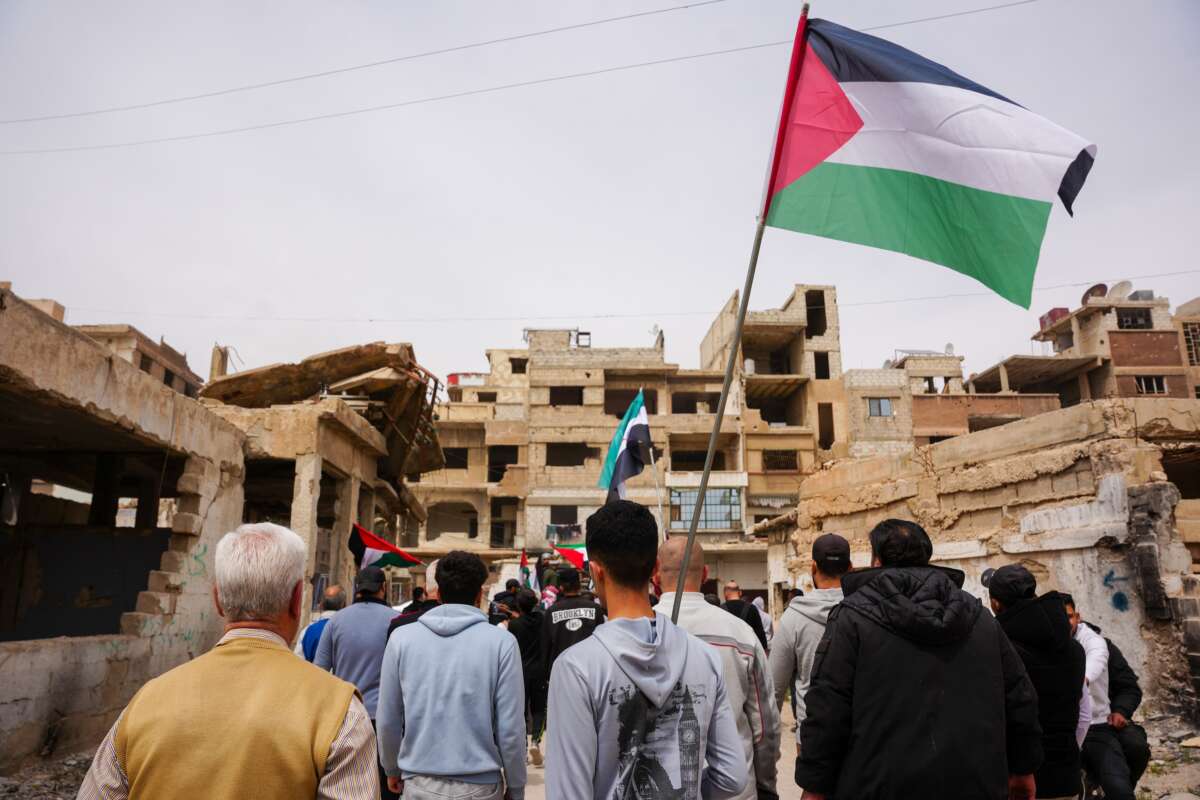
Honest, paywall-free news is rare. Please support our boldly independent journalism with a donation of any size.
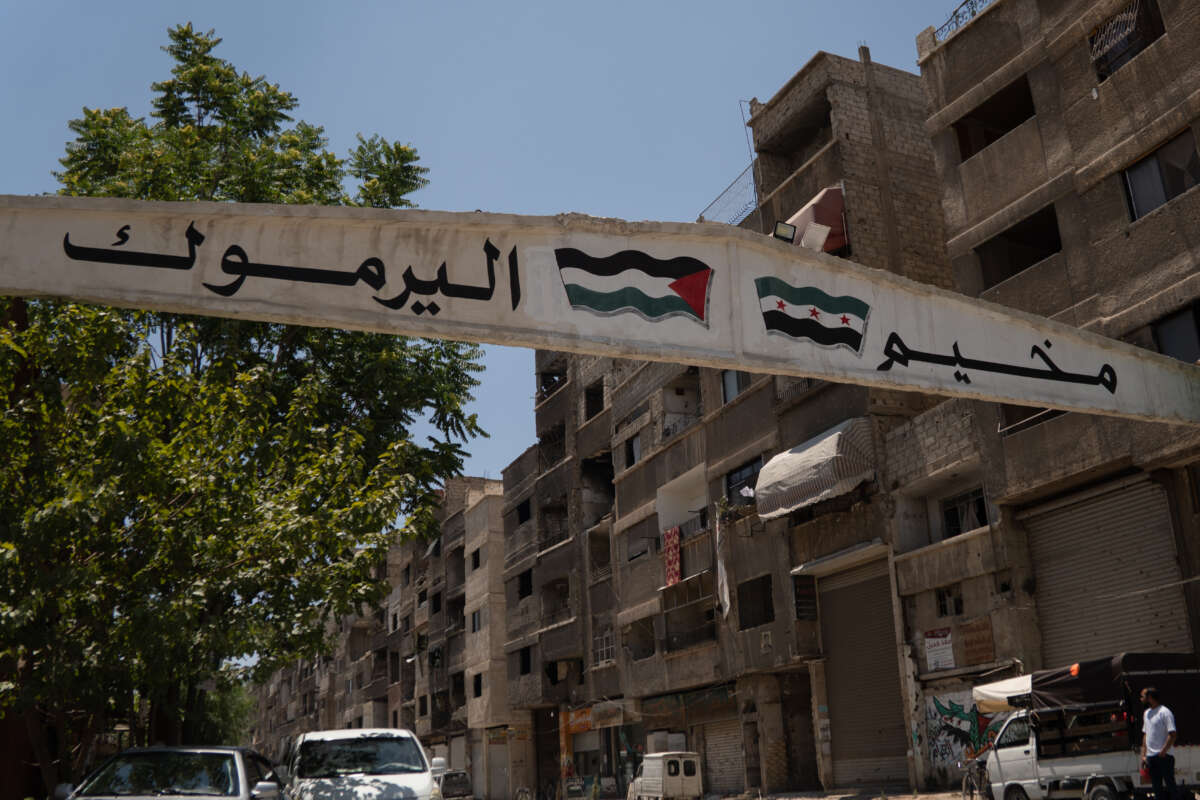
An arch crowns the entrance of a long, dusty, multi-laned street in the outskirts of Syria’s capital, Damascus. The text on the arch has been freshly painted — “Yarmouk camp” — with the Palestinian and Syrian Independence flags ensconced between the two words.
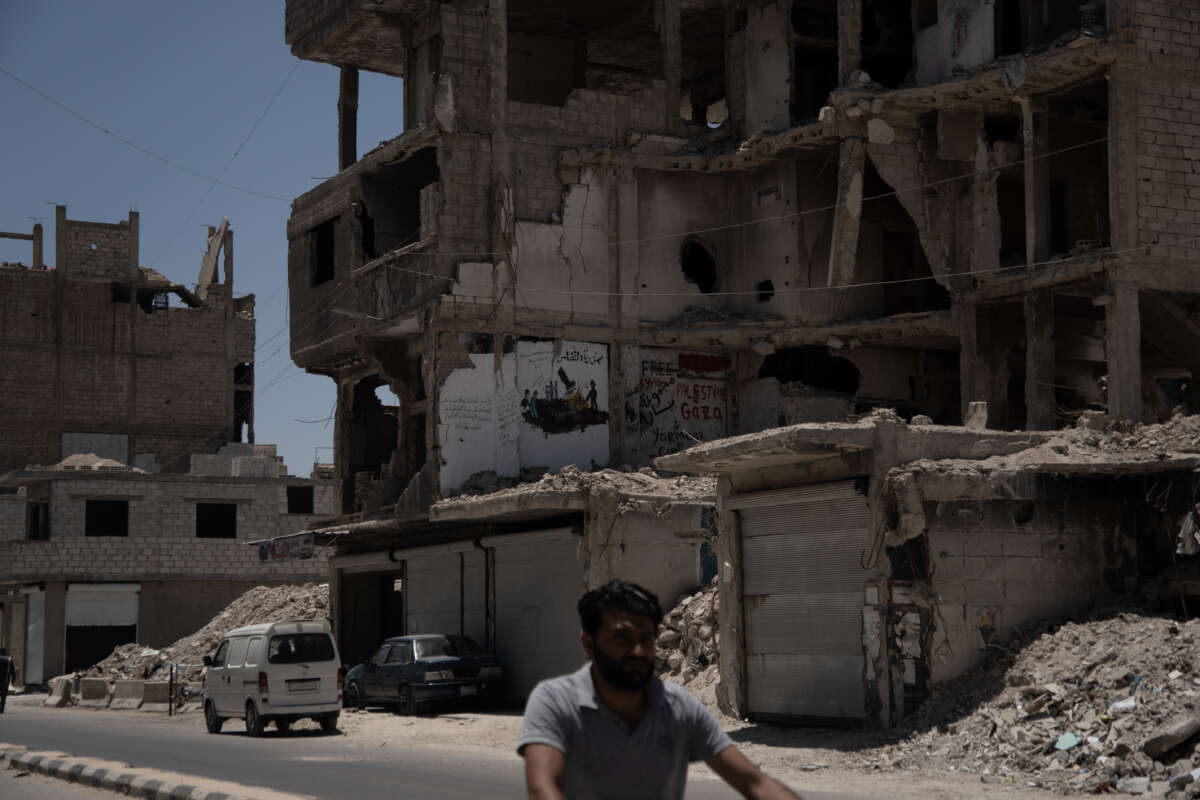
The street is dotted with small businesses getting back on their feet after over a decade of war in Syria. Closed shutters gathering dust, piles of garbage and destruction all around are eerie reminders of what the camp has witnessed. The Syrian war ran from 2011 to late 2024, when rebel forces headed by Hayat Tahrir al-Sham (HTS) toppled President Bashar al-Assad in a blitz overthrow. Yarmouk did not escape the clutches of the conflict.
Before 2011, Yarmouk housed about 160,000 Palestinian refugees, and was a key trade center and business hub. As one resident says, the camp was a “city of its own.” Within the complexities of the Syrian war, Yarmouk presented an additional layer of intricacy. Despite initial attempts by a large part of the camp’s population to maintain a sense of neutrality in the Syrian civil war, Yarmouk was dragged into the turmoil. In 2011, the camp was a safe haven for people fleeing the Assad regime but by the next year, surrounding areas had come under rebel control. In December 2012, the Assad regime began employing aerial warfare in the camp; a Russian-model MiG jet, bombed a mosque, hospital, and school sheltering refugees, marking the start of a destructive campaign by Assad, backed by Russia. In 2013, intensification of fighting in Yarmouk was accompanied by a massive siege of the camp imposed by the Assad government. Soon after, opposition factions took over the camp and gradually, the situation within it worsened.
Palestinian factions within the camp were divided — some were aligned with the Assad government while others were sympathetic to opposition groups. Later in the war, the camp was controlled by the Islamic State of Iraq and Syria (ISIS), before the Assad regime regained control in 2018.

Yasser Mahmoud Al-Ayadi, a resident of Yarmouk and native of Tiberias — now a city in Israel — remembers the siege with pain.
“We witnessed a lot of people dying from hunger. And there were people who died in the bombings. …The situation was really bad, it was inhumane,” he told Truthout.
The siege was immortalized in 2014 in a famous photograph depicting thousands of people queuing up for food, which highlighted the dire humanitarian crisis in the camp. Memories of those days still bring tears to the eyes of those who lived them. Arsan al-Shabi, 75, was born in Yarmouk and fled the camp during the war.
“I was here during the first siege in 2014. We didn’t have food — we were eating grass, like sheep,” he told Truthout, laughing dryly.
“We were eating cats,” chips in someone else who was listening, to which al-Shabi shrugged in response.

Assad’s Fraught Relationship With the Palestinian Cause
The Assad regime often positioned itself as an important member of the Axis of Resistance — a coalition of states, most notably Iran, and armed groups in the Middle East who position themselves as defending the region from U.S. and Israeli hegemony. This implied concern for (and solidarity with) the Palestinian cause. Al-Ayadi scoffs at the notion, calling it “theatrics.”
After the fall of the regime, leaked documents allegedly revealed high-level communication between Israel and Syria, often against Iran.
“It was … a matter of furthering [Assad’s] own interests,” says Al-Ayadi.
Nidal Betare, a Palestinian-American writer who grew up in Yarmouk, says that since the very beginning of Hafez al-Assad’s Ba’ath party’s rule, the family exploited the Palestinian cause to stay in power. In 2011, Nakba Day — the day Palestinians mark the ethnic cleansing of their people during the creation of the state of Israel — was commemorated by Palestinian Syrians with a march toward the Israeli-occupied Golan Heights. The march was promoted by the Syrian government, despite it being a dangerous endeavor for the participants. Many activists, including Betare, warned against Palestinian participation due to the personal danger they might face at the hands of Israeli forces, and suspicions that the Palestinians were a scapegoat in the Ba’ath regime’s show of force to Israel. The march went ahead anyway, and when Israeli forces opened fire on the protesters, the Syrian government didn’t intervene.
“A feeling began to emerge that the regime had used the Palestinians for its own ends, without regard for their safety, to deflect attention from the uprising then gaining ground,” he wrote in a 2013 article for the Institute of Palestine Studies.
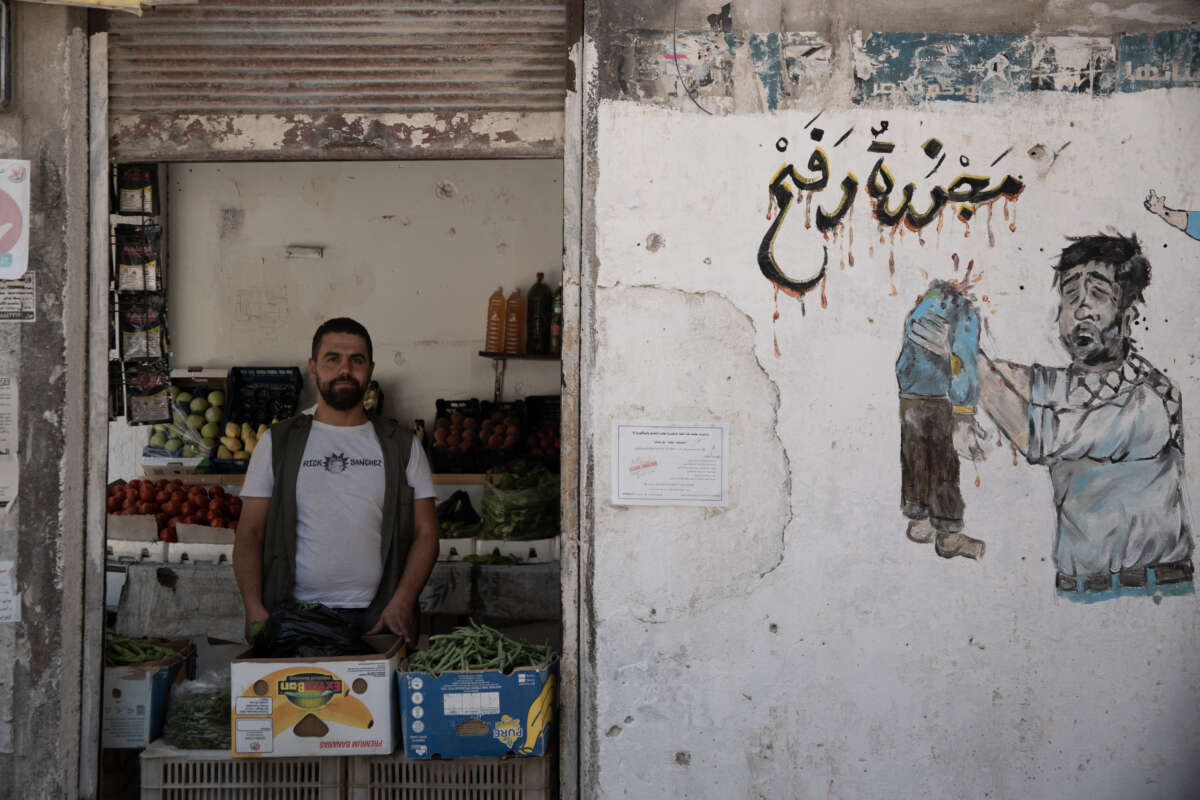
Wesam Sabaaneh, a Palestinian writer and activist from Yarmouk, echoes the sentiment.
“What happened in Syria was about Syria, not Palestine,” he told Truthout. “The Palestinian issue was used as a slogan to make people [stand] more with the regime, because they carried the Palestinian flag, and everyone would like that.”
Betare mentions how in a sense, Palestinians in Syria were fighting on multiple fronts. After moving to the U.S., he says his relationship with the National Coalition of Syrian Revolution and Opposition Forces, or the Syrian Coalition for short, was strained as it insisted he focus on the problems related to Assad rule in his advocacy. In a speech at a UN summit in 2014, he stated that Palestinians were refugees due to the Israeli occupation, and Israel’s refusal to implement UN Resolution 194, which provides Palestinians a right to return to their homes and receive compensation for their property losses.
Betare said the coalition told him its problem was not with Israel, but with Assad. “I told them, ‘Okay, you have one problem, I have two — the Israel problem, and Bashar al-Assad problem,” he explains. “[They were] trying to convince me to stop talking about Palestinian refugees and the right to return … which is something I could not do.”
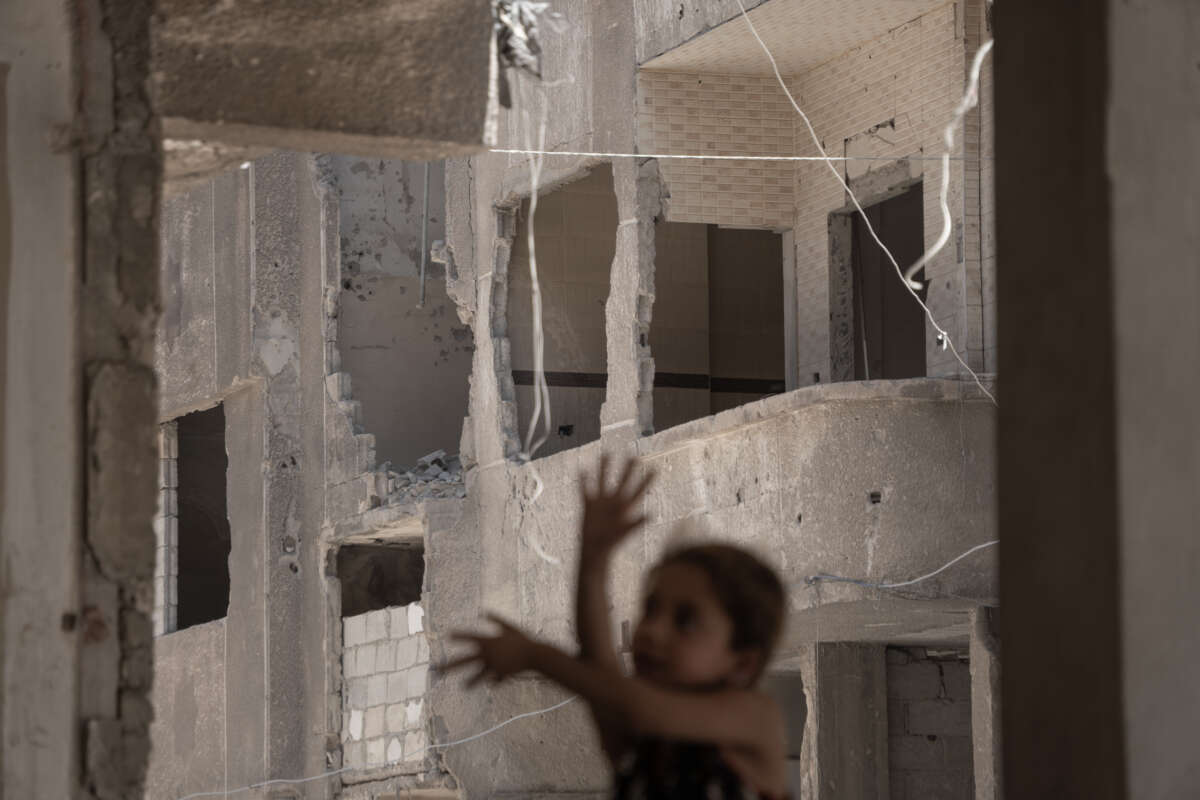
Over a decade later, the situation for Palestinians globally has only worsened. More than 58,000 people have been killed and over 135,000 injured in Israel’s devastating war on Gaza, following Hamas’s October 7 attack in Israel which killed about 1,200 people. Israel’s military campaign within the enclave has been denounced by many international organizations, including Amnesty International, as a genocide, and statements by high-level Israeli officials — including former Defense Minister Yoav Gallant’s referral to Palestinians as “human animals” — are clear indicators of genocidal intent. In February 2025, U.S. President Donald Trump suggested ethnically cleansing the Gaza Strip by forcibly displacing its population to other countries.
What’s Next for Yarmouk?
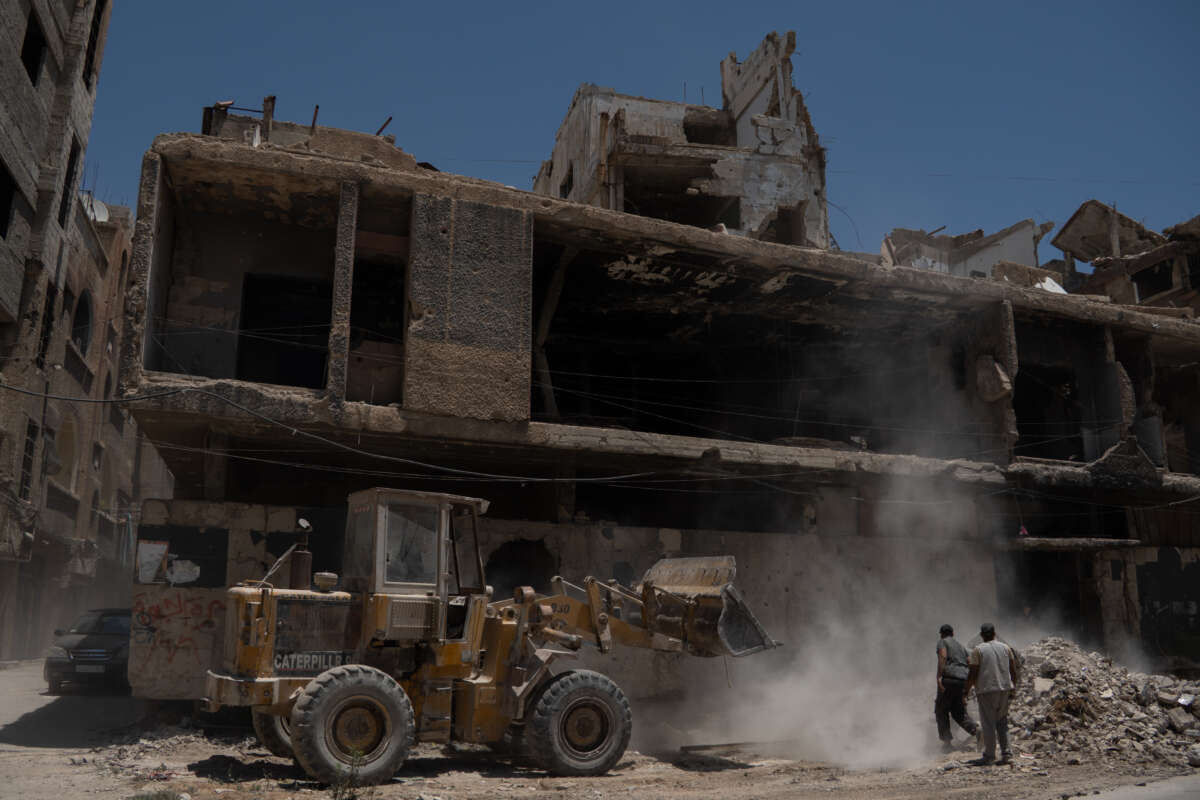
Twelve years on, life is now returning to the streets of Yarmouk. After the 2018 recapture of the camp by government forces, fighting was stalled. The camp was largely depopulated, and a highly limited number of people were given permission by regime forces to return to their homes. A couple of weeks after the fall of the regime in December 2024, the camp was sparsely populated, with barely any activity. Now, shops have reopened, and children play on the streets. On occasion, one comes upon excavators clearing out rubble, and workers fixing up electric cables. Sabaaneh says that the general mood in the camp is that of “big hope.”
“Now that people are done with the regime and the war, they’re thinking about how to rebuild and how to return to the camp and activate it,” he says.
With the fall of the regime, Yarmouk camp is facing a power vacuum in which the Palestinian Authority (PA) — a body that Sabaaneh says is widely considered to be “traitors” to Palestinian refugees — is trying to establish control and influence. In the Israeli-occupied West Bank, the PA has adopted policies in line with Israeli interests, including campaigns against the Al Jazeera media network and raids on militant groups. The PA is inextricably intertwined with the Palestinian Liberation Organization (PLO), which is the representative entity for Palestinians in Syria.
“Especially with what is happening in the West Bank and Gaza, people in general see the PA as Israeli security forces. This is why you see a lot of tension between Fatah [the PLO’s largest party] and the population in Palestinian camps, especially in Syria and Lebanon,” Sabaaneh explains.
Betare says that if the PLO took control of Yarmouk, it could create a situation like that of the Ain al-Hilweh camp in Lebanon. With the PA being the most influential body there, it regularly witnesses clashes over fund management and is rife with corruption. The Syrian government’s ideological stance on Palestinian Syrians remains unclear. The government has held indirect talks with Israel amid regular Israeli military bombing and incursions into Syrian territory, and also detained members of the Palestinian Islamic Jihad. Now, the new Syrian government has set up a local council to help with providing services, relief, and reconciliation, something Sabaaneh hails as a good “starting job.” At an Arab League summit in March 2025, Syrian President Ahmed al-Sharaa denounced Trump’s “unacceptable” plan to ethnically cleanse the Gaza strip, calling it part of a “larger project … to uproot Palestinians from their land.”
The Trump administration’s revocation of HTS’s terrorist designation and lifting of sanctions may improve material circumstances for everyone in Syria, including Palestinians. However, the White House’s stance against Palestinian resistance groups and Syria’s hopes for economic and diplomatic support from the U.S. may, in combination, chip away at Palestinian political rights under the guise of anti-terrorism. According to a White House fact sheet from June 30, 2025:
President Trump wants Syria to succeed — but not at the expense of U.S. interests. While seeking to reengage constructively, this Administration will continue to guard against all threats and monitor progress on key priorities: taking concrete steps toward normalizing ties with Israel, addressing foreign terrorists, deporting Palestinian terrorists and banning Palestinian terrorist groups, helping the United States prevent a resurgence of ISIS, and assuming responsibility for ISIS detention centers in northeast Syria.
Even before the Assad era, Palestinians in Syria have enjoyed similar rights to Syrian citizens themselves. Yet according to Sabaaneh, what most Palestinian refugees ultimately want is their right of return to their original homeland.
“[It’s about our] national identity as Palestinians; it’s the main issue we are fighting and living for. It’s not possible to stay for hundreds of years as refugees; we need a just solution,” he says.
Even Abdul Rahman Atrash, a 15-year-old Palestinian from Haifa (in modern-day Israel) who was born and brought up in Yarmouk, feels strongly about his original homeland. The teenager barely remembers the years of siege, but when asked about where he’s from, he says, “I’m Palestinian,” with a hint of pride in his voice.
Manning a cart selling sweets, Atrash dreams of both opening a sweet shop in Yarmouk and of being able to see Jerusalem one day. He follows the developments in Gaza closely, his voice rising in indignation when talking about Trump’s suggestion that Palestinians in Gaza be displaced to other Arab countries.
“No way, it’s their land — of course they’ll defend it. You can’t ask them to leave their land.”

Though 60 years Atrash’s senior, the sense of belonging resonates strongly with al-Shabi.
“We were brought up being told that Palestine is our country — our first country,” he says, when asked if he hopes to see his homeland one day.
“Syria is our country too, but our first country is Palestine and we don’t forget that.”
Media that fights fascism
Truthout is funded almost entirely by readers — that’s why we can speak truth to power and cut against the mainstream narrative. But independent journalists at Truthout face mounting political repression under Trump.
We rely on your support to survive McCarthyist censorship. Please make a tax-deductible one-time or monthly donation.