Honest, paywall-free news is rare. Please support our boldly independent journalism with a donation of any size.
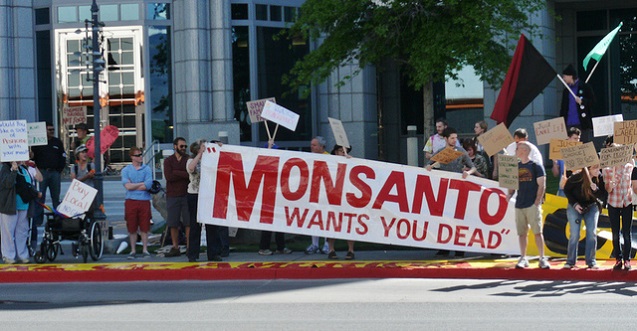
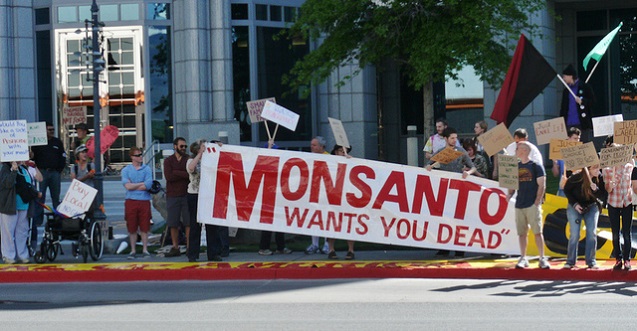 OccupyRenoMediaCommittee / Flickr )” width=”637″ height=”331″ />(Photo: OccupyRenoMediaCommittee / Flickr )
With the help of a $4.6 million check from the biotech giant Monsanto and millions more from other out-of-state corporate interests, the campaign to defeat a Washington state ballot initiative in November to label groceries that contain genetically engineered ingredients has outraised the initiative’s supporters by nearly three times, according to campaign data released last week.
The campaign for Washington ballot Initiative 522 is already looking a lot like last year’s Proposition 37 campaign in California, where biotech and agribusiness interests outspent organic food producers and grassroots labeling supporters by nearly 5 to 1 in a high-profile battle over labeling genetically engineered groceries in the Golden State. (Genetically engineered products are also known as Genetically Modified Organisms, or GMOs.)
The No on 522 campaign has raised $11.1 million so far and has spent only a fraction of its war chest. Monsanto tops the group’s list of donors, while pesticide giants Dupont and Bayer CropScience have donated $3.2 million and $562,000, respectively.
All three companies spent millions opposing Proposition 37 in California in November, 2012, along with individual members of the Grocery Manufacturers of America, which represents processed foods companies like Pepsico and Kraft. The trade group has donated $2.2 million so far to defeat the Washington GMO labeling initiative.
The Yes on 522 campaign was initially winning the fundraising race, but now trails its opponents with a total of $3.5 million raised and $800,000 spent. The group’s top donors include Dr. Bronner’s Magic Soaps ($950,000), Mercola.com ($200,000), and several organics food companies and consumer groups.
Washington’s Initiative 522 would require retail food products and seed stocks that have been produced with the help of genetic engineering to be clearly labeled as such. Several types of products are exempt, including alcoholic beverages, restaurant foods, medical foods and non-GMO animal products, regardless of whether the animals were fed genetically engineered feed.
A recent poll shows that 66 percent of Washington voters support Initiative 522, but both campaigns have yet to spend much money, and these numbers could change as campaign ads start popping up across the state.
In California last year, support for the Proposition 37 labeling initiative topped out at about 67 percent in mid-September before the No on 37 campaign began spending millions of dollars donated by Monsanto and other big firms on a statewide advertising campaign. Support for the initiative dropped steadily during the deluge of ads, and voters narrowly rejected the initiative.
Yes on 522 spokeswoman Elizabeth Larter told Truthout that the campaign expected to be outspent, so organizers started early. Initiative 522 received 350,000 signatures to get on the ballot, the second highest number in state history. The campaign has also recruited nearly 700,000 small donors and thousands of volunteers, Larter said.
“We’re approaching things differently,” Larter said. “Our team is made up of seasoned political professionals, and we really strived to make sure to communicate with voters early and often, and that’s what works in the long run.”
The Yes on 522 campaign’s messaging is different as well. While the pro-labeling campaign in California waded into the sticky global debate over whether GMO foods are safe to eat and came under fire for touting a controversial French study linking Monsanto corn to tumors in rats, the Washington campaign cites mainstream research on the negative environmental impacts of genetically engineered crop farming and has asked leading health food manufacturers to explain how easy and inexpensive it is to change food labels.
Larter, a Washington native, said voters in her state are smart, concerned about the environment, and won’t be happy about the flood of out-of-state money being spent by Initiative 522’s opponents.
Meanwhile, the No on 522 campaign is already sounding a lot like the anti-labeling campaign that won in California. On its web site, the group argues that labeling GMO foods will increase food costs, hurt farmers and saddle taxpayers with the expenses of a costly bureaucracy. The web site looks nearly identical to the No on 37 web site and makes many of the same arguments, so it should come as no surprise that both campaigns have enjoyed funding from the same megacorporate donors.
A terrifying moment. We appeal for your support.
In the last weeks, we have witnessed an authoritarian assault on communities in Minnesota and across the nation.
The need for truthful, grassroots reporting is urgent at this cataclysmic historical moment. Yet, Trump-aligned billionaires and other allies have taken over many legacy media outlets — the culmination of a decades-long campaign to place control of the narrative into the hands of the political right.
We refuse to let Trump’s blatant propaganda machine go unchecked. Untethered to corporate ownership or advertisers, Truthout remains fearless in our reporting and our determination to use journalism as a tool for justice.
But we need your help just to fund our basic expenses. Over 80 percent of Truthout’s funding comes from small individual donations from our community of readers, and over a third of our total budget is supported by recurring monthly donors.
Truthout has launched a fundraiser to add 379 new monthly donors in the next 6 days. Whether you can make a small monthly donation or a larger one-time gift, Truthout only works with your support.