Truthout is a vital news source and a living history of political struggle. If you think our work is valuable, support us with a donation of any size.
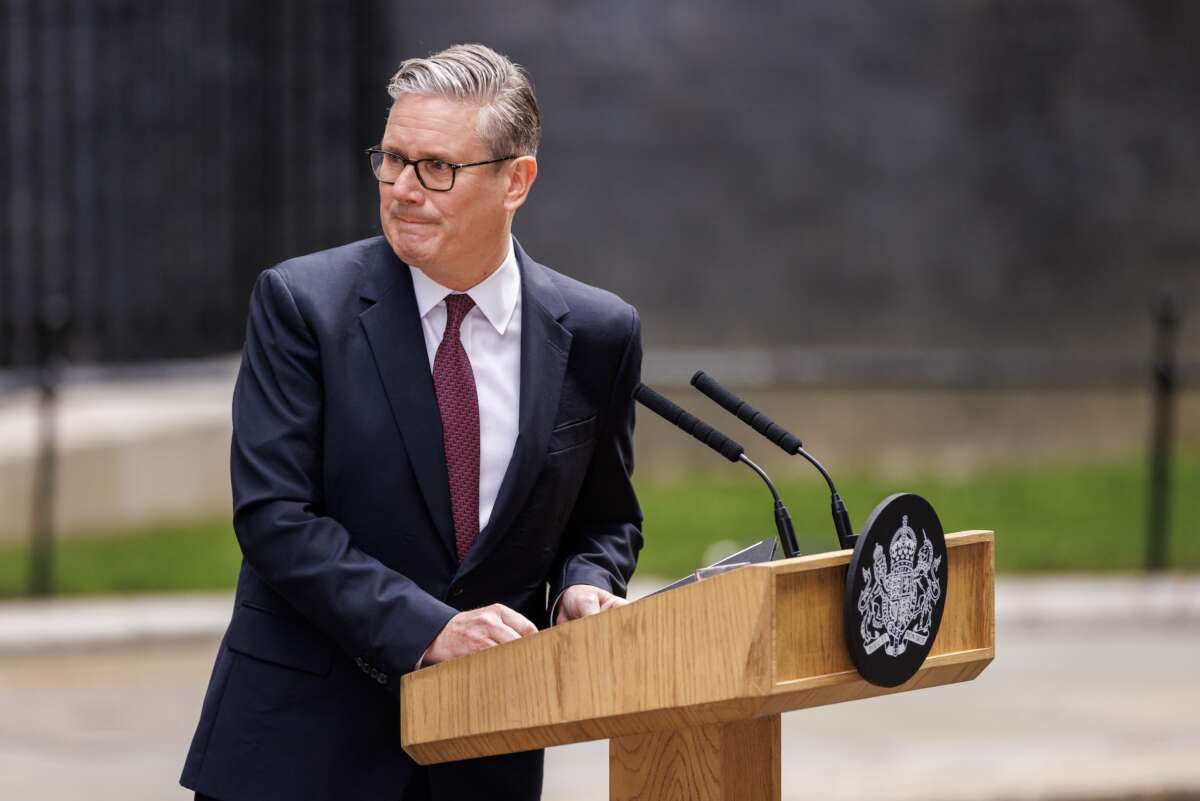
U.K. Labour Party leader Keir Starmer announced his resignation on Monday, after just 23 months as prime minister and a rapid decline in popularity.
Under Starmer’s leadership, the Labour Party suffered repeated and record defeats in local elections to the right-wing Reform Party. Starmer’s rapid unpopularity rested on his austerity policies and, among the left, his repression of Palestine solidarity activists.
Starmer’s likely successor is Andy Burnham, previously the mayor of Greater Manchester, who won a parliamentary by-election on Thursday that made Starmer’s resignation almost inevitable. Many in Labour understood Burnham’s by-election win to mean that the candidate has a higher chance of moving beyond Labour’s losses to Reform.
Former Health Secretary Wes Streeting, considered Burnham’s main rival, said that he will back Burnham. But critics are not optimistic that the change-over will bring an end to Labour’s crisis.
Charlie Hore, a socialist activist in the U.K., told Truthout:
Starmer won in 2024 by promising change, and then repeatedly kicked Labour’s supporters in the teeth. It’s hard to remember the last time that a government lost so much support and respect so quickly. Why? Take your pick – taking winter fuel allowances from pensioners; keeping the hated two-child cap on benefits; pandering to the racist right over migration and refugees; Peter Mandelson; supporting the genocide in Gaza; and suspending Labour MPs who opposed any of this.
The cutting of pensioners’ winter fuel allowances less than a month after Starmer’s election marked an initial drop-off of widespread support in a short tenure defined by reversals of promises. Starmer’s austerity measures added to a longstanding cost-of-living crisis in the U.K.
Starmer also consistently refused to acknowledge Israel’s genocide in Gaza, instead overseeing the ban on Palestine Action for its nonviolent direct action against Israeli arms factories. Starmer’s government designated Palestine Action – a group of mostly young activists demanding an end to U.K. complicity in the genocide – as a terrorist organization in July 2025, carrying out mass arrests, and appealing the U.K. High Court to keep the terrorism proscription in place just this year.
“But while Starmer’s government was vicious and mean-spirited, it was also weak, incompetent, and accident-prone,” Hore explained. “For months now the only thing saving Starmer was the lack of a credible alternative. Burnham’s appeal is that he’s not a mediocrity like Starmer, but Labour’s crisis is so deep that it’s difficult to see him saving them.”
Commenting on Friday, U.K. historian D.K. Renton wrote of Burnham that “Taking over Labour may [be] easy but governing he’ll find harder.” He also suggested that Burnham would have a difficult time replicating his local victory and changing the tide of increasing losses to the right-wing Reform party in local elections over the coming years.
Former Labour Party leader Jeremy Corbyn said in an interview on Sky News on Saturday that Burnham’s “basic economic strategy and views… seem to me to be accepting too much of the austerity that we’ve had imposed upon us.”
Burnham has also faced criticism for saying that he will retain Home Secretary Shabana Mahmood, who has called for an end to permanent refugee status in the U.K. and enforced the ban on Palestine Action.
Though Burnham called for a ceasefire in Gaza beginning in October 2023, he has, like Starmer, refused to call Israel’s actions a genocide. He has remained a member of Labour Friends of Israel and called the Boycott, Divestment, and Sanctions movement “spiteful.”
Starmer will remain caretaker prime minister until the next Labour leader is selected, by September at the latest.
Corbyn wrote on X after Starmer’s resignation: “Keir Starmer could have ended child poverty, homelessness and the grotesque levels of inequality in this country. Instead, he abandoned those in need, destroyed our civil liberties and facilitated genocide in Gaza.”
Media that fights fascism
Truthout is funded almost entirely by readers — that’s why we can speak truth to power and cut against the mainstream narrative. But independent journalists at Truthout face mounting political repression under Trump.
We rely on your support to survive McCarthyist censorship. Please make a tax-deductible one-time or monthly donation.