Part of the Series
Human Rights and Global Wrongs
Truthout is a vital news source and a living history of political struggle. If you think our work is valuable, support us with a donation of any size.
U.S. District Judge Alvin Hellerstein refused to dismiss drug trafficking charges against Venezuelan President Nicolás Maduro and First Lady Cilia Flores on March 26, even though the Treasury Department’s Office of Foreign Assets Control (OFAC) is blocking funds for their legal defense, in violation of the Sixth Amendment and the Due Process Clause of the U.S. Constitution.
But Hellerstein reserved the right to revisit the issue in the future if he determines that OFAC is arbitrarily obstructing the money for Maduro’s counsel of choice.
Venezuelan law provides for the payment of legal fees for the president and first lady. But OFAC issued — then three hours later retracted — a license to Venezuela that would allow the country to circumvent U.S. sanctions and pay for their defense.
“As a result [of the sanctions], counsel cannot provide a legal defense to Mr. Maduro or receive funds from the government of Venezuela to do so without first obtaining a specific license from OFAC,” Barry Pollack, Maduro’s defense attorney, wrote in the motion to dismiss the indictment.
Maduro and Flores have been in custody in the Metropolitan Detention Center in Brooklyn since January 3, when U.S. forces illegally kidnapped them from Venezuela and transported them to New York, while killing approximately 100 people. The indictment charges that Maduro, Flores, and other members of the Maduro government committed narco-terrorism and conspiracy to import cocaine into the U.S.
“After invading another country and forcibly bringing its sovereign head of state to the United States, the government of the United States is now actively preventing him from retaining counsel of his choice and receiving a fair defense in this Court, in violation of his Sixth Amendment and Due Process rights,” Pollack wrote.
“The U.S. government has unlawfully interfered with President Maduro’s Sixth Amendment right to legal counsel by revoking the OFAC license that allowed for payment of legal services,” National Lawyers Guild President Suzanne Adely told Truthout. “This is an outrageous and direct interference in his legal defense and should be grounds to end this sham prosecution immediately and free Maduro and his wife Cilia.”
When Hellerstein asked U.S. prosecutor Kyle Wirshba at the hearing on the motion to dismiss, “What is the interest of the government now in blocking those funds?” Wirshba replied: “National security and foreign policy.”
Hellerstein said: “I see no abiding interest in national security in the right to defend yourself. The right to defend is paramount.”
The judge added, “We are doing business with Venezuela … Things have changed in Venezuela … We do business with Venezuela; the oil is important because of the Strait of Hormuz.”
Hellerstein noted that the executive order establishing the sanctions was signed by President Barack Obama. “The interests are no longer implicated,” the judge told Wirshba. “Maduro and Flores are here. We have changed the situation in Venezuela. I don’t concede that what’s in the executive order is implicated anymore.”
“There is the Constitutional right to choose counsel,” Hellerstein declared. Regarding payment of the legal defense, he added, “Isn’t that a matter for Venezuela?”
Hellerstein asked Wirshba whether the judge could order OFAC to issue a specific license, and he replied, “I do not believe you have the authority as part of this case.”
Maduro does not personally have the funds to pay his lawyer Pollack, who asked the judge to dismiss the indictment because OFAC is blocking the defense funds.
Pollack has said that if he cannot be paid, he would like to withdraw from the case so the court can appoint other counsel to defend Maduro. Although Hellerstein acknowledged the Sixth Amendment right of defendants to counsel of their own choosing, he refused to dismiss the case at this stage.
The judge told Pollack he could withdraw from Maduro’s defense because “Defense by CJA [Criminal Justice Act Panel] or Federal Defender is adequate.”
But the Supreme Court has interpreted the Sixth Amendment right to counsel as the right to effective — not simply adequate — representation.
Moreover, appointing a public defender to represent them would drain legal resources intended for those who can’t afford attorneys, Pollack said, and that is not sensible in “a case where you have someone other than the U.S. taxpayer standing ready, willing and able to fund that defense.”
Hellerstein agreed that defending Maduro would entail “great expense” and exhaust the resources of most public defenders.
“Not only would the Court need to appoint counsel and foist the cost of Mr. Maduro’s defense on the United States taxpayers, despite the willingness and obligation of the government of Venezuela to pay Mr. Maduros [sic] defense costs, but also any verdict against Mr. Maduro would be constitutionally suspect,” Pollack wrote in the motion to dismiss.
The judge reserved his final ruling, stating, “If I find that in this case a specific license was arbitrarily withheld and the government does not comply, you could raise dismissal. For now, it’s too serious.”
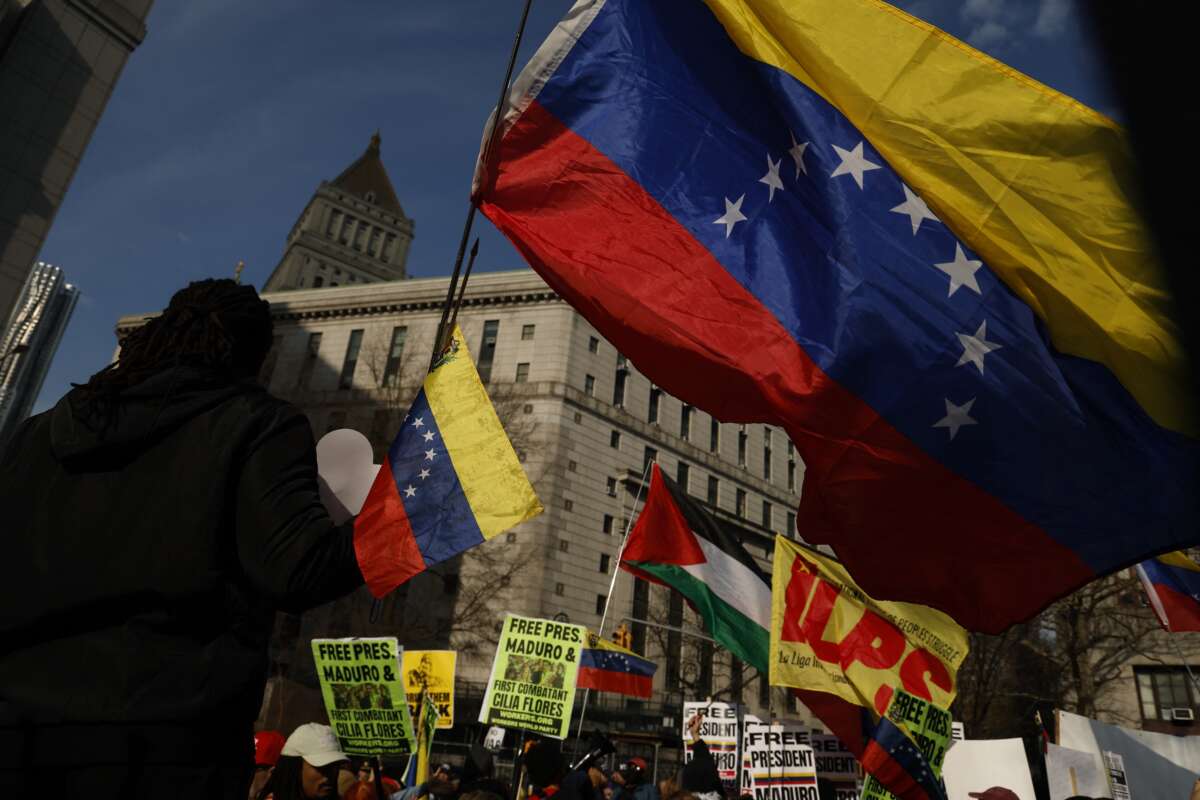
“Despite the presence of pro-Trump protesters calling for Maduro’s prosecution, civil society organizations are rallying, in New York and elsewhere, calling for Maduro and Cilia’s freedom and for justice and accountability for the criminal and violent kidnapping of a sovereign leader and imperialist aggression,” Adely told Truthout.
The first Trump regime severed relations with Venezuela in 2019, and the Biden administration continued that policy. Since the U.S. aggression against Venezuela and kidnapping of Maduro and Flores on January 3, 2026, the Trump administration is in the process of re-establishing formal diplomatic ties with Venezuela. Vice President Delcy Rodríguez, interim president of Venezuela, is a member of Maduro’s Bolivarian government.
OFAC has issued a license for Venezuelan diplomats to travel to the United States this week. That puts a lie to the U.S. prosecutor’s claim that national security prevents the incarcerated Maduro from receiving Venezuelan funds for his legal defense.
The defense motion to dismiss the indictment did not address Maduro’s immunity defenses, which will be raised in future proceedings. Meanwhile, we await Judge Hellerstein’s ruling.
Urgent Appeal for Your Support
Truthout relies on individual donations to publish independent journalism, free from political and corporate influence. In fact, we’re almost entirely funded by readers like you.
Unfortunately, donations are down. At a moment when independent journalism is urgently needed, we are struggling to meet our operational costs due to increasing political censorship.
Truthout may end this month in the red without additional help. We still need to raise $7,000. Please make a tax-deductible one-time or monthly donation if you can.