Truthout is a vital news source and a living history of political struggle. If you think our work is valuable, support us with a donation of any size.
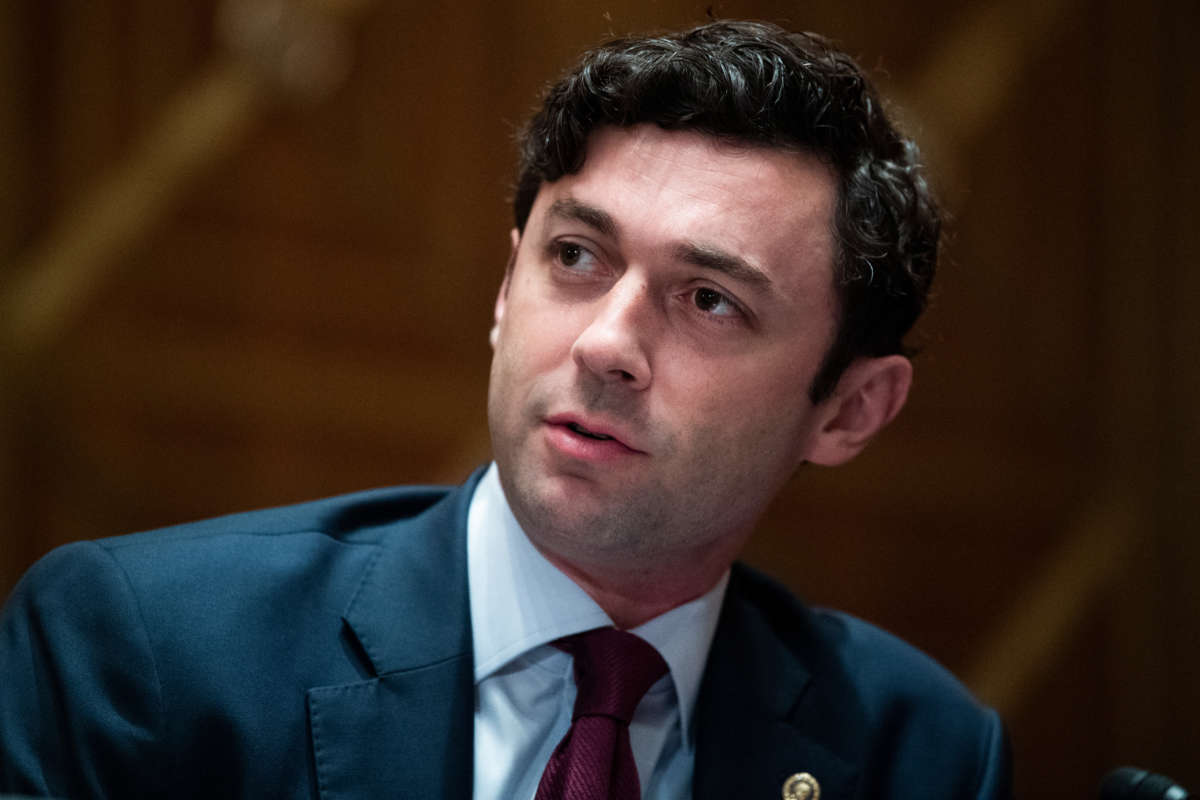
On Wednesday, Senators Jon Ossoff (D-Georgia) and Mark Kelly (D-Arizona) introduced an anti-corruption bill that would ban members of Congress and their families from actively trading stocks.
The Ban Congressional Stock Trading Act would compel members, along with their spouses and dependent children, to put all of their stocks into a blind trust when they take office. Members and their families would also be required to divest any stocks that aren’t able to be put into a blind trust. Democrats say that the primary aim of the bill is to increase transparency and accountability to the public by lessening conflicts of interest.
“Members of Congress should not be playing the stock market while we make federal policy and have extraordinary access to confidential information,” Ossoff said in a statement. The bill has garnered the support of government watchdog groups like the Project on Government Oversight (POGO).
Measures to ban members of Congress from trading stocks are overwhelmingly popular with voters across the political spectrum. A recent poll of 1,706 likely voters found that, among respondents, 70 percent of Democrats, 78 percent of Republicans and 80 percent of independents believe that members of Congress should be barred from stock trading.
Last year, Sen. Elizabeth Warren introduced a bill that is similarly aimed at curbing corruption. Warren’s bill would go slightly further, banning other top government officials from trading stocks, including the president, Cabinet members, Federal Reserve officials and federal judges. However, her ban wouldn’t apply to family members.
If the bill proposed by Ossoff and Kelly is effective, it could prevent future scandals relating to stock trading among Congress members, including scandals like one involving Sen. Kelly Loeffler (R-Georgia), one of Ossoff’s predecessors in Georgia.
In 2020, the Justice Department launched an insider trading probe into Loeffler and Senators Richard Burr (R-North Carolina), Dianne Feinstein (D-California) and James Inhofe (R-Oklahoma). The lawmakers made major stock sales just before the stock market dropped, shortly after receiving confidential briefings on the potential crash.
Those investigations were eventually dropped, but stock trading scandals remain common among Congress members. Reporters found that 54 members of Congress failed to properly report their stock trades in 2021, a move that is in violation of the STOCK Act, which aims to prevent insider trading and increase transparency around the finances of Congress members. The STOCK Act charges around $200 for each violation, a fine that is relatively low for an institution infamous for housing millionaires.
How effective the Ban Congressional Stock Trading Act would be is unclear. The financial penalties for violating the proposed law are higher, as members would be fined the amount of their congressional salaries if found violating the law. According to the bill, the fines would be the “monthly equivalent of the annual rate of pay payable to the Member of Congress”; a typical member makes $174,000 a year, or about $14,500 a month.
Though $14,500 is much heftier than the fee mandated by the STOCK Act, it still may not be enough to deter certain members from handing over control of their stocks. House Speaker Nancy Pelosi (D-California), for instance, owns millions of dollars’ worth of stocks; others, like Rep. Pat Fallon (R-Texas), have traded tens of millions of dollars’ worth of stocks in the past year alone.
The bill comes as somewhat of a snub to Pelosi, who defended members’ ability to trade stocks in December. “We’re a free market economy,” she said. “They should be able to participate in that.”
An urgent appeal for your support: 5 Days to raise $34,000
Truthout relies on individual donations to publish independent journalism, free from political and corporate influence. In fact, we’re almost entirely funded by readers like you.
Unfortunately, donations are down. At a moment when independent journalism is urgently needed, we are struggling to meet our operational costs due to increasing political censorship.
Truthout may end this month in the red without additional help, so we’ve launched a fundraiser. We have 5 days to hit our $34,000 goal. Please make a tax-deductible one-time or monthly donation if you can.