Support justice-driven, accurate and transparent news — make a quick donation to Truthout today!
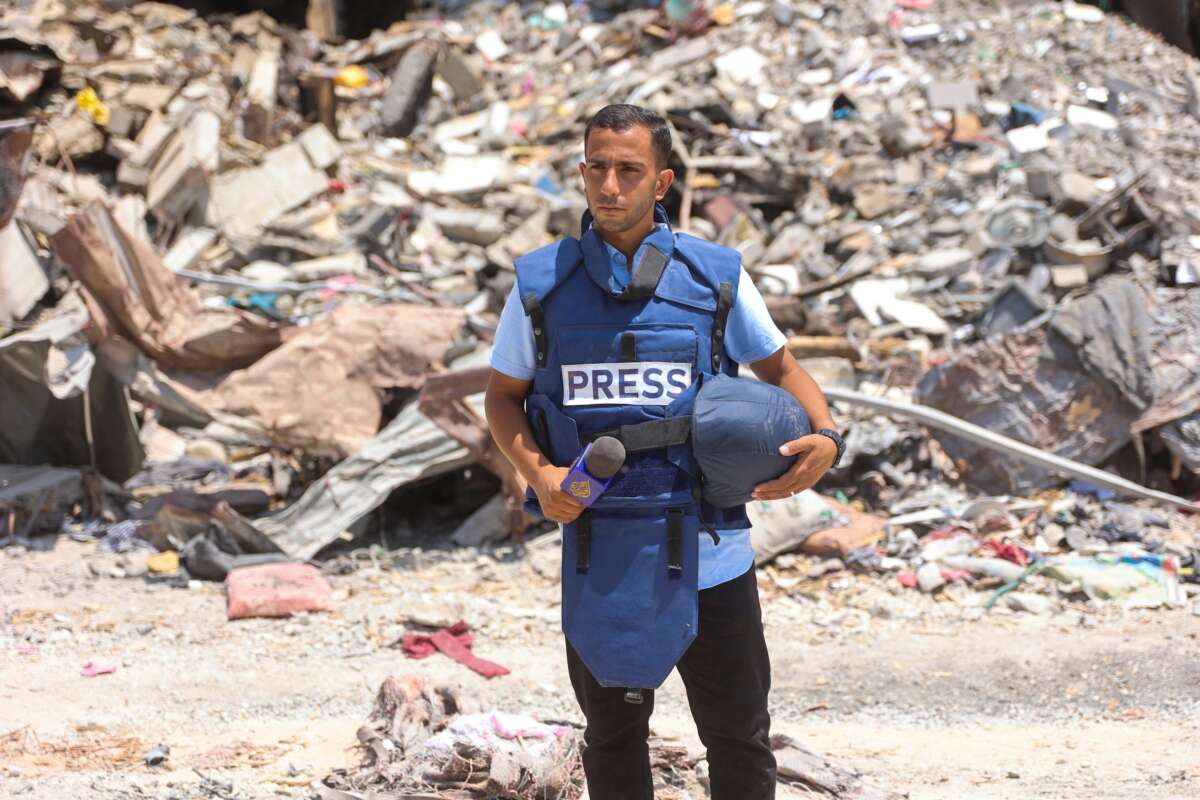
The Israeli military killed five journalists in a targeted strike in Gaza on Sunday, including celebrated reporter Anas al-Sharif, who was hailed as the “voice” of Palestinians in Gaza.
Israel struck the journalists’ tent outside of al-Shifa Hospital in Gaza City Sunday evening. The journalists worked for Al Jazeera.
Al Jazeera identified those killed as correspondent Mohammed Qreiqeh, and cameramen Ibrahim Zaher, Moamen Aliwa, and Mohammed Noufal. Israel struck the tent where the journalists gathered to work, as hospitals have more reliable sources for internet and electricity. Qreiqeh delivered a report on air shortly before he was killed, “speaking in his trademark eloquent manner,” Al Jazeera noted.
Al-Sharif, one of the most well-known journalists in Gaza, had faced public death threats from Israeli officials for months. In October, Israel published a list of six Al Jazeera journalists in northern Gaza it accused of being part of “terrorist” groups, providing no evidence. This list included al-Sharif and fellow north Gaza journalist Hossam Shabat, whom Israeli forces killed in a targeted strike this March.
Last month, as Israel was rapidly worsening its starvation crisis, al-Sharif became emotional in a report on the catastrophe. Amid his broadcast report, a woman collapsed in the street due to weakness from hunger, and the 28-year-old reporter shed tears over his grief. Someone off-screen urged him, “Keep going, Anas. You are our voice.”
After that report, the head spokesperson for the Israeli military, Avichay Adraee, openly attacked al-Sharif on social media numerous times, calling him a terrorist and providing no evidence. Al-Sharif slammed these statements as “public incitement.”
The Israeli military openly boasted about killing al-Sharif and his colleagues shortly after the strike on Sunday, writing in a social media post: “STRUCK,” alongside a bullseye emoji. Israel once again, as it did to many of the over 270 journalists it has killed as part of the genocide, accused al-Sharif of being a terrorist.
Palestinians have long warned that Israel has fabricated evidence in order to smear al-Sharif.
Al-Sharif’s loved ones posted a message that he wrote in the event of his death on his social media shortly after he was killed. The Al Jazeera reporter wrote that all he ever hoped for was to live long enough to reunite with his family in his ancestral home of Al-Majdal, now occupied Asqalan, which Israeli forces ethnically cleansed during the 1948 Nakba.
Both Al-Sharif and Qreiqeh had children who they were separated from when they stayed in north Gaza, which has been under siege from Israel for over a year, in order to report on the atrocities there.
“I have lived through pain in all its details, tasted suffering and loss many times, yet I never once hesitated to convey the truth as it is, without distortion or falsification — so that Allah may bear witness against those who stayed silent, those who accepted our killing,” al-Sharif wrote in his final message.
“I urge you not to let chains silence you, nor borders restrain you. Be bridges toward the liberation of the land and its people, until the sun of dignity and freedom rises over our stolen homeland,” he wrote.
He expressed grief that he would never get to watch his daughter, Sham, grow up, describing her as “the light of my eyes”; and that he would not be able to guide his son, Salah, in his footsteps.
Al-Sharif was reporting on Israel’s atrocities in Gaza up until he was killed in his tent. His reports were among few that were able to show the world glimpses of Israel’s assault in northern Gaza, which Israeli forces isolated from the rest of the Strip early on in the genocide. When the ceasefire deal — that Israel would later unilaterally end — was announced in January, video of al-Sharif taking his helmet and flak jacket off in relief circulated online.
Al-Sharif posted video footage of Israeli strikes on Gaza City just minutes before Israel killed him. Earlier that day, he pleaded for the world to stop Israel’s plan to take over Gaza City.
“If this madness does not end, Gaza will be reduced to ruins, its people’s voices silenced, their faces erased — and history will remember you as silent witnesses to a genocide you chose not to stop,” he wrote. “Please share this message and tag everyone who has the power to help end this massacre. Silence is complicity.”
Al Jazeera Media Network condemned the killings as an “assassination” by Israeli forces. The network said that al-Sharif’s killing is a clear attempt to silence the witnesses to Israel’s upcoming seizure and ethnic cleansing of Gaza City.
“The order to assassinate Anas Al Sharif, one of Gaza’s bravest journalists, and his colleagues, is a desperate attempt to silence the voices exposing the impending seizure and occupation of Gaza,” the media group said in a statement. “Anas and his colleagues were among the last remaining voices from within Gaza, providing the world with unfiltered, on-the-ground coverage of the devastating realities endured by its people.”
Many Palestinians and advocates for Palestinian rights have warned that the timing of the killing appears to be aimed at ensuring that there are no witnesses to Israel’s final steps of its genocide in Gaza.
An important fundraising appeal: 10 Days to raise $50,000
Truthout is one of only a few platforms for justice-oriented, grassroots journalism. Today, as political censorship from the right intensifies, we have no choice but to ask for your help.
We are fundraising right now to cover our basic operating expenses. If you can support Truthout with a one-time or monthly donation, you will make a significant impact on our work. Anything you can do makes a difference — we appreciate your support.