Support justice-driven, accurate and transparent news — make a quick donation to Truthout today!
On December 3, Israeli forces raided a home in the town of Qabatiya, south of Jenin, tearing down a map of Palestine hanging on the wall and confiscating another. The homeowners, a woman and her 11-year-old daughter, were detained for several hours and subjected to on-site field interrogations as Israeli troops vandalised the rest of the house before eventually withdrawing.
Noura Muhammad, the homeowner, told Mondoweiss that Israeli soldiers broke down the front door when they arrived, immediately asking her whether there was any “gold or money” in the house.
She added that after detaining her and her daughter alongside their neighbors, the soldiers interrogated the child, asking, “What do you want to be when you grow up?”
“They were attempting to get inside my daughter’s head to understand the future,” Noura told Mondoweiss, explaining that this is a common question that Israeli soldiers ask children to see whether they answer that they want to become resistance fighters. “They’re asking because they’re afraid of that future,” she explains.
In another home, a Palestinian youth with EU citizenship who spoke to Mondoweiss on the condition of anonymity said that Israeli soldiers had detained and interrogated him for hours, while telling him, “Why are you here? Leave the land of Israel.”
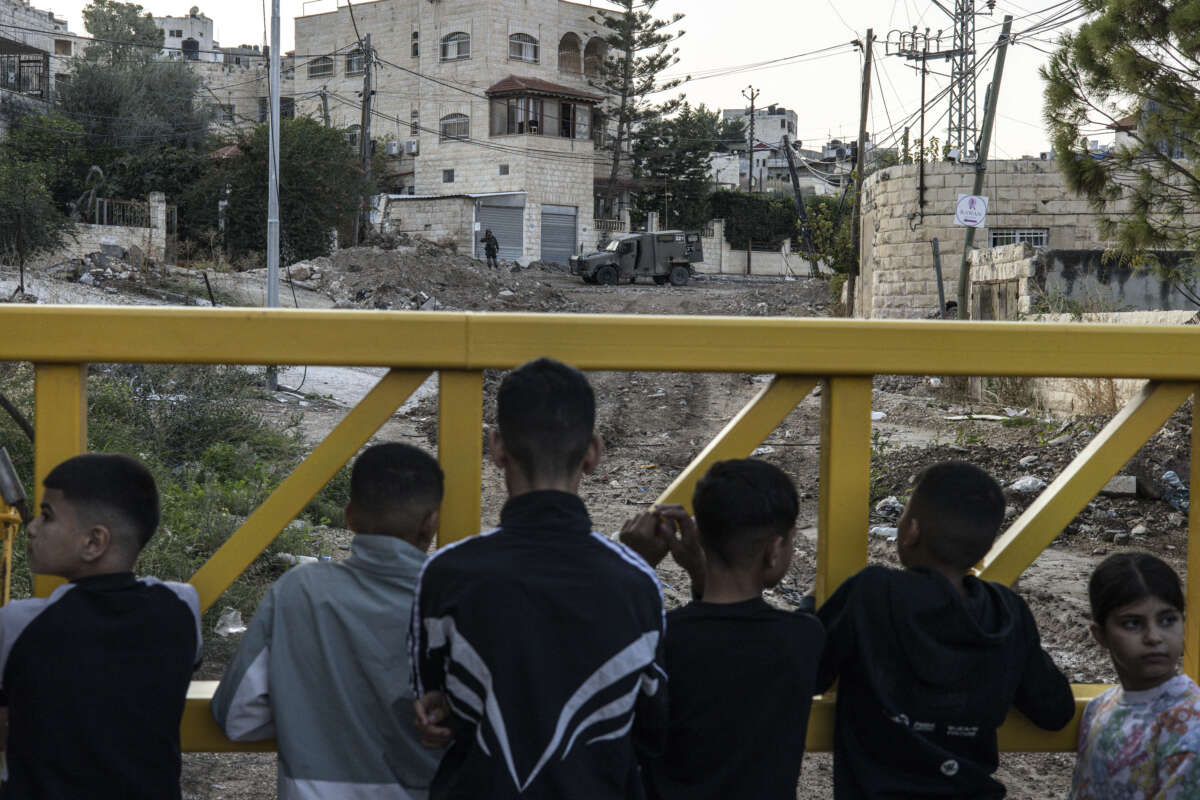
These are not isolated incidents. Over the past several weeks, the Israeli army has launched a renewed military campaign in the northern West Bank, first in Tubas and its neighboring villages and then extending to areas such as Jenin, where Israeli soldiers executed two young men in late November. Since then, Israeli forces have repeatedly conducted raids of cities and towns, imposed curfews, raided homes and converted them into military outposts, forcibly displaced residents, and detained, interrogated, and arrested hundreds of young men.
But what is behind this renewed military campaign, and why is it unfolding only now? While the official Israeli narrative claims that it is “combating terrorism,” locals in Jenin and other parts of the north say it is really about establishing a new reality on the ground of total Israeli dominance to make way for the resettlement of areas of Jenin that Israel had evacuated in 2005.
Military Escalation as Land Confiscation
Israel is attempting to create a new status quo in the West Bank as part of its objective of altering the north’s geography by repurposing Palestinian land to serve colonization and settler infrastructure. The ongoing military activities in these areas can only be understood with this context in mind, locals say.
The Israeli army, meanwhile, has issued claims that the resistance groups that it has suppressed over the past two years in areas such as Tulkarem and Jenin have begun to regroup and rearm. According to local journalists who spoke to Mondoweiss, Israeli claims that armed cells are being “reactivated” do not appear to reflect the reality on the ground.
On December 5, the Israeli army released a statement saying that its operations in the north are aimed at “deterring terrorism.” During a tour of the region, Israeli army Chief of Staff Eyal Zamir said that “we will not allow the threat of terrorism to grow, and we will act to thwart it in advance through preemptive offensive activities.”
These statements are not new. Similar rhetoric has increasingly appeared in Israeli news outlets in recent months, laying the groundwork for such sweeping operations under the banner of “counterterrorism.”
But the military escalation in the northern West Bank isn’t a series of isolated operations, but the opening move in a broader effort to reinstate settlement activity in the Jenin area, says Khaled Bdair, Alghad TV’s northern West Bank correspondent. Bdair argues that the purpose of these operations are to impose total military control over the area in order to “alter its geography,” namely by seizing large swathes of land.
On December 10, the Israeli authorities approved the construction of 764 new settlement units in the West Bank, bringing the total number approved by the government to 51,370 units since the end of 2022. Over 700,000 settlers currently reside in the territory, including approximately 250,000 in East Jerusalem, according to Israeli settlement watchdog Peace Now.
Following the announcement by the Knesset committee and the northern West Bank’s Settlements Council regarding the geographic boundaries of the areas to which settlers intend to return, Israeli authorities began to actively change realities on the ground by intensifying military operations and confiscating land on a near-daily basis.
Bdair says that in order for settlers to be able to move into this part of the northern West Bank, “a new security reality needs to be created to allow settlers to operate without obstacles.” This explains the intensified raids and continuous military presence in the north, he points out.
“The Israeli army is no longer acting in response to a specific security incident, but is instead adopting what its military officials refer to as a policy of ‘mowing the lawn,’” Bdair explained. “They are carrying out continuous and repeated operations aimed at depleting resistance structures in and around Jenin and maintaining a constant level of deterrence.”
Bdair stresses that Israeli forces are “raising the security threshold” to achieve two parallel objectives: first, to effectively meet the “security requirements” of the settlement plan, and second, to maintain a state of “high security alertness.”
This shift in military activities coincides with a qualitative change in the nature of military training, Bdair says, asserting that army exercises are no longer conducted in training bases in the Negev or the Jordan Valley — which typically use mock Palestinian villages and built structures to simulate operations — but are now carried out inside the West Bank itself in “real” locations.
This indicates that the army is treating the West Bank as a continuous operational zone, and is seeking to further consolidate its control over the north to lay the groundwork for accelerated colonization.
Israel Moves to Reinstate Evacuated Settlements
According to Amir Daoud, Director of Publishing and Documentation at the Colonization & Wall Resistance Commission, the army carries this out through two primary instruments: military orders related to road construction, which aim to entrench settlement outposts and provide them with permanent infrastructure; and the gradual and systematic return of settlement activity to the northern West Bank through amendments to the Disengagement Law, referring to a an Israeli law from 2005 that led to the unilateral Israeli withdrawal from settlements in Gaza and an additional four settlements in the northern West Bank during that year.
Daoud adds that although these settlements were formally evacuated in 2005, the lands on which they had been built remained off-limits to Palestinians and were effectively treated as closed military zones for approximately 17 years.
In contrast, settlers were allowed to rebuild a settlement outpost in the Homesh area near Jenin in mid-2023 under the guise of a religious school. “This constituted an early violation of the spirit of the Disengagement Law,” Daoud told Mondoweiss.
These violations came following the Knesset’s amendments to the law in March 2023 to allow settlers to colonize those areas. A little over a year later in July 2024, then Israeli Defense Minister Yoav Gallant moved to revoke the Disengagement Law entirely.
Daoud notes that this trajectory then witnessed a significant escalation in 2025. On May 29, the Israeli security cabinet approved the construction of 22 new settlements, the largest such decision in decades. Notably, Sanur and Homesh were included on the list, signaling an additional governmental push toward reinstating colonization activities in the formerly evacuated settlements.
Israeli Finance Minister Bezalel Smotrich had also announced the allocation of approximately two billion shekels for settlement projects a few days before the security cabinet decision. Smotrich’s allocation directly referenced Sanur, Daoud says, which has historically been a military site known as “Tarsala.” Actual large-scale settlement construction in Homesh has already begun on the ground.
This also explains the fact that the Israeli army recently deployed two military battalions to the Sanur military base, Daoud says, providing direct protection for the planned settlement infrastructure. These developments represent the expansion of military activity and settlement construction in tandem, Daoud explains, noting that the Israeli army has historically used its seizure of areas for “military use” to later announce that those areas would be used for building civilian settlements. As of October 7, 2024, Israel has issued 146 such seizure orders, an unprecedented number, Daoud clarifies. Most of those lands are intended for roads connecting old settlements with new ones.
‘Functional Coordination’ Between Settlers and the Army
Daoud explains that the pattern has become clear: settlers build a road illegally, after which the army intervenes by issuing a military order announcing it as a closed military zone, granting the road “legal cover.” Later, it becomes a civilian settlement, or it is used to expand settlement infrastructure.
This approach is particularly evident in Tubas, where Israeli forces have issued 21 seizure orders in recent months. Nine of these most recent orders aim to construct roads, walls, and trenches along a stretch of approximately 22 kilometers, extending from al-Aqaba in the north to Ein Shibli in the south of the governorate and cutting through the Jordan Valley region.
In order for this strategy to work, there needs to be a degree of coordination between settlers and the military. Daoud describes this as “functional coordination,” and the way it works is that settlers first impose their presence on the ground by constructing supposedly “unauthorized” outposts, and then the army converts it into a fixed reality by converting it into a closed military zone, only to later be opened up for civilian use.
Daoud also stresses that the ongoing military operations in the north can only be understood as part of the effort to create a “new security reality” that is more conducive to settlement expansion. The “security pretext,” he explains, remains Israel’s primary way of using military-legal instruments to establish realities on the ground that then pave the way for colonization.
The resulting picture is one in which military and settler activities are proceeding in an integrated manner, Daoud stresses; it is all part of a single project aimed at “reshaping the geography and demography” of the northern West Bank.
A terrifying moment. We appeal for your support.
In the last weeks, we have witnessed an authoritarian assault on communities in Minnesota and across the nation.
The need for truthful, grassroots reporting is urgent at this cataclysmic historical moment. Yet, Trump-aligned billionaires and other allies have taken over many legacy media outlets — the culmination of a decades-long campaign to place control of the narrative into the hands of the political right.
We refuse to let Trump’s blatant propaganda machine go unchecked. Untethered to corporate ownership or advertisers, Truthout remains fearless in our reporting and our determination to use journalism as a tool for justice.
But we need your help just to fund our basic expenses. Over 80 percent of Truthout’s funding comes from small individual donations from our community of readers, and over a third of our total budget is supported by recurring monthly donors.
Truthout has launched a fundraiser to add 500 new monthly donors in the next 9 days. Whether you can make a small monthly donation or a larger one-time gift, Truthout only works with your support.