The video is shocking. The footage is low quality, shot from above and behind the scene: A group of people run from state security forces up an empty highway at full speed. Four people are carrying a limp body. But under the fire of gunshots, tear gas and police sirens, three of the people drop the body and flee. The other man, in a blue jacket, kneels beside the body, and holds onto him.
Two armored vehicles arrive, lights flashing. Two men in green fatigues, helmets and body gear jump out. They point their weapons, and begin to kick and beat the two men on the ground — one alive, though he would end up unconscious and hospitalized, one already dead. The latter’s name was Efraín Fuerez. He was a 46-year-old Indigenous Kichwa community member from Cotacachi, Ecuador, and the father of two children.
Reports say Ecuadorian armed forces shot Fuerez three times with live ammunition the morning of September 28 on the Pan-American Highway close to the town of Ilumán. There is no video of the shooting itself, which took place immediately before these images.
Fuerez was the first to be killed by state forces after a week of widespread protests, led by Ecuador’s largest Indigenous movement, the Confederation of Indigenous Nationalities of Ecuador (CONAIE), against President Daniel Noboa’s austerity measures.
“Justice is what I want for my husband’s life,” Fuerez’s wife told a local media outlet. “He wasn’t a terrorist or someone bad. He was a hard worker. All I ask for is justice, for my husband and all of the people who are detained.”
“The police and military, using lethal weapons and ammunition, are shooting to kill against our communities as we exercise our legitimate right to social protest,” CONAIE posted on social media. “Efraín’s death was a direct execution in the midst of the repression … This act constitutes a very serious violation of human rights.”
CONAIE had announced an “immediate and indefinite national strike” on September 18 in response to Noboa’s lifting of diesel subsidies that sent gas prices skyrocketing by nearly 60 percent. Protests have since rippled across the country.
Noboa’s Measures Prompt Growing Anger
Noboa is the 37-year-old millionaire son of a banana tycoon. He’s one of President Donald Trump’s top three allies in Latin America, alongside El Salvador’s strongman Nayib Bukele and Argentina’s libertarian leader Javier Milei.
Noboa was reelected in April in a controversial election marred by disinformation and accusations of fraud and vote buying.
Noboa had previously promised not to touch gas or diesel subsidies. He repeated this in numerous interviews in previous years, and in the lead up to April’s election. Recently, however, he said he changed his mind because the measure wouldn’t impact inflation.
“We have inflation pretty well controlled,” he said during an interview with the news outlet Ecuavisa. “Eliminating this subsidy, which is more than a billion dollars a year, with the current situation, won’t impact inflation very much.”
Noboa’s spokesperson Carolina Jaramillo said lifting the diesel subsidy will save the Ecuadorian government $1.1 billion a year, which the government will use to provide financial social support for vulnerable sectors of society.
But community leaders say it has nothing to do with helping needy communities and everything to do with fulfilling Noboa’s commitments to the structural adjustment policies prescribed by the International Monetary Fund. The international organization agreed to increase its financial support to Ecuador in June.
“This government is committed to the International Monetary Fund and its classic neoliberal agenda of eliminating subsidies, raising taxes and raising fuel prices, privatizing education, health care, and social security,” Ecuadorian human rights defender Alexis Ponce told Truthout.
This is not the first time that shock doctrine policies like this have sparked an uprising among Ecuador’s Indigenous and social movements.
In 2019, Indigenous-led protests rattled the country after conservative President Lenin Moreno rolled out austerity measures and also tried to lift the fuel subsidy.
Indigenous communities again shut down the country in June 2022 after neoliberal financial policies from right-wing businessman and president Guillermo Lasso led to rising food and fuel prices. Nine people were killed during the protests, which was considered Ecuador’s largest general strike in recent memory.
Protests have now been ongoing for nearly two weeks. In addition to demonstrations and road blocks, marches have poured down highways, with protesters waving banners and carrying Ecuadorian flags. They’ve shut down major highways, in particular in the highland province of Imbabura, near the Indigenous town of Otavalo and Llumán, where Efraín Fuerez was killed.
The actions have seemed to gain strength.
One cell phone video sent to Truthout by a human rights observer shows dozens of members of the Zumbahua community in the province of Cotopaxi pushing boulders and rocks onto a highway as people shout, “Long live the strike!”
“Right now, we are shutting down the Latacunga-La Maná road,” says a voice off camera. “The people here are really pissed off. We aren’t going to allow anyone through. Not to get to the coast or the mountains. No one is paid or forced to be here. The people are just indignant with what’s happened in provinces around the country.”
Videos shared widely over social media show state security forces in helmets and riot gear firing tear gas and rubber bullets into protests and communities.
One map posted on X by the Ecuador Critical Geography Collective identified, as of September 30, 55 acts of documented repression and 16 cases of intimidation carried out by state security. The collective also documented 66 cases of what it calls “financial harassment,” with the bank accounts of human rights defenders and leaders of the movement frozen without explanation.
On October 1, the Ecuadorian Alliance for Human Rights reported 165 instances of human rights violations, with 100 people injured.
As of September 26 — the last time Ecuador’s Ministry of Interior updated the public about the strike — nearly 100 people had been arrested. Thirteen have been charged with terrorism.
“Compared to previous protests, Noboa has employed a much more hardline, ‘mano dura’ [‘iron fist’] approach to repression,” Pedro Labayen Herrera, a researcher with the U.S.-based Center for Economic and Policy Research, told Truthout. “The military was already in the streets as part of an unending series of states of emergency and his declaration of an ‘internal armed conflict’ in January 2024, but he has also sought to link the protesters with ‘narcoterrorists,’ criminals, and illegal mining.”
CONAIE released a powerful video over social media on September 27 in response to the terror charges. Members of the movement stand in the street and look into the camera.
“I’m a farmer, not a terrorist,” says an older man in the video.
“We are campesinos, not terrorists,” says a woman in traditional dress.
“I am a businessman, not a terrorist,” says someone in a white and grey wool poncho.
“Without a doubt the government is using the state of exception and the fight against organized crime to shield itself from the protests,” Billy Navarrete, the executive director of Ecuador’s Permanent Committee for the Defense of Human Rights, told Truthout. “The national government is instrumentalizing criminal violence to repress protesters who are demanding better living conditions and human rights.”
Ahead of the national strike, Noboa expanded the state of emergency (also described as a state of exception) that already applied to most of the country. In January 2024, Noboa issued his first state of emergency, suspending certain constitutional rights in order to battle what he called an “internal armed conflict” against drug gangs in the country. His new decree limited crowds in public spaces throughout seven provinces, among other things.
“This situation requires exceptional intervention by state institutions to safeguard security and guarantee citizens’ rights, public order, and social peace,” his decree stated.
Noboa has also temporarily moved the seat of his government to the city of Latacunga — 100 kilometers south of the capital Quito.
“While this may seem counterproductive — since Latacunga is in a region that is a stronghold of the Indigenous movement with a long tradition of demonstrations — Noboa intends it as a show of force and resolve,” said Labayen Herrera. “At the same time, the move seeks to divert the attention of protesters and organizers away from the capital, Quito, which was the site of major and decisive demonstrations in 2019 and 2022.”
Indigenous Organizers Won’t Back Down
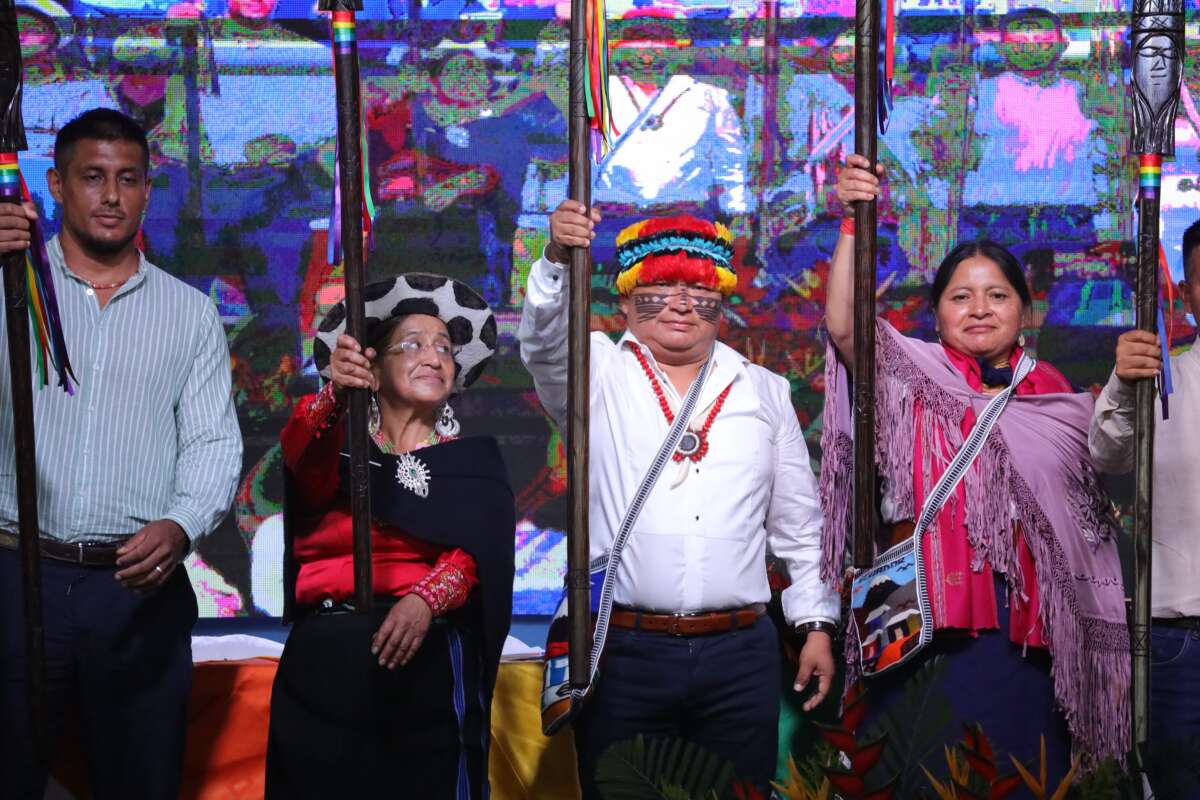
Ecuador’s Indigenous movement is in a peculiar moment. In a hotly contested vote amongst the organization’s leadership, Marlon Vargas was elected to be the group’s new president in July. He was sworn in a large ceremony in the town of Puyo, in the Amazonian province of Pastaza, where he’s from.
Hundreds of Indigenous peoples from across the country’s 14 different Indigenous groups packed into the city’s sports stadium.


Shamans laid out altars, lit incense, held ceremonies, and said prayers for the organization’s new leadership. Indigenous leaders from across the country spoke in support of the new leadership. Many wished it well, and also demanded that the organization continue to stand up, when necessary, to defend their territories and their rights.

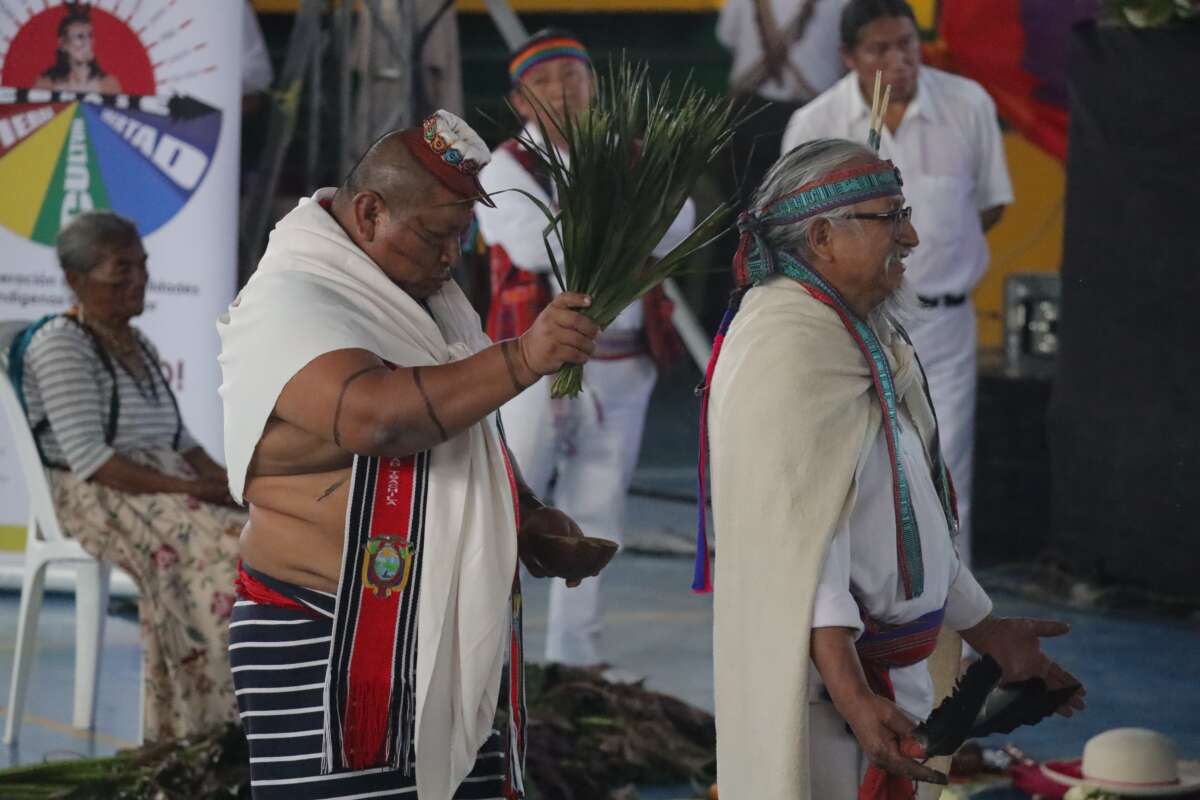
Some analysts had expressed doubts over Vargas’s ability to respond to the Noboa government, which has been moving to expand fossil fuel extraction and mining on Indigenous lands. But in his first speech following his inauguration, Vargas hit back hard.

“During my term at the head of CONAIE, it will have a clear and firm line: Confront all threats to our territories, extractivism, large-scale mining, the expansion of oil production, and any project that threatens life,” he told the packed crowd in the auditorium, in Spanish. “I will not surrender to any government or economic power. I am a man of dialogue with dignity. When dialogue is necessary, it will be done publicly and transparently. When we must rise up, we will do so with the strength that the unity and legitimacy of our struggles give us.”
Truthout spoke with numerous members of the organization who traveled to the event from around Ecuador. They expressed faith in the new leadership. Many wore traditional Indigenous dress.

Jairo Gualinga, a member of the Kichwa Sarayaku community in the Northern Amazonian province of Sucumbíos, wore a feather headdress and necklace of beads.
“I have known [Marlon Vargas] because we have worked together in moments of resistance, and I am sure that he can guide this organization in the way that the people have asked for,” Gualinga told Truthout. “And I am sure that he will be successful in maintaining and organizing our people for the good of the future of the Indigenous movement.”
Under Vargas’ leadership, CONAIE appears to be coalescing around the strike. The group has also created an internal commission of former presidents of the organization in order to help guide their strategy forward. Among them, is Leónidas Iza, who lost to the vote to Vargas earlier this year.
Noboa has promised not to back down. So have the country’s Indigenous social movements.
Analysts predict that both the protests and the repression will intensify, carrying the country down a road everyone has seen before.
“We are once again on the same path,” said Navarrete. “We have to consider that the Indigenous protest is not going to stop, and the government has to look for dialogue to avoid more misfortunes in relation to deaths, in relation to injured people, and in relation to people unfairly deprived of freedom.”
But until Noboa backs down and reinstates the diesel subsidy, Indigenous movements have promised to stay on the streets.
“Thanks to the mobilizations like this, we’ve been able to hold on to our territories,” Hugo Guatatoca, a young Indigenous communications student from the Amazonian region of Pastaza, told Truthout. “And right now, we are fighting against government measures that can harm our community. They say higher diesel prices won’t affect other people, but it really will have an impact, with increased food prices and bus fares. And this is all harming us right now.”
48 Hours Left: All gifts to Truthout now matched!
From now until the end of the year, all donations to Truthout will be matched dollar for dollar up to $28,000! Thanks to a generous supporter, your one-time gift today will be matched immediately. As well, your monthly donation will be matched for the whole first year, doubling your impact.
We have just 48 hours left to raise $28,000 and receive the full match.
This matching gift comes at a critical time. As Trump attempts to silence dissenting voices and oppositional nonprofits, reader support is our best defense against the right-wing agenda.
Help Truthout confront Trump’s fascism in 2026, and have your donation matched now!