Did you know that Truthout is a nonprofit and independently funded by readers like you? If you value what we do, please support our work with a donation.
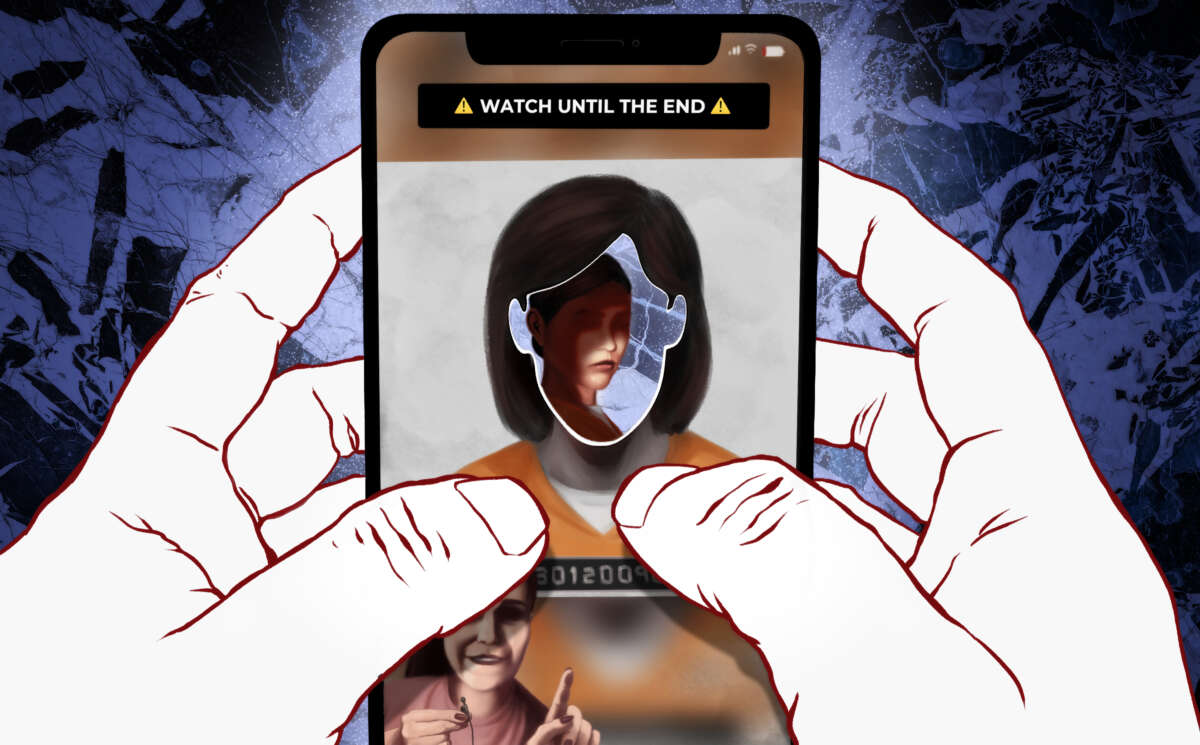
Most true crime media is consumed by women, some of whom may be watching because they relate to the true crime genre’s victims. But another group of true crime junkies has different motives for watching: men looking to connect with incarcerated women.
True crime media has manufactured a uniquely degrading pipeline: Women convicted of crimes become involuntary performers in a spectacle that attracts precisely the men most likely to dehumanize them. Incarcerated women featured in these venues are then flooded with letters, with a significant portion coming from self-described incels, men who frame their desire for connection through the language of sexual entitlement and misogyny. The genre itself engineers this outcome.
The messages incarcerated women receive range from odd to downright creepy. L.S., an incarcerated woman in Texas who was convicted of killing her ex-boyfriend’s new girlfriend and sentenced to decades in prison, told Truthout that she was contacted by a news/entertainment show a dozen times before it aired a program made without her participation. She decided to watch the show to see if there were any updates about her case. During the commercial breaks, she shared the messages she gets when media like this airs: Guys declaring their unyielding love. Men proposing marriage. She later received a nine-page handwritten letter describing her as coldhearted because she never replies. He swears he will never write to her again, but the next week, another letter arrives, saying he has visited her mother to ask why she won’t write him back. Another man writes to explain that she must learn her place as a woman without jealousy. He regularly proposes marriage, telling her that she can be his second wife. These programs make women vulnerable to abuse from correctional officers too — prison staff have threatened to take nude photographs of her to post, and to sell her personal items to stalkers.
C.D., who is also living behind bars in Texas, has been incarcerated for 31 years, since she was 15. The true crime program about her (in which she did not participate) depicts her as a drug-snorting, Satan-obsessed teenage goth with an exaggerated Southern accent (none of which is accurate, C.D. says). After the true crime program about her aired, C.D. began receiving emails from men seeking to establish relationships with her. In one exchange, one of these men compared her to his 15-year-old daughter, whose “headstrong, rebellious nature got her gang raped at 15” and suggested that C.D. had likely had similar experiences. On the day they began corresponding, he offered to marry her. While he said he would not “talk smut” to her or ask her to do so in return, he stressed that their first night together “would be like a wedding night with all the usual wedding night activities.” Although he told her that he did not want to give her “‘creep vibes,” he also detailed his personal grooming rituals as well as his unwillingness to live as “glorified roommates” with his ex-wife — all of this within two days of beginning their correspondence.
The true crime industry’s exploitation of incarcerated women reveals how mass incarceration and patriarchal violence are mutually reinforcing systems.
Why would anyone respond to an email like this? The economics of prison provide an answer. Women in Texas prisons are forced to work full time for no pay and are not provided with basic hygiene supplies. Imagine working more than 40 hours a week and still not being able to buy tampons because you aren’t paid to work. Women write back to get $30 a month to buy hygiene supplies. It’s not much, but it is enough for them to buy necessities. So when these men ask women to put lipstick on their nipples and labia to press on paper and they’ll send them $10, some women are desperate enough to do it.
Each time a woman’s true crime media is published or aired, the letters and emails begin anew. The messages are almost always sexual. One man wrote that his psychic told him to impregnate an incarcerated woman, so he sent the woman papers “saturated” with semen for insertion. Another offered to send a woman $30 a month if she would sext or have phone sex with him. He wrote, “I know we can’t send or receive too graphic of things but we can talk nasty and tell each other what makes us cum you are very pretty. I’ll send a pic you might like it goes through no problem FYI I have a fat cock” and sent a picture of himself in his underwear with an obvious erection. Many trace their genitals and mail them in. Ironically, these messages are permitted to reach women who never asked for them, while content about breast cancer, women’s anatomy, Depend undergarments advertisements, and the illustrated tampon instructions that are enclosed with all state-issued tampons are all banned by the prison for being “sexually explicit.”
These men are encouraged by shows that obsessively aestheticize female criminality, constructing narratives that simultaneously sexualize and pathologize women. Producers linger on mugshots and courtroom footage, packaging trauma and survival as entertainment while reducing complex human beings to archetypes: the seductress, the hysteric, the broken doll. For men who already view women as objects whose primary purpose is male sexual access, incarcerated women represent a perfect target. Here, we are rendered maximally vulnerable by state captivity, stripped of autonomy, depicted as both dangerous and damaged. We, because I (Kwaneta), too, have been involuntarily featured on countless true crime shows and inundated with misogynistic mail. The power imbalance is the attraction. By framing us through gendered tropes of emotional instability, sexual deviance, or manipulative femininity, true crime media validates the same misogynistic frameworks that incels embrace.
True crime media suggests we are fundamentally “other,” beyond the protections of normal social codes, available for consumption. The prison sign on the screen functions as an invitation.
Media companies should stop producing true crime media without the consent and involvement of the people featured. A person’s worst experiences should not serve as entertainment for anyone, let alone people seeking to sexualize the subjects.
From a feminist abolitionist lens, this represents a dual violence. First, the carceral state renders women captive and accessible. Then, media industries profit by converting that captivity into sexualized entertainment that exposes us to further harassment and dehumanization. The letters we receive — often explicitly violent, sexually graphic, or proposing “rescue” conditional on romantic or sexual compliance — constitute another layer of gendered harm, one enabled by our incarceration and amplified by our media exposure.
And the damage radiates outward. These narratives reinforce broader cultural scripts that position women, particularly those who transgress, as perpetually available for male judgment, fantasy, and violation. They naturalize the idea that women’s suffering can be entertainment, that female autonomy is conditional, that certain women exist outside the boundaries of respect. Every person who consumes this media uncritically participates in a system that treats incarcerated women as spectacle rather than human beings deserving of dignity and liberation.
We have written previously about the harms true crime media does to survivors of trauma — a label applicable to nearly every incarcerated woman. Here’s an additional harm: exposure to unwanted sexualized messages and the corresponding pressure to accede to these relationships in order to survive. Three solutions to this problem come to mind. First, of course, is abolition. Abolition demands we dismantle not only prisons but the cultural machinery that makes captivity profitable and consumable. The true crime industry’s exploitation of incarcerated women reveals how mass incarceration and patriarchal violence are mutually reinforcing systems. Until we refuse to participate in industries that commodify captive women’s lives, we enable the conditions that make our exploitation by the state, by media corporations, and by individual misogynists possible.
Short of abolition, however, media companies should stop producing true crime media without the consent and involvement of the people featured. A person’s worst experiences should not serve as entertainment for anyone, let alone people seeking to sexualize the subjects. And finally, incarcerated people should be provided with the things they need — good and sufficient food, drinkable water, medical care, and hygiene supplies. Remove the survival incentive and incarcerated women would not feel pressured to feed the sexual fantasies of true crime consumers.
An urgent appeal for your support: 9 Days to raise $50,000
Truthout relies on individual donations to publish independent journalism, free from political and corporate influence. In fact, we’re almost entirely funded by readers like you.
Unfortunately, donations are down. At a moment when independent journalism is urgently needed, we are struggling to meet our operational costs due to increasing political censorship.
Truthout may end this month in the red without additional help, so we’ve launched a fundraiser. We have 9 days to hit our $50,000 goal. Please make a tax-deductible one-time or monthly donation if you can.