Honest, paywall-free news is rare. Please support our boldly independent journalism with a donation of any size.
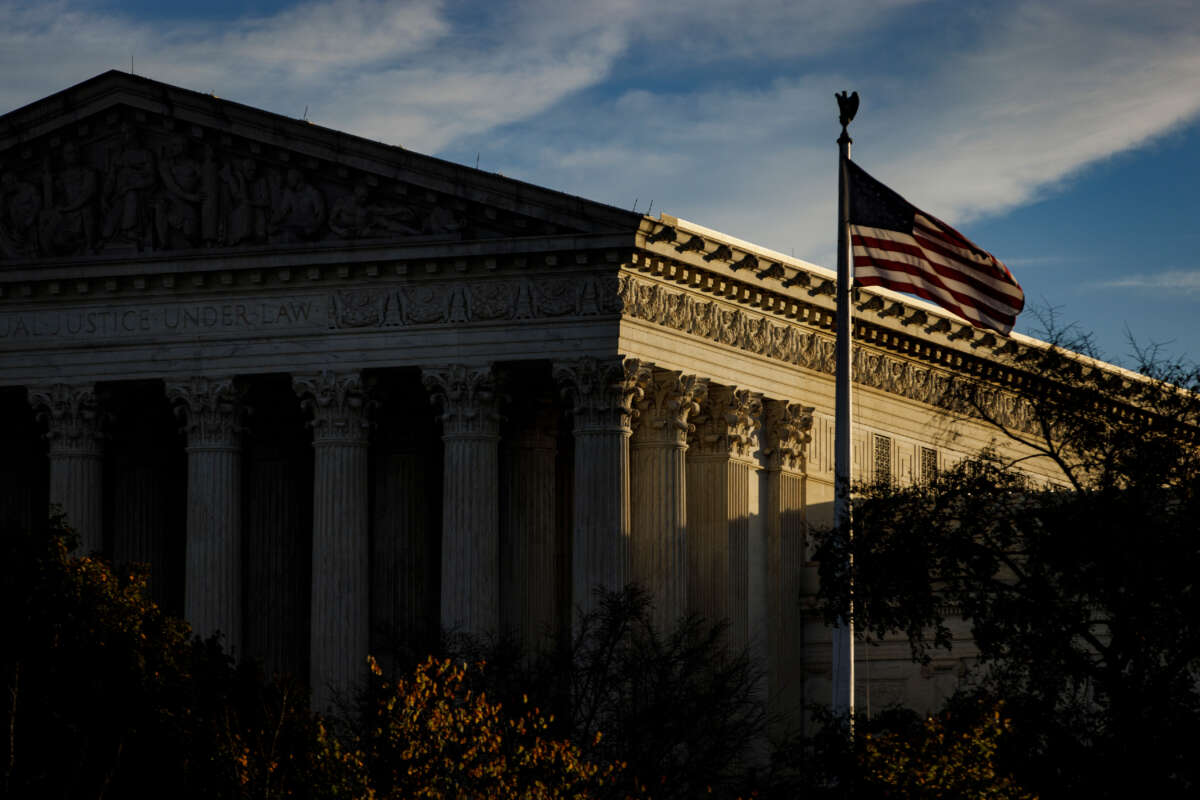
In a somewhat surprising ruling on Thursday, the Supreme Court ruled to uphold the Indian Child Welfare Act (ICWA), delivering a win to Native American communities by upholding a decades-old law aimed at keeping Native American children from being taken away from their families and tribes.
In a 7-2 decision on Haaland v. Brackeen, justices struck down all challenges to the law, “some on the merits and others for lack of standing,” as Justice Amy Coney Barrett wrote in the majority opinion. The Court rejected the plaintiffs’ argument that the 1978 law unconstitutionally discriminates against white families in the process of adopting Native American children. Justices Clarence Thomas and Samuel Alito dissented.
“Often, Native American Tribes have come to this Court seeking justice only to leave with bowed heads and empty hands. But that is not because this Court has no justice to offer them,” wrote Justice Neil Gorsuch in his concurring opinion. “Our Constitution reserves for the Tribes a place — an enduring place — in the structure of American life. It promises them sovereignty for as long as they wish to keep it.”
The ICWA is a landmark law that was originally put in place to undo the U.S.’s abhorrent history of separating Native children from their parents and communities. For 150 years, thousands of Native children were removed from their families and sent to emotionally and physically abusive boarding schools under a federal initiative that was intended to carry out cultural genocide and forcibly assimilate Native children into white America.
As Native Americans fought against the initiative, the federal government began using adoption as a new way to “assimilate” Native children, purposefully placing Native children into white adoptive families. The ICWA was established to fight back against these efforts, and gives preference to keeping Native children with their families or tribes in the adoption process. Though its implementation is uneven, Native American advocates say that the law is still crucial to helping Native families and tribes keep their sovereignty intact.
Native American advocates and leaders celebrated the decision.
“We hope this decision will lay to rest the political attacks aimed at diminishing tribal sovereignty and creating instability throughout Indian law that have persisted for too long,” said Cherokee Nation Principal Chief Chuck Hoskin Jr., Morongo Band of Mission Indians Chairman Charles Martin, Oneida Nation Chairman Tehassi Hill and Quinault Indian Nation President Guy Capoeman in a joint statement.
NDN Collective President and CEO Nick Tilsen said that the decision is a reminder that lawmakers and advocates must go further in protecting Native sovereignty and reversing centuries of violent oppression. NDN Collective said the decision allows the group to breathe a “sigh of relief.”
“Ensuring Native children can be held and raised by their own communities is an important way to heal our people from the colonization and brutalization waged by the U.S. government for hundreds of years,” said Tilsen. “We must go further, by continuing to address the root causes of Indigenous children still being taken from their families — deeply entrenched trauma and poverty fueled by systemic racism, lack of Indigenous sovereignty, and governmental neglect.”
The case was brought by a white Christian couple, along with the state of Texas and several other couples, who wished to adopt Native American children and argued that the law discriminates against them. The plaintiffs’ argument was so aggressive and broad that Native advocates feared that it would undo trivial sovereignty altogether, as well as pose a threat to other landmark statutes like the Affordable Care Act or the ban on whites-only lunch counters.
The Court agreed with tribal leaders that Native communities are a political group under the ICWA, rather than a racial one, as precedent also establishes. Nearly 500 tribes and over 60 Native organizations had signed onto briefs supporting the upholding of the ICWA.
Important Message: Please Read
For 25 years, Truthout has survived by publishing impactful investigative journalism and analysis; distributing full editions 365 days a year; and building a community of readers who support us with small, hard-earned donations.
Eighty percent of our $3 million yearly budget comes from small donors alone. Of those, 8,000 readers support us with monthly donations. Back in 2018, when Facebook decided to suppress the circulation of posts made by organizations, thereby cutting readers off from seeing many articles shared by the news organizations they had intentionally decided to follow, Truthout’s total traffic declined by 40 percent, as nearly all of our traffic from that platform disappeared.
Now, Google has recently rolled out its AI search bar, providing AI summaries instead of directing readers to our site. Google Search is our single largest source of traffic; it’s the route by which nearly one third of our readers find us. Much like in 2018, a shocking 40 percent of our Google traffic has disappeared overnight.
It will not be easy for Truthout to shoulder this blow. Nor will it be easy for our peers and collaborators — news sites that depend on traffic and aren’t bankrolled by large corporations.
If you can support Truthout with a donation today, you can help us resist the AI onslaught. Please give today.