Douglas Holtz-Eakin, a former director of the Congressional Budget Office under President George W. Bush, recently published an op-ed in The Guardian titled “We Have to Get U.S. Spending Under Control” that is both sad and funny. The sad part is seeing Mr. Holtz-Eakin come to this. He did a fine job of running the Congressional Budget Office, shielding it from partisan influence and producing reports that were useful to all sides.
Now, however, he’s parroting the party line, and he doesn’t even seem to be making much of an effort. I mean, still peddling expansionary austerity at this point? The funny part is his description of the anti-austerity position as the “pundit orthodoxy.” Wow. Just the other day the various Joes — the TV commentators Joe Scarborough, Joe Kernen, etc. — were saying that I’m all alone, a “unicorn,” one of maybe three or four people in the whole world who don’t think that the deficit is the biggest problem we face. Now I’m part of an orthodoxy?
Well, maybe. Look at all the pundits on major op-ed pages or TV shows calling for an end to austerity and more stimulus. There’s me, and there’s, well, maybe Martin Wolf at the Financial Times. But I guess I’m such a big guy that I’m an orthodoxy all by myself. Disco-Era Macroeconomics There was another sad thing in that Holtz-Eakin article. It was really disappointing to see him pulling the old Keynesian-policies-caused-stagflation line.
Needless to say, I get this all the time. But it usually comes from people who have some excuse for not knowing either what Keynesianism means or what actually happened in the 1970s.
So, what people like me have been calling for is a temporarily relaxed attitude toward deficits as long as the economy remains depressed and monetary policy is up against the zero lower bound. What does that have to do with the 1970s?
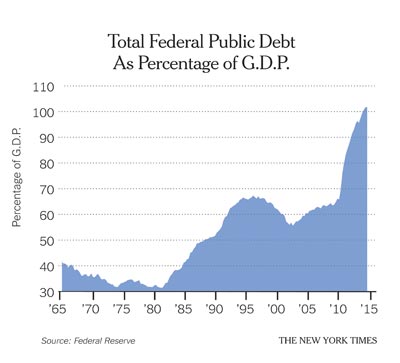 Well, here’s a chart on the ratio of debt to gross domestic product. So, as you can see, during the 1970s the United States had deficit spending that ran up the national debt, until Ronald Reagan was elected in 1980 and restored fiscal soundness. Oh, wait: it’s actually the opposite.
The truth is that whatever you might say about economic policy in the 1970s, it had nothing to do with Keynesian fiscal policy — and it did not involve increasing debt. People on the right tend to use “Keynesian” to mean “liberal stuff I don’t like,” but aside from that definition, the 1970s tell us nothing about the issues we’re discussing right now.
You can argue that monetary policy was too loose, that the Fed was too expansionary in 1972 and that it failed to tighten in the face of oil-shock-driven inflation. But again, the idea that this experience has any relevance to expansionary fiscal policy in the face of a liquidity trap is totally bogus.
But I guess I should have expected this; after all, it’s also standard to argue that the troubles of the 1970s somehow proved that the welfare state is the root of all economic evil, which makes equally little sense.
Trump is silencing political dissent. We appeal for your support.
Progressive nonprofits are the latest target caught in Trump’s crosshairs. With the aim of eliminating political opposition, Trump and his sycophants are working to curb government funding, constrain private foundations, and even cut tax-exempt status from organizations he dislikes.
We’re concerned, because Truthout is not immune to such bad-faith attacks.
We can only resist Trump’s attacks by cultivating a strong base of support. The right-wing mediasphere is funded comfortably by billionaire owners and venture capitalist philanthropists. At Truthout, we have you.
Truthout has launched a fundraiser to raise $45,000 in the next 8 days. Please take a meaningful action in the fight against authoritarianism: make a one-time or monthly donation to Truthout. If you have the means, please dig deep.