Did you know that Truthout is a nonprofit and independently funded by readers like you? If you value what we do, please support our work with a donation.
When voters across the country filed into polling stations on November 4, making choices that could shape their communities over coming years, residents of Somerville, Massachusetts, also had the opportunity to vote on a question of international significance: whether their city should boycott and divest from companies complicit in Israeli apartheid and genocide in Gaza.
The nonbinding ballot initiative instructs the mayor and all other elected officials “to end all current city business and prohibit future city investments and contracts with companies as long as such companies engage in business that sustains Israel’s apartheid, genocide, and illegal occupation of Palestine.” It marks the first time voters in the U.S. have had the opportunity to directly declare their support for the Boycott, Divestment, and Sanctions (BDS) movement through a ballot initiative.
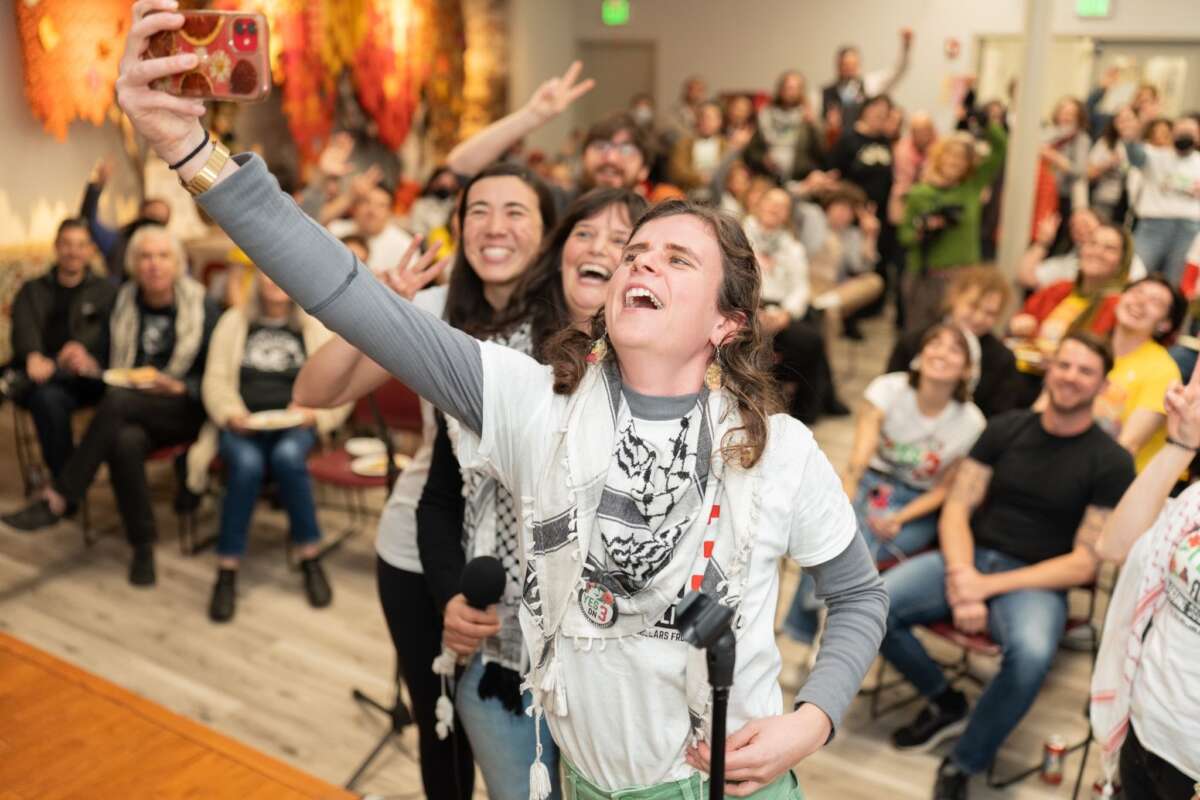
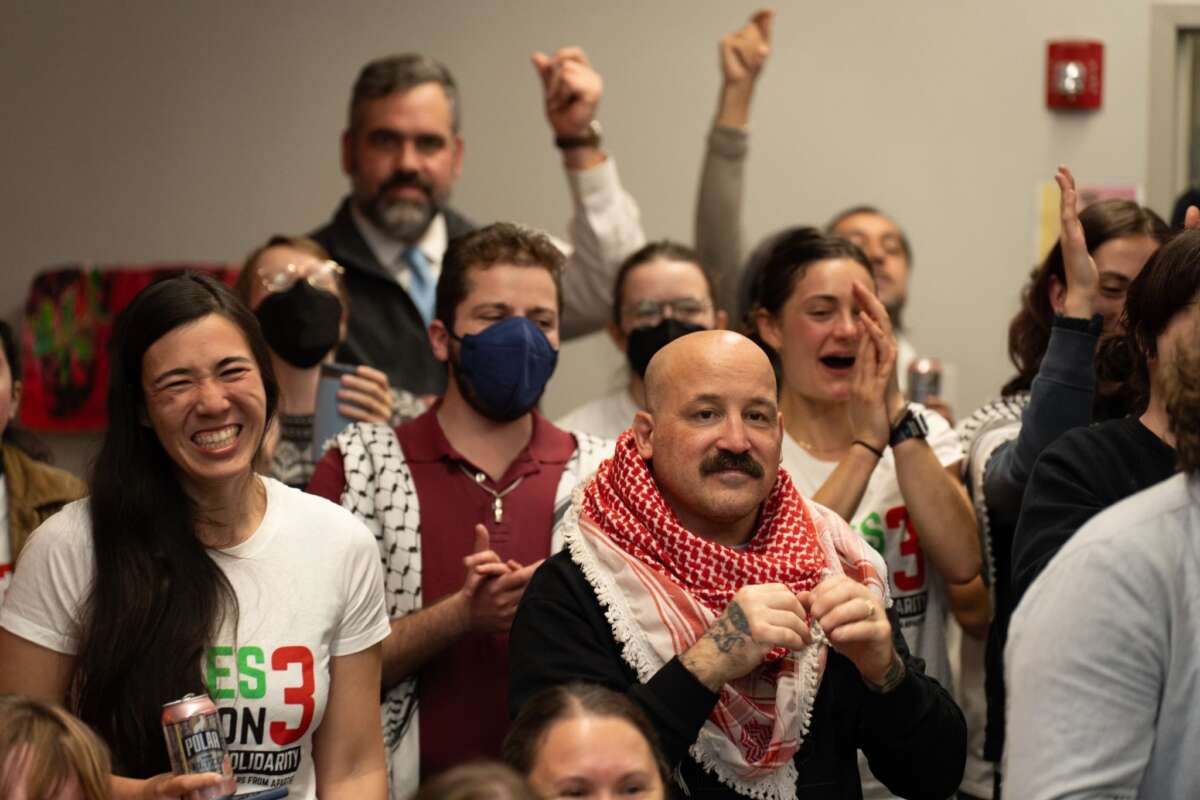
Later that evening, the organizers behind the initiative gathered at Connexion United Methodist Church in East Somerville. As polls closed, volunteers trickled in from their shifts at polling stations and get-out-the-vote operations. Around 8:30 pm, the group’s Palestinian leadership gathered on stage and the room waited in tense silence as organizer Mia Haddad read out the initial results. When all the votes were counted, more than 11,000 of Somerville’s 81,000 residents voted in favor of the measure — roughly 56 percent of the vote. All told, the question got the highest number of votes that night, besting the winning mayoral candidate by over 1,000 votes. It was a landslide. The room erupted. Volunteers hugged, cried, and began chanting: “Not another nickel, not another dime, no more money for Israel’s crimes.” Chairs were pulled aside and a celebratory dabke broke out, filling the room.
“It was just such a beautiful night, a culmination of just so much our community has built … Looking out into the crowd and seeing every single person there, whose name I knew, who I had spent countless hours talking to, working with, learning from, it was so overwhelming and beautiful,” Haddad told Truthout, choking up as she spoke. “I will never forget this moment. It was historic.”
Laying the Groundwork
The Palestine Solidarity Ballot Question, known formally as Question 3, took a long path to victory. It started in late 2023, when residents began organizing as Somerville for Palestine (S4P) to push their city council to pass a resolution calling for a ceasefire in Gaza. The resolution passed by a vote of 9-2 in January 2024, making Somerville the first city in Massachusetts to officially call for a ceasefire. “Pretty much the day after that, we celebrated and then we moved forward into the next stage of action,” said S4P organizer Leila Skinner. “We wanted tangible action to be taken to stop Israel’s genocide against Palestinians in Gaza.”
To start, activists began looking into Somerville’s ties to companies on the BDS list. They found that over the past decade, the city had paid over $1.7 million in contracts to Hewlett-Packard, which maintains the biometric surveillance system used at Israel’s illegal apartheid checkpoints in the occupied West Bank. A public records request also revealed that the city’s pension fund has over $500,000 invested in Lockheed Martin, a weapons manufacturer whose fighter jets and Hellfire missiles have been key tools in Israel’s destruction of Gaza.
“The activists and organizers were like, okay, so we passed a ceasefire resolution … That’s great, but now what about divestment and boycott and other ways we could put pressure, particularly on these weapons manufacturers and surveillance technology companies?”
“The activists and organizers were like, okay, so we passed a ceasefire resolution,” recalled Massachusetts State Rep. Erika Uyterhoeven, who is also a member of Somerville for Palestine. “That’s great, but now what about divestment and boycott and other ways we could put pressure, particularly on these weapons manufacturers and surveillance technology companies?”
At first, organizers hoped to pass divestment legislation through the city council. They were optimistic, in part due to past successful local divestment measures targeting South Africa in the 1980s and fossil fuels in 2014. S4P began seeking meetings with every city councilor to push them to take material action to stop the genocide. Nine out of 11 councilors agreed to meet with organizers — the same councilors who had voted in favor of the ceasefire. But over the fall and winter of 2024, activists were disappointed by the officials’ reticence. “Many of them, though they claim to privately support us in these constituent meetings, they refused to take public action such as passing a resolution or ordinance boycotting and divesting from complicit companies,” Skinner told Truthout.
Left with little support from the majority of councilors but strong support from voters — nearly a quarter of Somerville voters chose “no preference” in the 2024 Democratic primary in solidarity with the uncommitted movement — Somerville for Palestine decided to take the issue to voters.
Building a Campaign
On March 25, just three days before organizers were to deliver a petition with the required 30 signatures to the city council requesting they place the divestment question on the ballot, masked federal agents abducted Tufts student Rümeysa Öztürk off a Somerville street. The federal government had revoked Öztürk’s visa over an op-ed she had written calling for Tufts to divest from Israel, and her case quickly galvanized both the city and the country. In the following days, members of Somerville for Palestine worked with local immigrant rights groups to organize protests demanding her release. As hundreds of community members gathered outside Somerville City Hall on March 28, Öztürk’s detention loomed large.
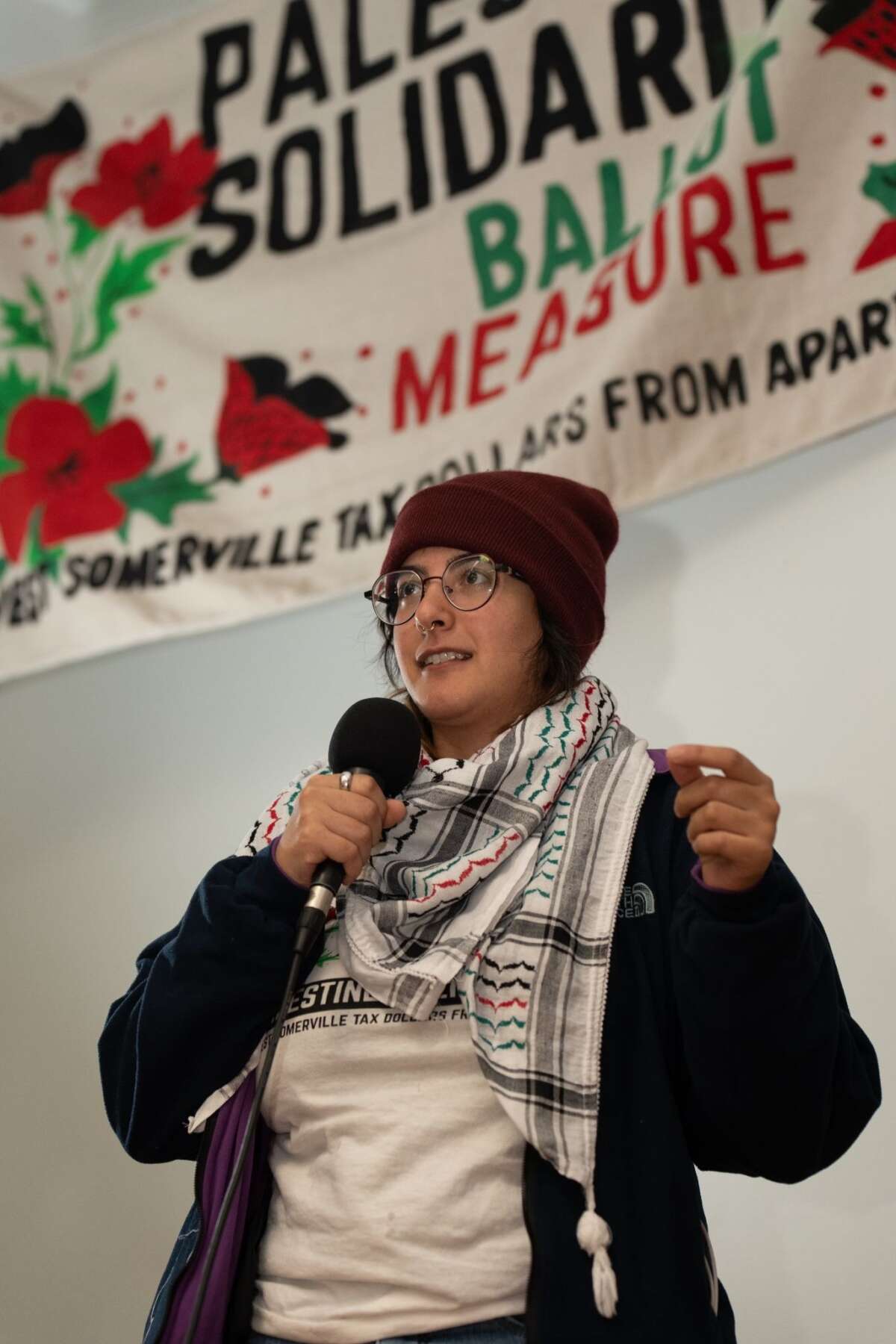
When the council chamber doors opened, over 50 residents flooded in to pack the room. The council had the decision to either accept the petition and put the question directly on November’s ballot, or to file it and require organizers to collect signatures from 10 percent of the city’s electorate — around 5,500 people. Two members of Somerville for Palestine spoke in favor of the measure. In opposition stood two Somerville residents, one of whom was Samantha Joseph, the New England regional director of the Anti-Defamation League (ADL). “This question is nothing more than a symbolic gesture driven by bias rather than what’s best for this community,” Joseph told the council. Her speech would be one of the opening salvos in the ADL’s ongoing efforts to undermine the divestment campaign.
After the speeches, the council voted 9-2 to file the petition. “It takes real leaders to … take a stand, and many of my colleagues did not take a stand today, and I’m really disappointed in them for that,” councilor at-large Willie Burnley Jr., a member of Somerville for Palestine who had announced his own candidacy for mayor a month prior, told Tufts Daily News. “But I am excited because we are a leader-full community, full of people who will do the work and take that moral stand about our municipal dollars.”
As organizers began planning to collect thousands of signatures, they turned first to another city: Pittsburgh. In August 2024, Pittsburgh organizers, sponsored by the Pittsburgh chapter of the Democratic Socialists of America (DSA), submitted more than 15,000 signatures to put a divestment question on the city’s 2024 ballot. But the petition quickly faced legal challenges from the local Jewish Federation and the city controller, which successfully disqualified enough signatures to put it below the 10,000 threshold. Undeterred, many of the campaign’s leaders reorganized under the name Not On Our Dime, collecting over 20,000 signatures to put the question on the 2025 ballot. This time, however, opponents’ challenge took advantage of a provision of a recent state law requiring signatories to list the address at which they’re registered to vote, not their current address. In response, Not On Our Dime withdrew the petition but vowed to continue the fight.
When Somerville for Palestine began pursuing a ballot measure, Skinner said, “Not On Our Dime organizers from Pittsburgh were one of our first contacts and connections.” Under the Pittsburgh leaders’ advice, S4P set an ambitious goal with a generous buffer to accommodate inevitable challenges: 10,000 signatures, twice the number required by law. “Our motto was ‘10,000 signatures, 10,000 conversations about Palestine,’” Skinner recalled, “and we blew that out of the water.”
“Our motto was ‘10,000 signatures, 10,000 conversations about Palestine’ … and we blew that out of the water.”
It took some time for S4P to gain steam when it began collecting signatures in April 2025. Some early events would draw only a couple of volunteers, and were hampered by the tail end of Massachusetts’s long, wet winter. But as the campaign picked up momentum, the volunteer base — and coalition — quickly grew. Volunteers knocked on doors across the city, participated in stand-outs, and canvassed at farmers’ markets and other summer events. By late summer, organizers say their door-knocking days regularly drew over 20 volunteers each.
As more Somerville residents came on board, so too did other community organizations. The campaign worked closely with a number of endorsing groups in the broader local social movement ecosystem, but the outreach also brought in less likely partners. Somerville for Palestine members who were also in the Somerville Educators Union (SEU), the largest union in the city representing more than 700 workers, successfully pushed the union to back the initiative in a membership vote. SEU “voted to endorse Question 3, because we understand that our silence is complicity,” wrote Palestinian teacher and union member Jamal Halawa, “especially when our tax dollars go to funding the oppression of the Palestinian people.”
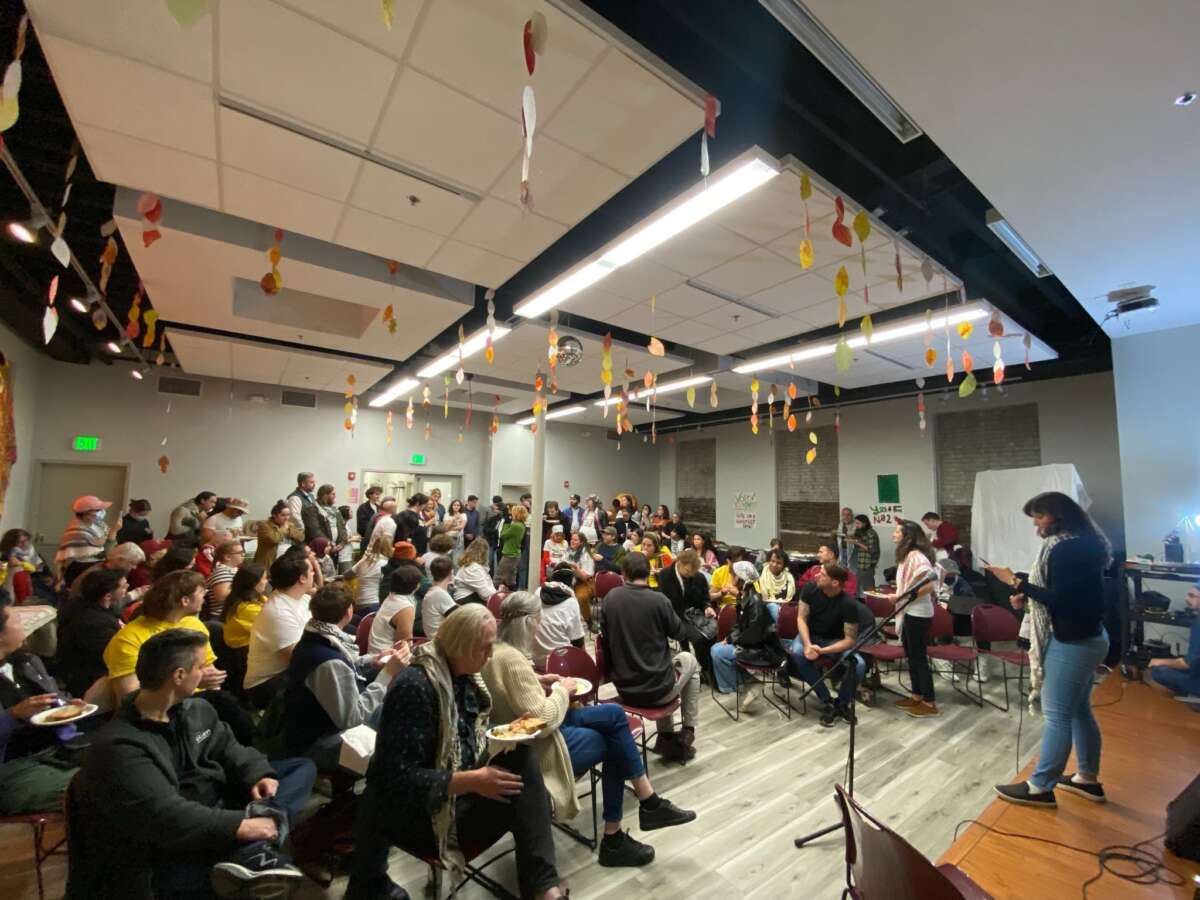
Somerville for Palestine also created structures that helped them expand as they campaigned, early on developing a Southwest Asian and North African (SWANA) caucus that prioritized Palestinian leadership as well as a Jewish caucus to lead outreach to the local Jewish community. As the campaign heated up, the group also created mechanisms to bring volunteers into leadership roles, asking frequent canvassers who showed initiative to take on increased responsibilities, like serving as canvass leads. By the fall, the group’s biweekly meetings sometimes drew more than 100 attendees.
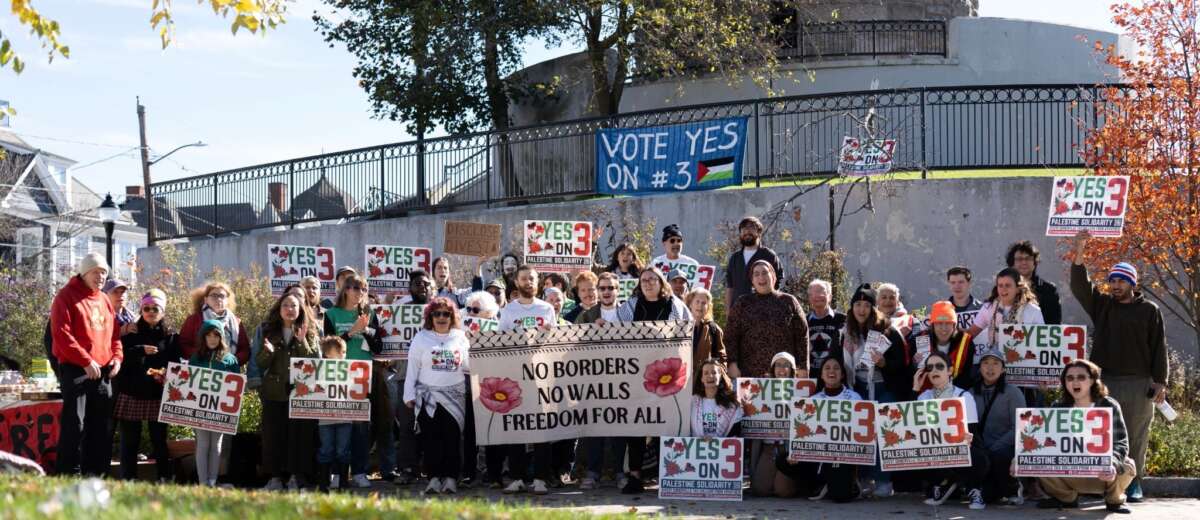
All told, organizers say the “Yes on 3” campaign mobilized nearly 300 volunteers, collected 11,000 signatures, and knocked on 10,000 doors in the weeks leading up to the election. On September 18, dozens of volunteers carried signs and banners as they delivered the final round of signatures to City Hall.
Fighting the Opposition
Despite robust support for the campaign from residents, the opposition put up a fight. Zionist opponents of the measure formed Somerville United Against Discrimination (SUAD) in June 2025. The group quickly raised over $200,000 from the Anti-Defamation League, Combined Jewish Philanthropies, and an array of area residents, with an average donation of around $1,000. The group sent out mailers and ran TV ads under the slogan “Focus on Somerville,” and urged residents to vote “no” on Question 3 because it “ignores the problems here in Somerville, creates tension and fear, and pits neighbors against neighbors.” SUAD did not respond to Truthout’s request for comment before publication time.
Given the dire need for donations directly to Palestinians in Gaza, S4P organizers had been hesitant to fundraise for their own local effort. But faced with a well-funded opposition, they ultimately decided they needed to fight back. In less than a month they raised $50,000 — mostly in small donations — enough to send out three different mailers to residents, fund text- and phone-banking efforts, and purchase voter rolls to bring targeted outreach to residents’ doors.
On October 2, SUAD brought a challenge to the Somerville Election Commission seeking to invalidate over 8,000 of the signatures S4P had collected and remove the question from the ballot. The challenge claimed both that the signatures had been improperly collected outside of the permitted collection period, and that the measure itself was unconstitutional and discriminatory.
After two years spent watching a live-streamed genocide, on top of decades of apartheid and ethnic cleansing, this campaign offered an opportunity to hope — to seek safety and solidarity in their own community.
With hardly any warning, leaders scrambled to respond to the challenge by an October 4 hearing. “Somerville for Palestine sprang into action,” organizer Sara Halawa recounted on stage during election night. “We had all the volunteer attorneys that are the good guys available on conference calls quickly.” Organizers turned to Lucy Tumavicus, an S4P member who had just begun pursuing a law degree. “Lucy … was in her third week of law school at the time, and we said, ‘You’re gonna be our lawyer!’” Halawa recalled. Tumavicus and other leaders quickly wrote up an answer to the challenge. On the day of the hearing, around 75 supporters of the ballot question packed the hearing room of the city’s election commission. “Lucy just destroyed them,” said Halawa. Several local and state elected officials also testified in support of the measure. After a brief deliberation, the election commission voted to overrule SUAD’s challenge.
Despite the commission’s decision, SUAD didn’t go down without a fight. On October 14, after ballots had already been printed, the group filed a lawsuit against the City of Somerville seeking to invalidate the question. They again put forth a variety of unrelated legal arguments in an attempt to remove the question from the ballot — claiming that signatures had been collected before the city council had made a “final” decision on the question, that the measure was both discriminatory and vague, and that it unconstitutionally “infringes on the federal foreign affairs power.” SUAD also claimed the measure would lead to lawsuits, a frequent warning used in their mailers and campaign materials. “I guess they would know,” Tumavicus retorted, “because they’re the only group that’s brought legal challenges against this question.” Finally, on October 30, just five days before Election Day, a judge denied the lawsuit and upheld the election commission’s decision.
S4P organizers then turned to their final task: getting out the vote. On November 1, “Yes on 3” held a multipronged effort. The campaign rallied in Prospect Hill Park, while at the same time a group with Somerville Runners for Palestine jogged all the way across the city handing out flyers and another team of canvassers knocked doors in the neighborhood around the rally. Volunteers phone banked and canvassed throughout the weekend. When Election Day came, the “Yes on 3” campaign had volunteers at every polling station in addition to others on the doors and phones. Finally, as polls closed at 8:00 pm, dozens of volunteers gathered to hear the results.
What Victory Means
For the Palestinian leaders behind the “Yes on 3” campaign, this victory was about far more than one election or one city. After two years spent watching a live-streamed genocide, on top of decades of apartheid and ethnic cleansing, this campaign offered an opportunity to hope — to seek safety and solidarity in their own community. “I felt so elated just being up there with my Palestinian leaders, getting to share in this moment,” Haddad told Truthout. “We’ve never been able to experience this kind of support as Palestinians.”
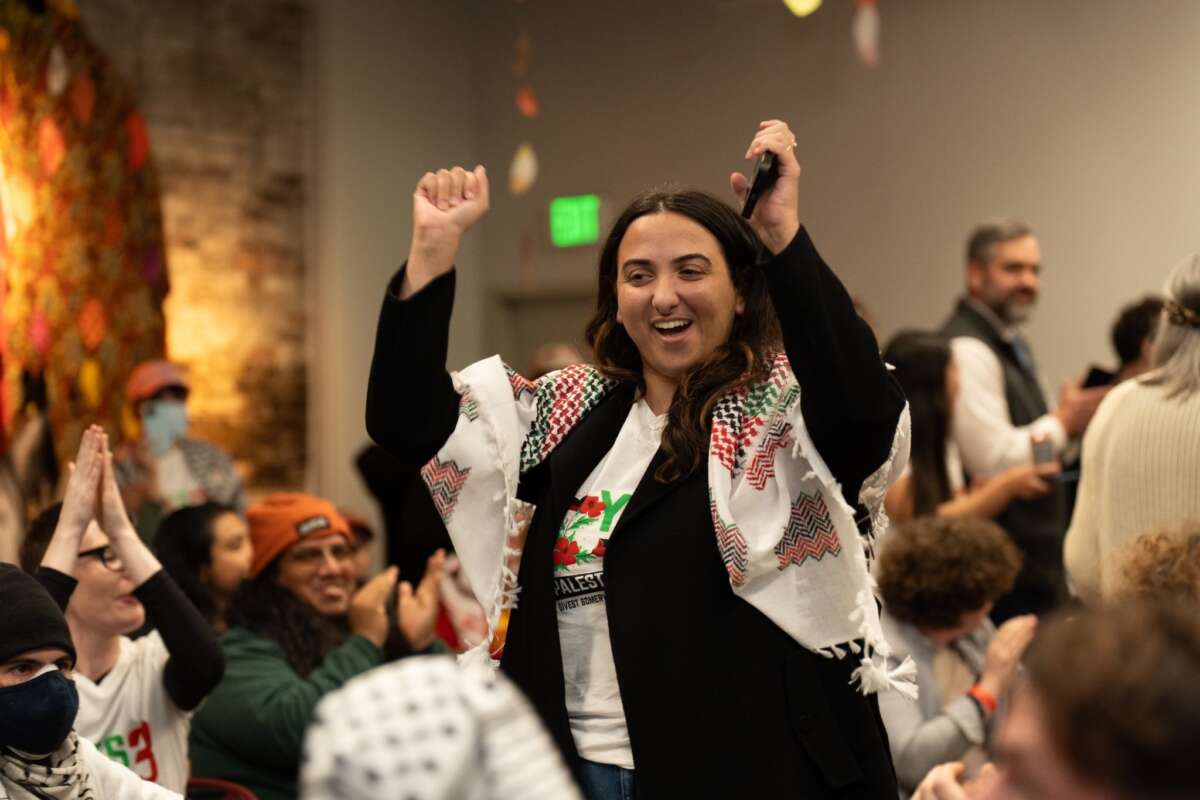
“I tell people when I’m talking about Question 3 — I grew up here in the belly of the beast, 50 years, and I never thought, I never dreamed, I never imagined that this would be on the ballot,” said Jamal Halawa on stage amid the election night celebration, “Somerville for Palestine makes me believe.”
“We didn’t compromise on our language. People went out today and they read ‘Israel, apartheid, genocide,’ and they said yes!”
“Being a part of this organization has freed me. It freed me from apologizing for racism, freed me from doubting myself, freed me from the dark pit of just doing nothing,” Halawa continued. “Somerville for Palestine has given me courage in battle.”
As they danced and celebrated, the activists also knew their work was far from over. Under city law, the ballot question had to be nonbinding. That means it’s now up to organizers to pressure the mayor and city council to pass binding legislation actually halting city business with corporations on the BDS list. “We want to make sure that our city leaders don’t shy away from that,” Haddad said, “because that’s what the voters wanted and voted for.” This is made more difficult by the fact that Burnley, who endorsed “Yes on 3,” lost the mayoral election to Jake Wilson, who did not. S4P leaders, however, were energized and undeterred, urging members to turn out to the next City Council meeting to demonstrate the force of voters’ mandate.
Several Palestinian organizers emphasized that the refusal to soften their language or make concessions was key to the campaign’s success. “We didn’t compromise on our language. People went out today and they read ‘Israel, apartheid, genocide,’ and they said yes!” said S4P leader Amina Awad to the assembled crowd. “This is what happens when we come together, when we won’t be silenced by political intimidation.”
“This is the most powerful form of resistance. Because we all know, besides the bombs and the army, it’s the economics,” Fawaz Abusharkh, a co-founder of the Boston Coalition for Palestine, told Truthout. “It’s the money and the power that sustains everything behind it. Without divestment that money is still gonna keep coming.”
Looking Forward
Organizers were also acutely aware of the broader spotlight they were under. “Not only is Somerville watching us, but people nationally are watching us,” Skinner said to the assembled crowd on election night. “We know that this has the potential to be a watershed moment, we know that and the opposition knows that too — and they’re scared.”
The opposition seems to feel the same way; one of their September campaign texts warned, “If we lose … similar campaigns will spread across Massachusetts and around the country.”
“If our politicians are not going to take action to reverse this, then it must be given to the people to give them the power to make these decisions.”
There’s evidence to back up the potential of this strategy, particularly in Democratic strongholds. A growing majority of Americans disapprove of Israel’s actions in Gaza, and a recent Quinnipiac poll found that three-quarters of Democrats oppose continued supply of U.S. military aid to Israel. As cities across the country gear up for the 2026 midterm cycle, many activists may turn to Somerville as a model for electoral engagement. “If our politicians are not going to take action to reverse this, then it must be given to the people to give them the power to make these decisions,” said Erin Axelman, the co-director of the documentary Israelism and a supporter of S4P. “I very much hope that this is a blueprint for further action across the country.”
S4P has already worked closely with a number of other Massachusetts groups, including Allston Brighton for Palestine, Northshore for Palestine, Jamaica Plain for Palestine, and Medford for Palestine, the latter of which passed its own divestment legislation through city council in August. And as the crowd cheered their victory on election night, longtime activist Hala Jadallah urged them to turn support back to the group that had first mentored their campaign: “Let’s go get them on the ballot in Pittsburgh!”
“We have built this from the ground up, this framework for how to build community and organize and bring the people together,” added Haddad, “and I think that is something that we definitely want to impart on other communities.”
An important fundraising appeal: 6 Days to raise $39,000
Thank you for reading Truthout today. We have a brief message before you go.
Unfortunately, donations are down for Truthout at a time when media faces immense pressure. Yet, grassroots media is vital in the fight against Trump’s authoritarian reign. Our mandate to tell the truth, share strategies for resistance, and speak against fascism grows more urgent each day. We must appeal for your support.
If you can support Truthout with a one-time or monthly donation, you will make a significant impact on our work. Please donate during our fundraiser.