Honest, paywall-free news is rare. Please support our boldly independent journalism with a donation of any size.
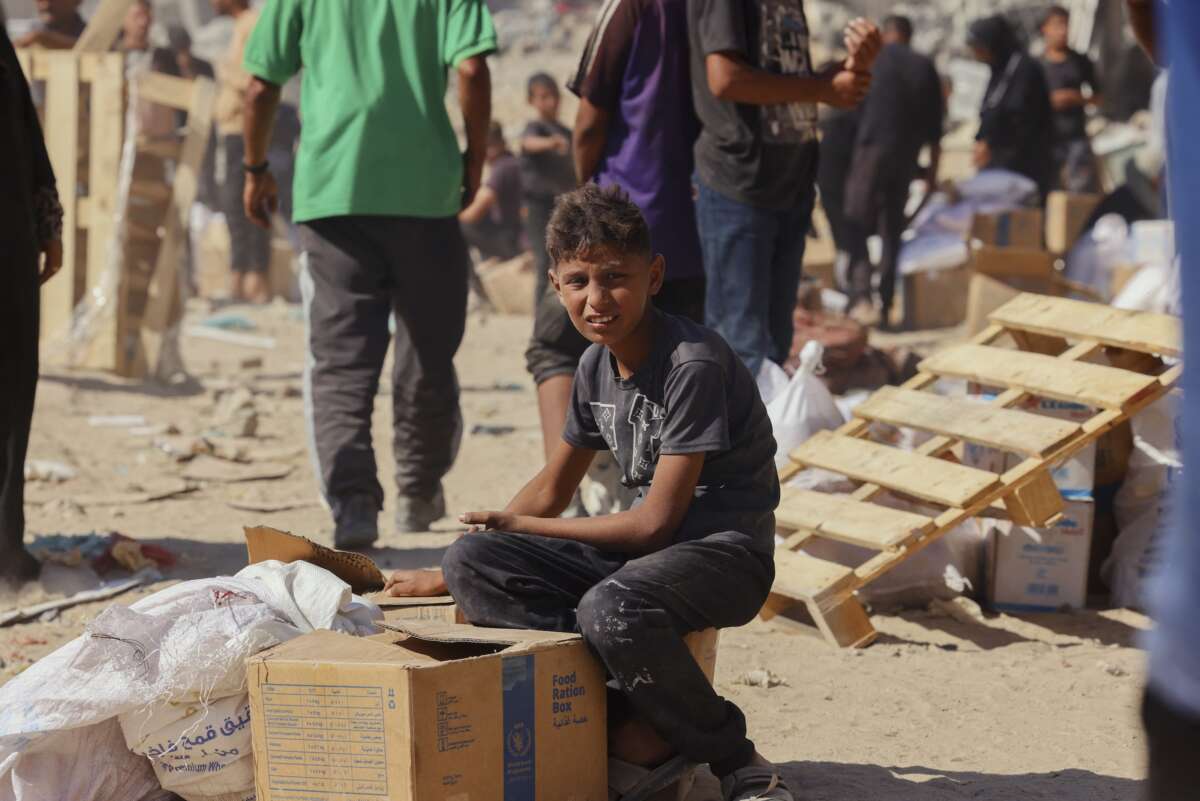
Israel has only allowed a small fraction of aid trucks required by the ceasefire deal to enter Gaza, Palestinian officials have said, in the latest report of Israeli officials violating the terms of the agreement and prolonging their famine campaign in the Strip.
According to the Gaza Government Media Office, as of Monday evening, only 986 aid trucks have entered Gaza since the beginning of the ceasefire agreement. This is despite the ceasefire deal stipulating that 6,600 trucks should have entered in that amount of time.
This is only about 89 trucks per day on average, the office said, out of 600 that Israel pledged to allow to enter daily. This represents a mere 14 percent of the aid entry that parties agreed to to bring an end to Israel’s humanitarian blockade and manmade famine in Gaza.
It is even far below Israel’s threat last week to only allow 300 trucks per day into Gaza as a result of Hamas’s inability to return the remains of all of the Israeli captives who died amid the genocide. Israel made that threat despite a reported understanding by Israeli officials that it would be difficult to return the bodies due to Israel’s continued blockade on heavy equipment that could be used to clear rubble.
The severely downgraded aid entry “reflects the continued policy of strangulation, starvation and humanitarian blackmail practiced by the occupation” against millions of Palestinians in Gaza, the Government Media Office said.
Aid groups have also decried the continued blockade of aid by Israel. A World Food Programme spokesperson said on Tuesday that entry is falling far short of what is needed and is not enough to stymie the spread of famine.
“Daily deliveries continue and they are now averaging around 750 tonnes,” the spokesperson, senior regional communications office Abeer Etefa, told reporters. “That’s much better than what we had before the ceasefire, but it’s still well below our target, which is around 2,000 tonnes every day.”
She emphasized that Israel must open more border crossings in order for agencies to deliver at the scale that is needed. Israeli Prime Minister Benjamin Netanyahu has said that Israel will keep one of the most important entry points, the Rafah crossing, closed indefinitely.
The UN Relief and Works Agency for Palestine Refugees (UNRWA) has said that it has three months’ worth of supplies to feed and care for all 2.2 million Palestinians in Gaza. But it has continued to be blocked by Israel, which has only allowed in a “trickle” of aid so far.
The continued blocking of aid supplies comes as Israel has already committed at least 80 violations of the ceasefire so far, the Gaza Government Media Office said on Sunday. This includes killing at least 97 Palestinians and injuring over 230 so far.
An important fundraising appeal: 7 Days to raise $42,000
Truthout is one of only a few platforms for justice-oriented, grassroots journalism. Today, as political censorship from the right intensifies, we have no choice but to ask for your help.
We are fundraising right now to cover our basic operating expenses. If you can support Truthout with a one-time or monthly donation, you will make a significant impact on our work. Anything you can do makes a difference — we appreciate your support.