Did you know that Truthout is a nonprofit and independently funded by readers like you? If you value what we do, please support our work with a donation.
Food insecurity groups have officially declared that a famine is ongoing in Sudan for the first time in the current civil war, indicating the deep need for international funding and action to combat the hunger catastrophe.
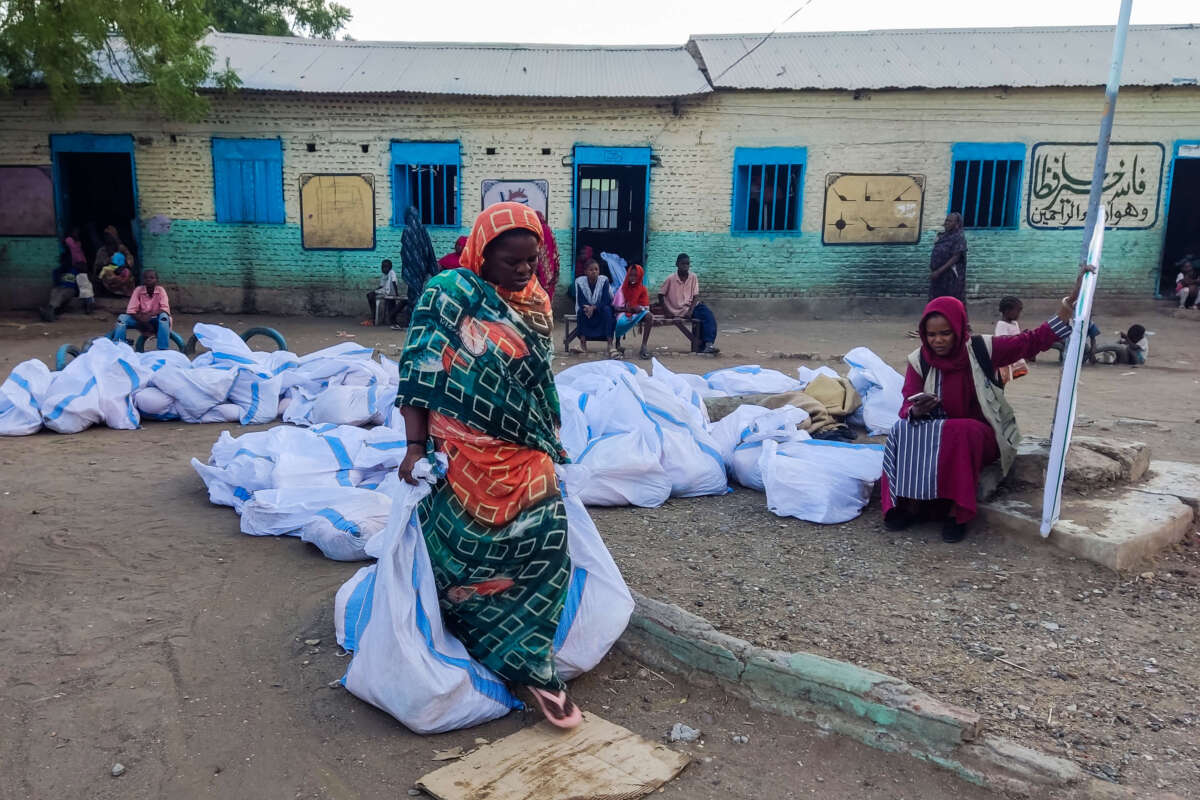
The Sudan working group of the UN-backed Integrated Food Security Phase Classification (IPC) and the U.S.-created Famine Early Warning Systems Network (FEWS NET) has said that famine is ongoing at Zamzam camp — a camp for internally displaced people south of el-Fasher in Darfur — where roughly 500,000 people are sheltering.
According to FEWS NET, the thresholds for famine — which are very high for official famine declarations — were surpassed in Zamzam in June, due to the rapid deterioration of conditions in recent months after paramilitary forces sieged el-Fasher.
Humanitarian aid has been nearly completely blocked in Darfur, as both the Rapid Support Forces (RSF) and Sudanese Armed Forces (SAF) have been undermining aid deliveries to millions of people in Sudan. Zamzam has not received aid for months.
Famine declarations are rare, requiring an extremely widespread level of hunger and death across a region. Experts and humanitarian groups have been warning of famine setting in in Zamzam for months, and conditions were already horrific before recent escalations; in February, Médecins Sans Frontières estimated that one child was dying of starvation every two hours in the North Darfur camp.
The IPC review found other camps around el-Fasher, Abu Shouk and Al Salam are likely also undergoing similar conditions to Zamzam, but are unable to properly determine a classification of the hunger there because of limited access.
“Without an end to this conflict, and in the absence of large-scale humanitarian food assistance, extreme human suffering will persist,” said FEWS NET decision support advisor Lark Walters.
Though food insecurity may be particularly acute around el-Fasher, Sudan is home to the world’s largest hunger crisis, in which a staggering 26 million people, or over half the population, are facing “crisis” levels of hunger.
This is the third time that a famine has ever been declared by the IPC since it was created two decades ago, and the second in Africa. Because experts have set the famine classification thresholds so high, they often come after the situation has become dire; in Somalia’s drought and famine in 2011, over 100,000 people had died by the time officials declared a famine that eventually claimed the lives of over a quarter million people.
Some experts have suggested that part of the reason a famine declaration has taken so long in Sudan has been because the IPC working group there is tied to Sudan’s government, controlled by one of the warring groups that believes a famine declaration in Darfur would hinder their war efforts.
International aid groups have called for an opening of humanitarian aid access points and an immediate influx of resources into the region in order to combat the famine.
“It is not too late to stop famine from spreading to other parts of the country,” said World Food Programme Executive Director Cindy McCain. “The Sudanese people are counting on us as their lifeline after enduring unimaginable hardship since this conflict began.”
Oxfam said that the famine declaration “highlights the catastrophic failure of the international community to act swiftly to end this gruesome war and scale up aid efforts.”
An important fundraising appeal: 24 Hours to raise $23,000
Truthout is one of only a few platforms for justice-oriented, grassroots journalism. Today, as political censorship from the right intensifies, we have no choice but to ask for your help.
We are fundraising right now to cover our basic operating expenses. If you can support Truthout with a one-time or monthly donation, you will make a significant impact on our work. Anything you can do makes a difference — we appreciate your support.