Did you know that Truthout is a nonprofit and independently funded by readers like you? If you value what we do, please support our work with a donation.
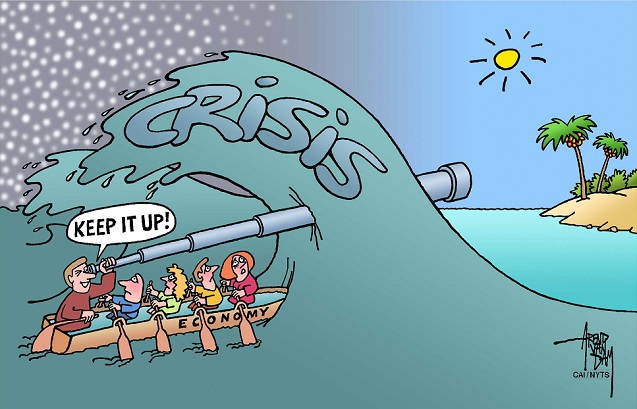
There’s an alarming amount of optimism out there about the United States’ economic prospects for 2014. Let me make the situation even more alarming by saying that I basically share that optimism. Why? Because of the Three Stooges effect: if you’ve been banging your head against a wall for no good reason, you’ll feel a lot better when you stop.
One way to describe the American economy in 2013 is to say that it was, in effect, trying to begin a strong recovery, but was held back by terrible federal fiscal policy. Housing was making a comeback; if state and local austerity policies were not going into reverse, at least they were not getting more intense; and household spending was starting to revive as debt levels came down.
But the feds were raising the payroll tax, slashing spending via the sequester, and more. Incidentally, because of these other factors, I don’t take seriously the claims of market monetarists that the failure of growth to collapse in 2013 somehow shows that fiscal policy doesn’t matter.
Austerity in the United States, although a really bad thing, wasn’t nearly as intense as what happened in Southern Europe; it was restrained enough that it could be – and, I’d argue, was – more or less offset by other developments over the course of a single year.
The point, in any case, is that the head-banging is about to stop – not in a sense that we’ll reverse our move in the wrong direction, but that we won’t keep on moving in that direction. Meanwhile, the housing market is still improving, and other stuff is relatively favorable.
None of this vindicates the multiple years of sluggish recovery that should have been vigorous. And let’s be clear: this kind of forecast is much less reliable than, say, my predictions that inflation and interest rates would stay low in the United States as long as we remained stuck in a liquidity trap, which were grounded in model fundamentals.
Still, the new year starts with some good omens. Oh, and on politics: since Obamacare is a nondisaster and Americans are facing the prospect of a decent rate of economic growth, the midterm congressional elections in November may not go the way that many conservatives currently expect.
What a Good Year Won’t Prove
A brief addendum: If 2014 is a year of relatively good growth, you know that many people will take that as somehow refuting Keynesianism – “Hey, didn’t you guys predict that the economy would never recover without fiscal stimulus?”
No, we didn’t. As I wrote in 2009: “In the long run, we will have a spontaneous economic recovery, even if all current policy initiatives fail. On the other hand, in the long run …” The fact that things eventually get better is neither a refutation of Keynesian analysis, nor a reason to excuse or overlook the vast economic and human costs of the bad policies to date – just as it does not vindicate austerity policies in Britain, either.
An urgent fundraising appeal: We still need to raise $12,000
Truthout is one of only a few platforms for justice-oriented, grassroots journalism. Today, we face an existential threat.
Due to Google’s launch of AI search, we’ve seen a drastic plunge in our site traffic and, as a result, our revenue. We lost 15 percent of our readership overnight. This was a readership we painstakingly built over decades, and it vanished because Google chose corporate greed over a healthy democracy.
We are fundraising right now to meet our basic operating expenses. If you can support Truthout with a one-time or monthly donation, you will make a significant impact on our work. Anything you can do makes a difference — we appreciate your support.