Honest, paywall-free news is rare. Please support our boldly independent journalism with a donation of any size.
The U.S. military has reportedly targeted several key railway lines in Iran in strikes on Thursday, with the U.S. unleashing dozens of strikes after President Donald Trump unilaterally declared the ceasefire “over” the day before.
On Thursday, the U.S. struck a railway that connects the capital of Tehran with the city of Mashhad, as well as a railway bridge near the city of Agh Qala in the northeast, according to U.S. media sources, as well as Iranian authorities. The Islamic Revolutionary Guard Corps said that the U.S. also struck two bridges in eastern Iran on Thursday.
The infrastructure attacks mark an escalation by the U.S. The U.S.’s strikes on infrastructure during the first phase of the war were considered particularly dire due to their impacts on civilian life. Trump’s repeated threats to target bridges and power plants in Iran have been considered to be potential war crimes by experts of international law.
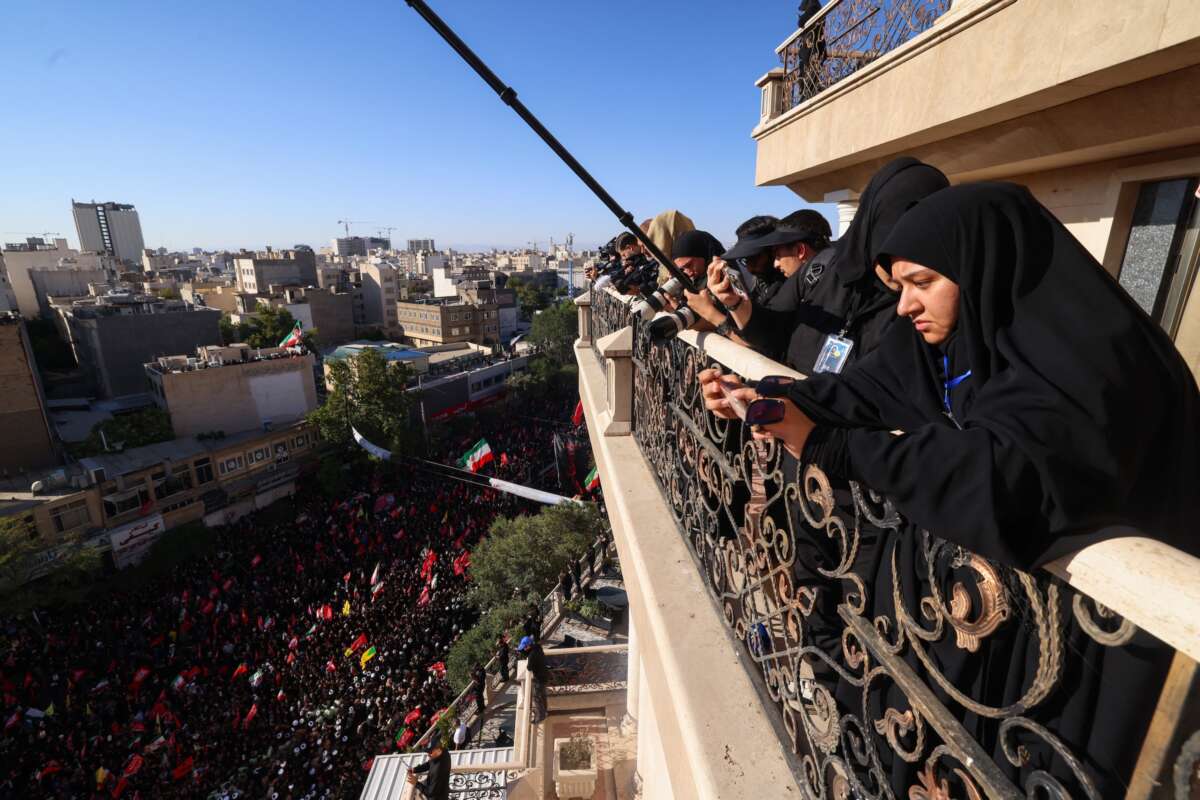
The attack on the railway connecting Tehran and Mashhad came just hours before former Supreme Leader Ayatollah Ali Khamenei was slated to be buried in Mashhad on Thursday, a procession that nevertheless drew massive crowds. Iranian officials said service between the cities had to be suspended due to the attack, and the Islamic Republic of Iran Railways called the strike “a criminal attack.”
The railway struck in the northeast, in Iran’s Golestan province, meanwhile, is a strategically important line that connects the country to China and Russia.
U.S. Central Command (CENTCOM) said in a press release that the military struck 90 targets overnight in Iran, “including air defense systems, coastal surveillance assets, missile and drone storage sites, naval capabilities, and military logistics infrastructure along Iran’s coastline.”
That brings the total number of targets struck in the past two days to over 170, according to CENTCOM. The New York Times reports that this is 14 times the number of targets struck by the U.S. during the last two days of U.S. strikes in June.
Thursday’s strikes come a day after an aggrieved Trump said, at the NATO summit in Turkey, that “I think it’s over” with regard to the Memorandum of Understanding between the U.S. and Iran.
The Strait of Hormuz and the associated costs of its relative closure have continued to be a major sticking point in the negotiations for a permanent end to the war. Traffic in the strait dropped this week after tankers on the Oman side of the passage were struck on Monday.
In addition to the new round of strikes, the U.S. also reimposed sanctions on Iranian oil this week. Iran retaliated against the latest round with attacks on U.S. bases in Kuwait, Bahrain, and Qatar on Wednesday and Thursday.
We lost 15 percent of our traffic overnight.
We now have three full months of data since Google changed its search to feature AI results. The numbers are worse than we anticipated. Overall readership that comes to Truthout through Google is down 54 percent against last year. The number of new readers who discover Truthout via Google searches is down 49 percent, and returning users from Google are down 51 percent.
We lost 15 percent of our readership overnight. This was a readership we painstakingly built over decades, and it vanished because Google chose corporate greed over a healthy democracy.
We anticipate a loss of roughly $500,000 in online revenue as a result of this massive traffic plunge in the next year alone.
The only way we can keep publishing is with strong reader support. We are asking you to start a monthly donation to Truthout today — anything you can do, whether $5 or $25, makes a difference.