Part of the Series
Struggle and Solidarity: Writing Toward Palestinian Liberation
Truthout is a vital news source and a living history of political struggle. If you think our work is valuable, support us with a donation of any size.
After more than two years of Israel’s attacks on the Gaza Strip, over 72,000 Palestinians are dead and more than 171,000 are injured, according to Gaza’s Ministry of Health. Amid these enormous losses, we are observing Eid al-Fitr, the “festival of breaking the fast” that takes place at the end of the holy month of Ramadan.
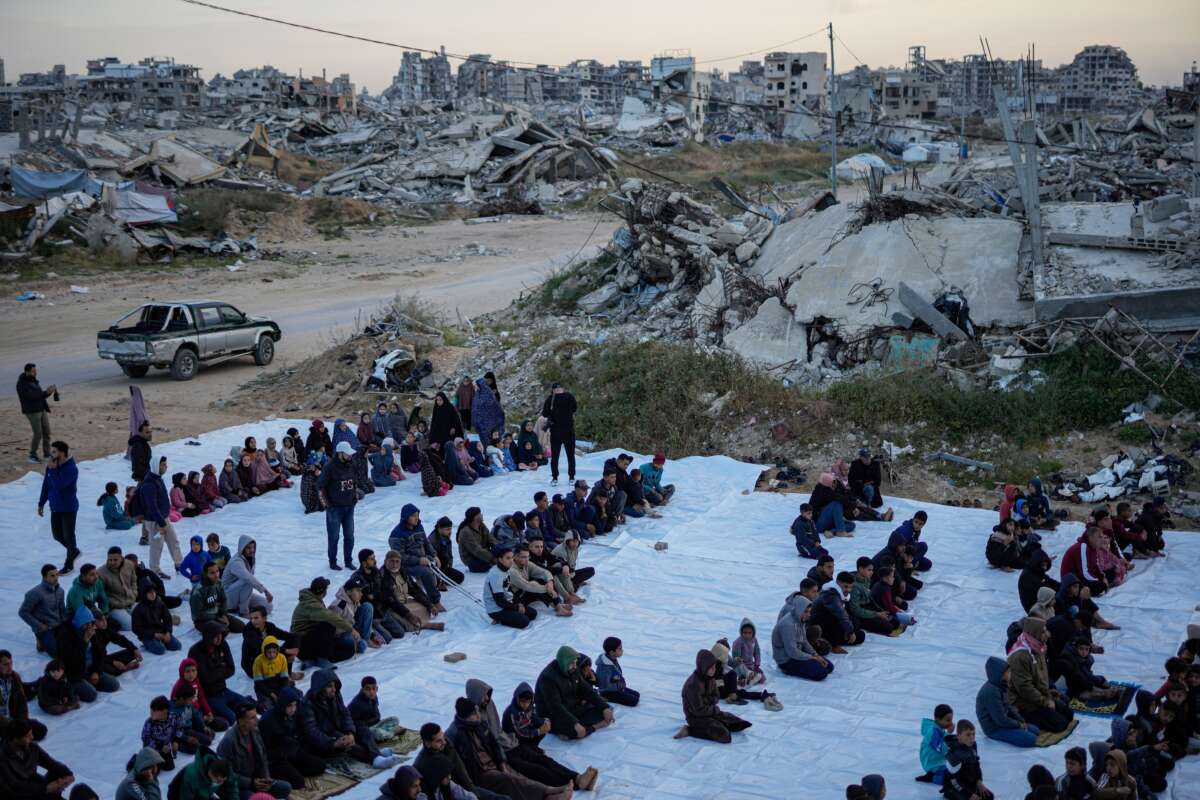
The last four celebrations of Eid in Gaza have been marked by the sounds of warplanes, gunfire, and shelling. Although this year’s Eid arrives without the sounds of war that residents of Gaza had grown accustomed to during past Eids, signs of joy remain limited. Thousands of families have lost their homes and loved ones, while many live in shelters or among the ruins of their houses, altering the traditional rhythms and customs of the holiday.
In the years before the genocide, mornings in Gaza during Eid were marked by thousands of worshippers flocking to mosques for the Eid prayer. But these rituals have changed significantly following Israel’s assault, which also affected places of worship. According to the Ministry of Endowments and Religious Affairs in Gaza, 1,109 out of 1,244 mosques in the Strip have been either completely or partially destroyed since the beginning of the war in October 2023, rendering most of them unusable. With many mosques no longer available, residents this year were forced to perform Eid prayers in small open-air prayer spaces, streets, or tents in displacement centers, reflecting how the war has altered even the most enduring religious practices in Gazan life.
1,109 out of 1,244 mosques in the Strip have been either completely or partially destroyed since the beginning of the war in October 2023, rendering most of them unusable.
Mohammad Al-Hajj, the imam of the Martyrs of Al-Aqsa Mosque, spoke with Truthout about how Eid rituals have changed since the war. He explained that preparations for Eid used to begin days in advance, with worshippers volunteering to clean and organize the mosque ahead of the Eid prayer, which would gather hundreds of neighborhood residents. He added that children would arrive at the mosque in their new clothes at dawn, waiting in the courtyard for the prayer to begin amid an atmosphere of joy and tranquility.
Al-Hajj notes that these scenes have changed dramatically due to the war’s destruction and displacement, yet residents still strive to maintain their religious rituals. “Despite everything that has happened, people are determined to pray and celebrate Eid, even if the prayer is now held in small spaces or among tents,” he said.
“Despite everything that has happened, people are determined to pray and celebrate Eid, even if the prayer is now held in small spaces or among tents.”
Abeer Al-Hilu never imagined celebrating Eid without her three children, who were killed in an airstrike that hit their home in northern Gaza. Her oldest was 10, the second 7, and the youngest 4. She explained that Eid was always the most joyful time of the year for them, as they eagerly awaited new clothes, outings, and visits to relatives.
“They used to ask me days before Eid when we would buy their new clothes, and they would plan where we would go after prayer,” Abeer recalled. “On Eid morning, I would wake them early, dress them in their new clothes, and take them to pray, then visit family.” She continued, her voice heavy with grief: “Today, I don’t know how Eid will come without them … the house is silent, and no one asks to go play or visit relatives.”
She adds that the hardest part of this year’s Eid is seeing other children celebrate while her own are absent from the places they once filled with life. “Eid was theirs … they were the happiest during it,” she said, adding that she will spend the holiday remembering their laughter and voices that once filled the house.
Another grieving survivor of the war is Abdullah Al-Nouri, 22, the sole survivor of his family, all of whom were killed when their home was bombed. In the moment of the attack, Abdullah struggled to survive amid the rubble, surrounded by destruction and the loss of everyone he loved.
“Every Eid is hard for me … no one is with me to share the joy or even pray with me,” Abdullah told me, his voice full of sorrow. “All I hear are the laughter of children and the sounds of other families, reminding me of what I’ve lost. Sometimes I wish I could wake up and find myself with my family, even for just a moment, to feel that warmth and celebration with my loved ones again.”
Abdullah said Eid is no longer just a holiday for him; it is now a test of patience and resilience during which he strives to maintain his religious rituals even while alone amid the ruins of his home.
For many Palestinians living abroad, Eid al-Fitr feels very different this year. Lamis Al-Kurd, who left Gaza before the war, lost her entire family during the conflict. “Every Eid, I used to go celebrate with my family and hear their laughter. Now, I am alone, and no one is with me,” Lamis said. “I see people celebrating around me, children playing and laughing, but my house is empty … the feeling of Eid has become very painful.”
In spite of the distance and the loss of her family, Lamis continues to observe religious rituals from afar, sharing the holiday with friends through phone calls, trying to maintain her traditions and the memories she cherished in Gaza. She emphasized: “Eid is now a time for me to remember my family, to try to stay connected to them despite the distance, and to hold onto the moments we shared together.”
Despite all the losses and destruction, the people of Gaza remain determined to celebrate Eid, maintaining prayers, setting up temporary prayer spaces, and finding small moments of joy for children among the tents and rubble. For them, Eid is no longer just a religious occasion; it has become a symbol of resilience, a celebration of life amid pain, and a reminder that life does not stop even under the harshest circumstances.
In the streets people strive to preserve their rituals and traditions, including prayer, exchange of greetings, and symbolic visits, showing that the social spirit has not died with the war. Children, despite everything, continue to play and laugh, their voices serving as living proof that life endures.
For those who have lost loved ones or are left alone, like Abdullah Al-Nouri, Eid becomes a test of patience and strength, and an opportunity to honor memories of those who have passed. For young Palestinians living abroad, like Lamis Al-Kurd, the holiday is a time to connect with loved ones from afar, preserving spiritual bonds and memories despite death and forced separation.
Eid al-Fitr in Gaza this year unfolds against a backdrop of pain and loss, but it also carries a message of hope and resilience. Despite empty homes, rubble, and the silence left by absent loved ones, the spirit of Eid remains alive in our hearts, showing that Palestinians, no matter the circumstances, continue to celebrate life, maintain our religious and social connections, and hold on to the promise that brighter days of joy, routine, and peace will return.
An important fundraising appeal: 5 Days to raise $35,000
Truthout is one of only a few platforms for justice-oriented, grassroots journalism. Today, as political censorship from the right intensifies, we have no choice but to ask for your help.
We are fundraising right now to cover our basic operating expenses. If you can support Truthout with a one-time or monthly donation, you will make a significant impact on our work. Anything you can do makes a difference — we appreciate your support.