Did you know that Truthout is a nonprofit and independently funded by readers like you? If you value what we do, please support our work with a donation.
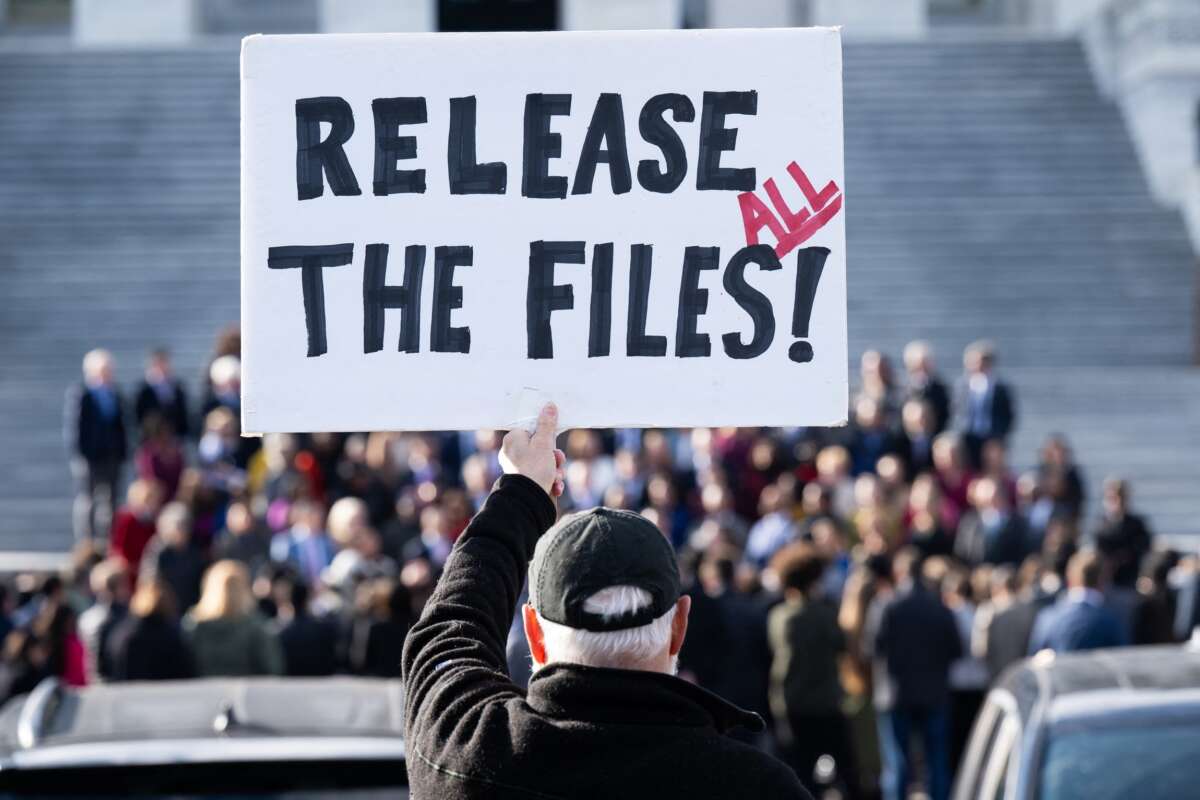
On Thursday, the Department of Justice (DOJ) released three previously withheld documents from the Epstein files that include accusations against President Donald Trump, who had a close friendship with accused sex trafficker Jeffrey Epstein.
The documents detail an FBI interview in 2019 with a woman who alleged that Trump sexually assaulted her in the 1980s, when she was between the ages of 13 and 15 years old.
The allegations within the documents have not been corroborated by any additional evidence. However, the decision to exclude them from the Epstein files database has led to widespread suspicion that the DOJ was concealing them on Trump’s behalf, in violation of the Epstein Files Transparency Act, which prohibits files from being restricted for the purpose of protecting someone’s reputation.
The newly released files detail four separate interviews with the woman, in which she describes accusations against both Epstein and Trump. The department had previously released documents referencing the existence of the memos detailing the interviews, but only one interview — outlining Epstein’s alleged misdeeds — was included on the database.
The FBI interviewed the woman, whose name is redacted in the files, between July and October 2019. In the second interview, she alleges that Epstein introduced her to Trump. It’s during that trip that she says Trump sexually assaulted her.
According to the woman’s account, Trump asked other people in the room to leave them alone, after which he said “something to the effect of, ‘Let me teach you how little girls are supposed to be,'” the woman said in the interview. Trump then attempted to force her to perform oral sex, after which she bit him, she said, resulting in Trump hitting her.
The DOJ denies the authenticity of the woman’s account, describing the accusations as “untrue and sensationalist claims.”
In the final interview with the FBI, agents asked the woman whether she would expand upon her interactions with Trump. The woman refused to do so, asking “what the point would be of providing the information at this point in her life when there was a strong possibility nothing could be done about it,” the report noted.
The woman’s concerns are valid from a legal standpoint, as Trump was president at the time the interviews took place. Justice Department policy forbids the pursuit of criminal charges against a sitting president, based on a questionable determination in 1973 by the DOJ that held that such inquiries “would impermissibly undermine the capacity of the executive branch to perform its constitutionally assigned functions.”
In releasing the previously withheld memos, the DOJ sought to explain the action as a mistake, claiming that they were not included in the Epstein files database because they had been errantly flagged as duplicate documents.
There is deep skepticism among the American public over how the administration is handling the Epstein files.
According to an Economist/YouGov poll released on Tuesday, 66 percent of Americans believe there are more files yet to be released that the government hasn’t included on the database. Only 5 percent believe all of the files that are available have been released.
A Data for Progress poll released in February also demonstrates that 55 percent of Americans believe Trump has been dishonest in his comments about the Epstein files, including in his descriptions of his former relationship with Epstein. A slight plurality of respondents, 48 percent, believe Trump should be impeached over his administration’s handling of the Epstein files.
According to Rep. Jamie Raskin (D-Maryland), who has viewed unredacted versions of the Epstein files, Trump’s name appears “more than a million times.”
Raskin has also suggested that the DOJ has intentionally obstructed members of Congress from viewing the unredacted files in a timely manner.
“This is what a cover up looks like,” Raskin said last month.
Media that fights fascism
Truthout is funded almost entirely by readers — that’s why we can speak truth to power and cut against the mainstream narrative. But independent journalists at Truthout face mounting political repression under Trump.
We rely on your support to survive McCarthyist censorship. Please make a tax-deductible one-time or monthly donation.