Honest, paywall-free news is rare. Please support our boldly independent journalism with a donation of any size.
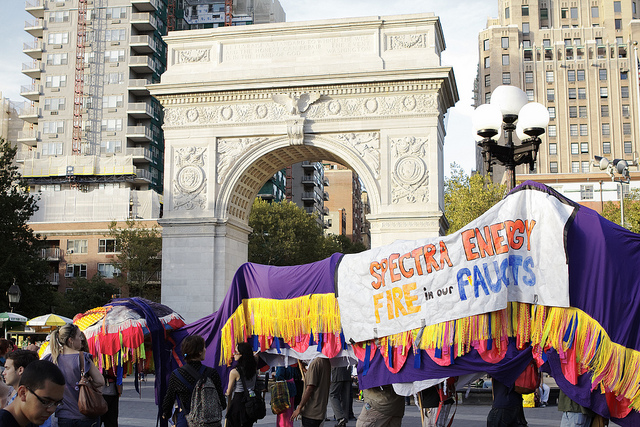
Some of the nation’s biggest natural gas pipeline companies – including Kinder Morgan and Houston-based Spectra Energy – are rushing to expand their network of high-pressure pipelines across New England and much of the Eastern part of the country. Spectra’s Algonquin pipeline now stretches thousands of miles from the Midwest into Florida, New Jersey and Massachusetts, leading up toward Canada.
New England communities are becoming new pipeline way stations, bearing the risks of the fracked gas pipelines but gaining few benefits.
A planned extension of the Algonquin pipeline snakes under roads within a mile of my house in the small town of Dedham, Massachusetts, with a metering pipeline station placed next to an active blasting site in a quarry. Members of Dedham’s chief policy-making agency, the Dedham Board of Selectmen, unanimously oppose the pipeline and are suing Spectra in a move typical of the resistance in hundreds of communities. But Spectra is moving up its pipeline construction schedule and broke ground on June 17, 2015. Nothing better illustrates the transformation of our democracy into a “corpocracy,” a system that maintains popular elections but is ruled by a corporate oligarchy and its political allies in Washington.
Because it generates lower greenhouse gas emissions than coal or oil, natural gas is positioned as the marketable corporate alternative to renewables such as wind and solar, and it is extremely profitable, especially when sold in the European and Asian markets, where much of the Algonquin pipeline gas will be exported. New England communities are becoming new pipeline way stations, bearing the risks of the fracked gas pipelines but gaining few benefits.
In a new wave of resistance focused on stopping gas pipelines – part of the national “Blockadia” movement – city councils, health boards, conservation commissions and other local or state agencies have passed numerous bans on the pipeline construction, refused to issue permits and sued to stop the expansion of the Algonquin pipeline. Opposition is based on lack of required notifications to abutters, dangers to waterways and threats to public health and endangered species from methane – the most potent greenhouse gas – and from other cancer-causing chemicals in the fracked gas. Documents show that Spectra and Kinder Morgan have records of thousands of leaks, fires and explosions, exposed in a 2013 report released by Sen. Edward Markey of Massachusetts.
But construction is accelerating as the natural gas industry – financed by some of the biggest Wall Street banks – is entrenching a 21st century gas pipeline infrastructure that will impede the building of the clean energy infrastructure necessary to mitigate climate change.
FERC operates like the World Trade Organization corporate tribunals (… such as the Trans-Pacific Partnership, the TPP), where big global corporations write the rules of global trade and override the nation’s democratic laws.
How can the companies ignore local and state environmental and health laws? The answer lies in federal regulation of the oil and gas infrastructure by the Federal Energy Regulatory Commission (FERC), an independent commission in the federal Department of Energy consisting of five members appointed by the president and overseeing, among other things, transmission and sale of oil and gas, with legal authority to preempt local and state law. It authorizes pipeline development without any strong countervailing legal power and with little meaningful deference to local or state environmental law or popular will. The president and Congress do not review FERC decisions.
FERC is the quintessential model of corpocracy trumping democracy. Often called a “rubber stamp,” it is energy governance of, by and for the oil and gas industry. FERC’s power is cloaked in the legal authority issued by a formally democratic Congress serving as a handmaiden to the big energy interests and financial corporations that fund and lobby national politicians into submission.
FERC operates like the World Trade Organization corporate tribunals (highlighted by Sen. Elizabeth Warren in her opposition to the big trade agreements such as the Trans-Pacific Partnership, the TPP), where big global corporations write the rules of global trade and override the nation’s democratic laws.
Senators Markey and Warren, among other progressive politicians, are among the mainstream key players in any effort to override the natural gas corpocracy and the larger corpocracy eroding US democracy. But their efforts will bear fruit only if the growing numbers of ordinary Americans – a new majority living near gas pipelines and who now see their voice and popular laws blatantly ignored – take dedicated, visionary action in their communities, the courts and the streets.
Environmental and economic justice movements working to stop the oil and gas pipelines – and to shut down the pipelines of corporate money into politics – represent the best hope of undermining the corpocracy and renewing democracy.
The struggle between corpocracy and democracy is the defining issue of the 21st century. It will determine not only the fate of our democracy but the fate of the planet, since the corpocracy prioritizes short-term profit over the health of humans and all living species.
A terrifying moment. We appeal for your support.
In the last weeks, we have witnessed an authoritarian assault on communities in Minnesota and across the nation.
The need for truthful, grassroots reporting is urgent at this cataclysmic historical moment. Yet, Trump-aligned billionaires and other allies have taken over many legacy media outlets — the culmination of a decades-long campaign to place control of the narrative into the hands of the political right.
We refuse to let Trump’s blatant propaganda machine go unchecked. Untethered to corporate ownership or advertisers, Truthout remains fearless in our reporting and our determination to use journalism as a tool for justice.
But we need your help just to fund our basic expenses. Over 80 percent of Truthout’s funding comes from small individual donations from our community of readers, and over a third of our total budget is supported by recurring monthly donors.
Truthout has launched a fundraiser to add 500 new monthly donors in the next 9 days. Whether you can make a small monthly donation or a larger one-time gift, Truthout only works with your support.