
Truthout is an indispensable resource for activists, movement leaders and workers everywhere. Please make this work possible with a quick donation.
Some people are suddenly panicking over the recent report showing that the eurozone is officially in deflation. But sudden panic is the wrong reaction; you should have been gradually panicking over an extended period. The news isn’t actually any worse than what we’ve been seeing for a while.
The key is not to look at the headline number, but to keep your eyes on the core.
Core inflation – like the Keynesian multiplier – is one of those much-ridiculed concepts (hey, you’re measuring inflation without the inflation!) that has, in fact, performed extremely well in recent years. Back in 2010-11, when rising gas prices were sending headline inflation numbers up, I and many others received a lot of hostile comments for claiming that there wasn’t any real inflation bulge.
But core inflation, which is measured by taking food and energy out of the price index, has indeed been a much more reliable guide than headline inflation, which fluctuates wildly.
As the chart on this page shows, this has been as true for Europe as it has for America.
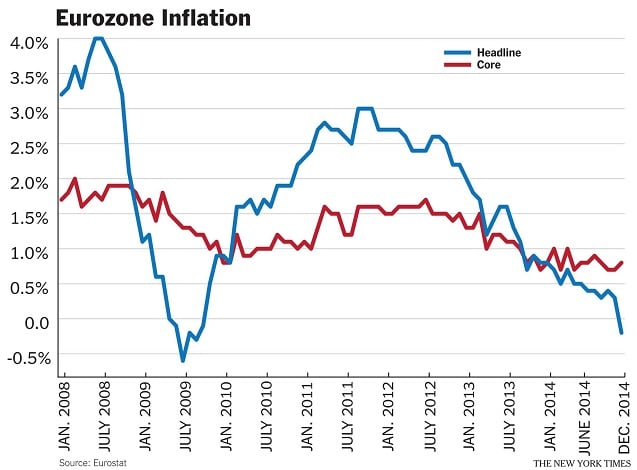
And core inflation is basically unchanged in the new report. It has been on a long slide, and is far below the European Central Bank’s target (which is itself too low).
The same logic that made me ignore the inflation bulge when oil was going up says to ignore the dip when oil is plunging. I won’t say not to panic – you should be panicking about Europe. But keep it steady, OK?
A Trip Down Euromemory Lane
Jean-Claude Trichet, president of the E.C.B., in an interview with La Repubblica in June 2010: “As regards the economy, the idea that austerity measures could trigger stagnation is incorrect. … In fact, in these circumstances, everything that helps to increase the confidence of households, firms and investors in the sustainability of public finances is good for the consolidation of growth and job creation. I firmly believe that in the current circumstances, confidence-inspiring policies will foster and not hamper economic recovery, because confidence is the key factor today.”
Olli Rehn, the former vice president for economic and monetary affairs at the European Commission, in a Financial Times column in December 2012: “Europe must stay the austerity course.”
Europe marched into this disaster with its eyes wide shut.
An urgent appeal for your support: 24 Hours to raise $15,000
Truthout relies on individual donations to publish independent journalism, free from political and corporate influence. In fact, we’re almost entirely funded by readers like you.
Unfortunately, donations are down. At a moment when independent journalism is urgently needed, we are struggling to meet our operational costs due to increasing political censorship.
Truthout may end this month in the red without additional help, so we’ve launched a fundraiser. We have 24 hours to hit our $15,000 goal. Please make a tax-deductible one-time or monthly donation if you can.