Truthout is a vital news source and a living history of political struggle. If you think our work is valuable, support us with a donation of any size.
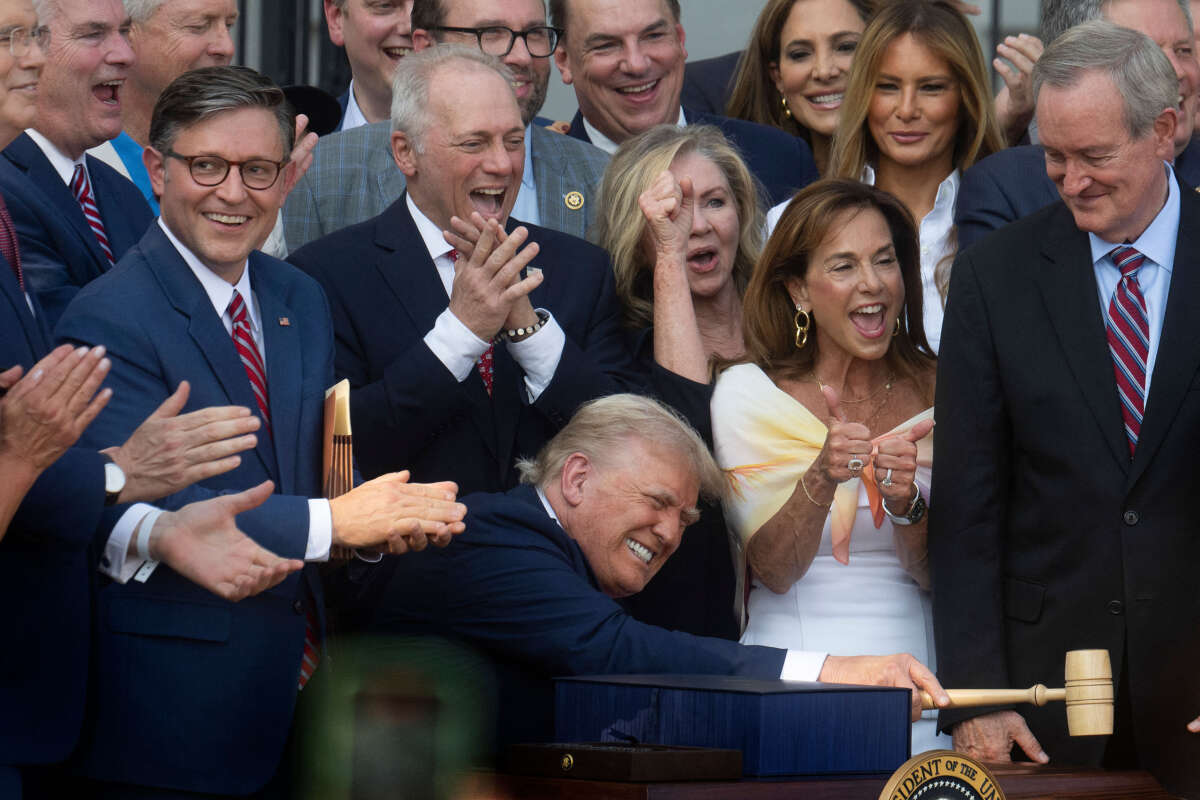
Donald Trump’s so-called “Big, Beautiful Bill,” which was signed into law last week, has been described as a monstrous piece of legislation. In this exclusive interview for Truthout, world-renowned progressive economist Robert Pollin provides an overview of this “disgraceful” federal budget bill. Pollin is distinguished professor of economics and co-director of the Political Economy Research Institute at the University of Massachusetts Amherst. The interview that follows has been lightly edited for clarity and length.
CJ Polychroniou: Trump’s so-called “Big, Beautiful Bill” has now become law, achieving what ultra-conservatives have been fighting for decades, which are huge tax breaks and major cuts to social safety net programs. Of course, there is a lot more reactionary stuff included in this megabill, such as hundreds of billions of dollars devoted to Trump’s anti-immigration agenda and derailing the green transition by taking an axe to clean energy and boosting, in turn, fossil fuel production. In sum, I think Ed Kilgore’s claim that this 940-page bill “is, in fact, the single most sweeping piece of legislation in American history” is quite accurate, although some of its effects won’t be felt for some time. Can you discuss specifically the economic and social repercussions of Trump’s megabill, especially in light of the view that the U.S. is the most unequal high-income country in the world?
Robert Pollin: Trump’s federal budget bill is disgraceful along multiple dimensions. We can start with its egregious distributional impacts. The bill will make the rich still richer through tax cuts while attacking the living standards, including the health and food security, of working people and the poor.
Trump and company claim that people at all income levels will benefit from the bill’s tax cuts. There is a tiny sliver of truth in this. According to the Institute on Taxation and Economic Policy (ITEP), the Trump tax provisions will deliver an average of $40 in savings to the lowest 20 percent of income earners in 2026. Meanwhile, the richest 1 percent will end up $66,000 richer. This recalls the famous observation by Anatole France in 1894 that, “The law, in its majestic equality, forbids rich and poor alike to sleep under bridges, to beg in the streets, and to steal their bread.”
But even these figures do not conclude the story. ITEP also notes that, once we also account for the impact of Trump’s tariffs — with these tariffs being a tax on imported products — those in the lowest 20 percent income bracket will not keep their $40 in benefits, but rather end up worse off by about $300. Meanwhile, the richest 1 percent are still better off by about $58,000.
Much more punishing still for lower-income people are the spending cuts to Medicaid, the health insurance program that now covers 85 million low-income and disabled people, along with other health funding cuts. The Congressional Budget Office (CBO) estimates that, through the Trump measure, at least 17 million people will lose their coverage by 2034. In addition, cuts to the federal food security program (SNAP), on which 42 million people now depend, could eliminate this support for up to 5 million people.
Moreover, this purposeful Trump project to shower money on the rich while depriving lower-income people of health care and food arrives after nearly 50 years of neoliberal policy dominance had already skewed income and wealth inequality to extreme levels. For example, the average wage for non-supervisory workers as of 2023 was roughly equal, at about $28 an hour, to where it was in 1972 (controlling for inflation), even though average worker productivity had increased two-and-a-half-fold over this period. Meanwhile, the average CEO’s pay was 30 times higher than the average worker in 1972, but exploded to 290 times higher by 2023. In other words, the average worker’s annual income remained roughly constant at around $50,000 per year over this 50-year span, while the average CEO’s pay skyrocketed from $1.5 million to nearly $15 million.
We have opportunities right now for major climate policy victories at the state and local levels, even in the face of Trump.
Under Joe Biden’s four years in office, some modest progress was made toward countering this rising inequality trend, including through Biden’s support for union organizing drives and through enforcing existing (but long-neglected) anti-monopoly laws. Trump and company are now committed to wiping out these small gains. This is while Trump stridently proclaims his commitment to working people and while, to date, large segments of the working class have been willing to give Trump the benefit of the doubt.
Of course, one centerpiece of Trump’s appeal to the U.S. working class has been his brutal attacks on immigrants, including those with legal status as well as undocumented people. To support this program, the bill allocates an average of more than $20 billion per year through 2029 to build new immigrant detention centers and expand Immigration and Customs Enforcement (ICE) operations. This funding more than doubles the current ICE budget. Trump and company claim that undocumented immigrants have flooded into the country, that most of them are criminals, that they are stealing jobs from U.S.-born workers, and that they are draining the public schools, hospitals and other programs of resources without paying taxes to support these public programs.
None of these claims are remotely true. In fact, according to the best available evidence, the population of undocumented immigrants in the U.S. has not changed significantly since 2005, varying between about 11–12 million people overall. Moreover, all immigrants, including undocumented immigrants, are less likely to commit crimes than the U.S.-born, including both violent and nonviolent crimes. In terms of taxes and financing public programs, as of the most recent 2022 data, undocumented immigrants paid nearly $100 billion in federal, state, and local taxes, amounting to an average of nearly $9,000 per undocumented immigrant. Furthermore, more than one-third of all taxes contributed by undocumented immigrants are funding programs that they are unable to access. That is, they are paying into Social Security, Medicare, and unemployment insurance, but are receiving no benefits in return. This is also while, in 2023, the official unemployment rate for U.S.-born workers was 3.6 percent, the lowest figure on record.
What about the environmental repercussions? How does Trump’s “Big, Beautiful Bill” impact U.S. climate policy, and what does it mean for global climate change?
Trump’s bill is one more weapon amid his relentless wave of attacks against any and all efforts to avert the mounting climate catastrophes. Even prior to the bill’s passage, the Trump administration had already introduced, according to Columbia University’s Climate Backtracker, more than 200 measures to “scale back or wholly eliminate climate mitigation and adaptation measures.”
Trump has also fired hundreds of government scientists and installed climate change deniers into critical government positions. The Trump bill itself repeals or phases out the tax credits for solar and wind energy investments, electric vehicle purchases, and making home energy-efficiency improvements that were important features of the Biden Inflation Reduction Act (IRA).
The impact of the overall Trump program on the climate will be severe, as intended. U.S. carbon dioxide (CO2) emissions — the main cause of global heating — have fallen by roughly 20 percent over the past 20 years. Biden’s policies did contribute to this downward trend, even while the rate of emissions reductions remained insufficient relative to the global climate stabilization goal of net zero emissions by 2050. Trump’s policies will stop even these modest gains over the short term. If Trump’s program is allowed to remain in place, the likelihood for achieving zero emissions by 2050 becomes nil.
How can we fight back effectively? For starters, we need to proclaim loudly the reality that clean energy investments are delivering money and jobs in all regions of the U.S., including in red states. Thus, wind power is thriving in Texas, Iowa, Oklahoma, and Kansas. Moreover, at the end of Biden’s presidency, West Virginia had received about $5 billion and Pennsylvania about $9 billion in new clean energy investment commitments tied to Biden’s IRA. It is hard to believe that working people in these and other states will be okay with these projects folding, and the jobs generated by them foregone, all thanks to Trump.
The CBO estimates that the tax cuts in Trump’s bill will generate an average of $450 billion per year in government revenue loss over the next 10 years.
Still more: Investments in clean renewable energy and high efficiency are now, by far, the cheapest ways to deliver energy to consumers. Even Trump’s own Energy Department’s most current report on comparative electricity costs confirms this. It estimates that electricity generated by onshore wind and solar projects that begin operating in 2030 will cost between 3–3.2 cents per kilowatt hour. The natural gas price will be more than twice as high, at 6.5 cents.
We have opportunities right now for major climate policy victories at the state and local levels, even in the face of Trump. One important example was the passage of the Climate Change Superfund law in New York State last December, right before Trump took office. Under this measure, oil and gas companies will pay an average of $3 billion a year for the next 25 years for climate adaptation and resilience measures throughout the state. This victory in New York followed from the successful campaign to enact a similar measure in Vermont earlier in 2024. Comparable bills are now advancing in Massachusetts, California, and Maryland.
This federal budget bill is projected to add trillions of dollars to the nation’s debt load and widen deficits. Is the U.S. in the “fast lane” to what Elon Musk calls “debt slavery?”
Elon Musk and his late, unlamented leadership of the so-called Department of Government Efficiency (DOGE), demonstrated both unbridled malice and a buffoonish level of ignorance regarding the operations of the federal government. Moving on to at least minimally serious analysts, the CBO estimates that the tax cuts in Trump’s bill will generate an average of $450 billion per year in government revenue loss over the next 10 years. Increased spending on attacking and deporting immigrants as well as increased military spending will cost the government another roughly $30 billion per year. This brings the total average costs of Trump’s bill to nearly $500 billion per year.
Meanwhile, according to the CBO, the spending cuts for health care, food security, and clean energy will together amount to an average total of about $170 billion per year. Overall then, the CBO estimates that Trump’s bill will expand the federal deficit by about $330 billion per year over the next decade (i.e., $500 billion in tax cuts and spending increases minus $170 billion in spending cuts). This will be on top of the government’s 2024 budget deficit of nearly $1.9 trillion.
The 2024 federal deficit was equal to about 6.3 percent of last year’s U.S. gross domestic product (GDP). This 6.3 percent of GDP budget deficit is larger than at any other non-recession period since World War II. The government did run much larger deficits to counteract the 2008-09 Great Recession and the 2020-2021 COVID lockdown. But we are not now experiencing any kind of comparable economic crisis. As of 2024, the government’s accumulated debt was also at a peacetime high of 97 percent of GDP. This is nearly three times higher than the 2007 pre-Great Recession figure, which was 35 percent of GDP.
The most critical point is that the current deficits are not serving to prevent an economic collapse. They are rather simply helping rich people get richer, while attacking the living standards of working people and the poor, as well as continuing to lavish exorbitant funds on the military.
By running large fiscal deficits now … the government is effectively paying rich people to lend it money rather than making them pay minimally decent shares of their income and wealth in taxes.
Is the government about to go broke as a result? The most important indicator here is how much we have to pay to cover these debts — i.e., the interest that the government pays on the U.S. Treasury bonds. In 2024, the government paid nearly $900 billion in interest to its creditors, equal to 3.8 percent of GDP. That is below the 4.9 percent of GDP that the government paid during the Ronald Reagan/George H.W. Bush presidential era. We did not hear Reagan, Bush, or any other Republican politician of that era scream then that the sky was falling. Nor did the sky fall.
Still, the government’s $900 billion in 2024 interest payments totaled more than it spent on education, scientific research, public infrastructure, environmental protection, and global humanitarian aid combined. Moreover, government interest payments were at $350 billion as of 2021, 1.5 percent of GDP. Thus, the 2024 interest payments were nearly three times larger than only three years prior. This huge spike in interest payments was caused both by the ballooning of government debt obligations, but even more so, by the sharp rise in interest rates that the government now has to pay its creditors. The average interest rate on five-year U.S. government bonds rose from 0.9 percent in 2021 to 4.1 percent in 2024. Interest rates on government debt are likely to stay high now under Trump, as the budget deficit expands and the value of the U.S. dollar falls relative to other major currencies (the dollar’s value has fallen by more than 10 percent relative to other major currencies since Trump returned to office).
The government’s creditors are mainly rich individuals and foreign governments. The government does have the wherewithal to keep forking over these interest payments to its creditors. Yet, by running large fiscal deficits now, when we are not fighting a recession or a world war, the government is effectively paying rich people to lend it money rather than making them pay minimally decent shares of their income and wealth in taxes. Correspondingly, the government’s interest payments that are now lining rich people’s pockets — and will flow into these pockets even more abundantly thanks to Trump’s bill — also represent hundreds of billions of dollars that could otherwise be devoted to public health, public education, food security, and building a green economy.
Press freedom is under attack
As Trump cracks down on political speech, independent media is increasingly necessary.
Truthout produces reporting you won’t see in the mainstream: journalism from the frontlines of global conflict, interviews with grassroots movement leaders, high-quality legal analysis and more.
Our work is possible thanks to reader support. Help Truthout catalyze change and social justice — make a tax-deductible monthly or one-time donation today.