Did you know that Truthout is a nonprofit and independently funded by readers like you? If you value what we do, please support our work with a donation.
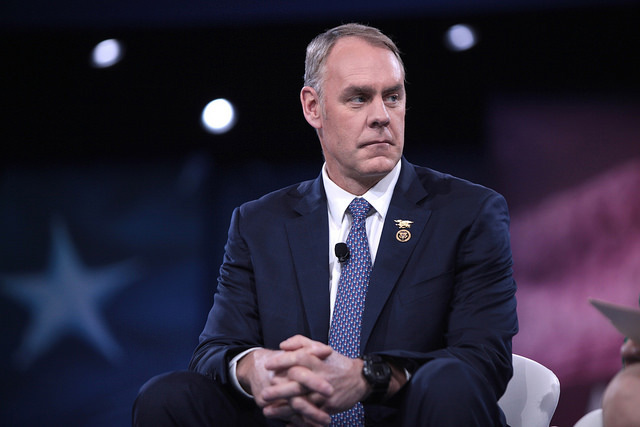
President Trump’s Secretary of the Interior was confirmed on Wednesday by the Senate.
Rep. Ryan Zinke (R-Mont.) was approved by the upper chamber in a 68-31 vote, with 17 members of the Democratic Caucus backing his nomination.
Senate Minority Leader Chuck Schumer (D-N.Y.) spoke out against Zinke’s selection before the vote, casting doubt on the Congressman’s prior pledges to oppose the sale of public lands. The Department of the Interior oversees, among other agencies, the country’s National Park Service.
“You can’t be a Roosevelt Conservationist, when you vote to make it easier to sell off public lands,” Schumer said.
Zinke, an avid outdoorsman, claims to be for the preservation of parks, in the mold of NPS-founder, former Republican President Theodore Roosevelt. He has stated repeatedly that he opposes the privatization of public lands, but has voted twice in the past year to make that process easier.
During his confirmation hearing, in January, Zinke was asked about one of those votes by Sen. Martin Heinrich (D-N.M.). Heinrich had pointed out the vote took place just weeks prior to the hearing, at the start of the current session of Congress.
Zinke told Heinrich he would not have supported the proposal, which pertained to land valuation, if it had been brought up as stand-alone legislation.
“I think I voted seventeen times against either transfer or sale of public land,” he told Heinrich. The senator ended up voting in favor of Zinke’s nomination.
Though Zinke says he opposes privatization, he also vociferously supports the Trump administration’s energy agenda, which includes leasing wide swaths of public lands to the fossil fuel industry.
“The president-elect has said that we want to be [energy] independent,” Zinke said. “It is better to produce energy domestically under reasonable regulation than watch it be produced overseas with no regulation.”
“The war on coal, I believe is real,” he also stated, referring to right-wing criticism of Obama-era policies, including a ban on Interior leases to the coal industry. President Trump is expected next week to issue an executive order, reversing the moratorium, according to Reuters.
Zinke’s views on climate change also came up during the confirmation process. He denied believing, as Trump has claimed, that human-influenced warming is actually “a hoax.”
“I think where there’s debate is what that influence is and what we can do about it,” Zinke told Sen. Bernie Sanders (I-Vt.), during the confirmation hearing.
“There’s debate on this committee,” the senator responded, “but not within the scientific community.” Sanders ended up voting “no” on Zinke’s nomination.
Important Message: Please Read
For 25 years, Truthout has survived by publishing impactful investigative journalism and analysis; distributing full editions 365 days a year; and building a community of readers who support us with small, hard-earned donations.
Eighty percent of our $3 million yearly budget comes from small donors alone. Of those, 8,000 readers support us with monthly donations. Back in 2018, when Facebook decided to suppress the circulation of posts made by organizations, thereby cutting readers off from seeing many articles shared by the news organizations they had intentionally decided to follow, Truthout’s total traffic declined by 40 percent, as nearly all of our traffic from that platform disappeared.
Now, Google has recently rolled out its AI search bar, providing AI summaries instead of directing readers to our site. Google Search is our single largest source of traffic; it’s the route by which nearly one third of our readers find us. Much like in 2018, a shocking 40 percent of our Google traffic has disappeared overnight.
It will not be easy for Truthout to shoulder this blow. Nor will it be easy for our peers and collaborators — news sites that depend on traffic and aren’t bankrolled by large corporations.
If you can support Truthout with a donation today, you can help us resist the AI onslaught. Please give today.