Truthout is a vital news source and a living history of political struggle. If you think our work is valuable, support us with a donation of any size.
As war on Iran rages again, and tired rhetoric of “Iranian sleeper cells” resurfaces, Iranian American communities are bracing for another round of backlash at home in the U.S. through immigration enforcement.
Last year, ICE agents arrested Mandonna Kashanian while she was picking figs in front of her New Orleans home. She was 64 years old with no criminal record, had arrived in the United States in 1978 and lived in New Orleans for 47 years — volunteering with Habitat for Humanity and raising a family of U.S. citizens. She was then detained by ICE without due process and released only after Republican House Majority Leader Steve Scalise personally intervened. Her community showed up. She was lucky. Most Iranian Americans have not been so lucky.
Her arrest followed the first round of illegal, unprovoked Israeli airstrikes on Iran last June. In just one week after that June war, federal immigration authorities took 183 Iranians into custody — up from just five the week before, according to data included in a report I contributed to last October in Prism. The pattern is unmistakable: The more war we have with Iran, the more we dehumanize and abuse Iranians here — and in the times that U.S. bombs have fallen on Iran, ICE has arrested and abused Iranians en masse in the United States. As of September 2025, 320 documented final orders of removal had been issued to Iranians; 83 cases were heard in California courts and 28 deportees were residents of Los Angeles County alone — the heart of the largest Iranian American community in the country.
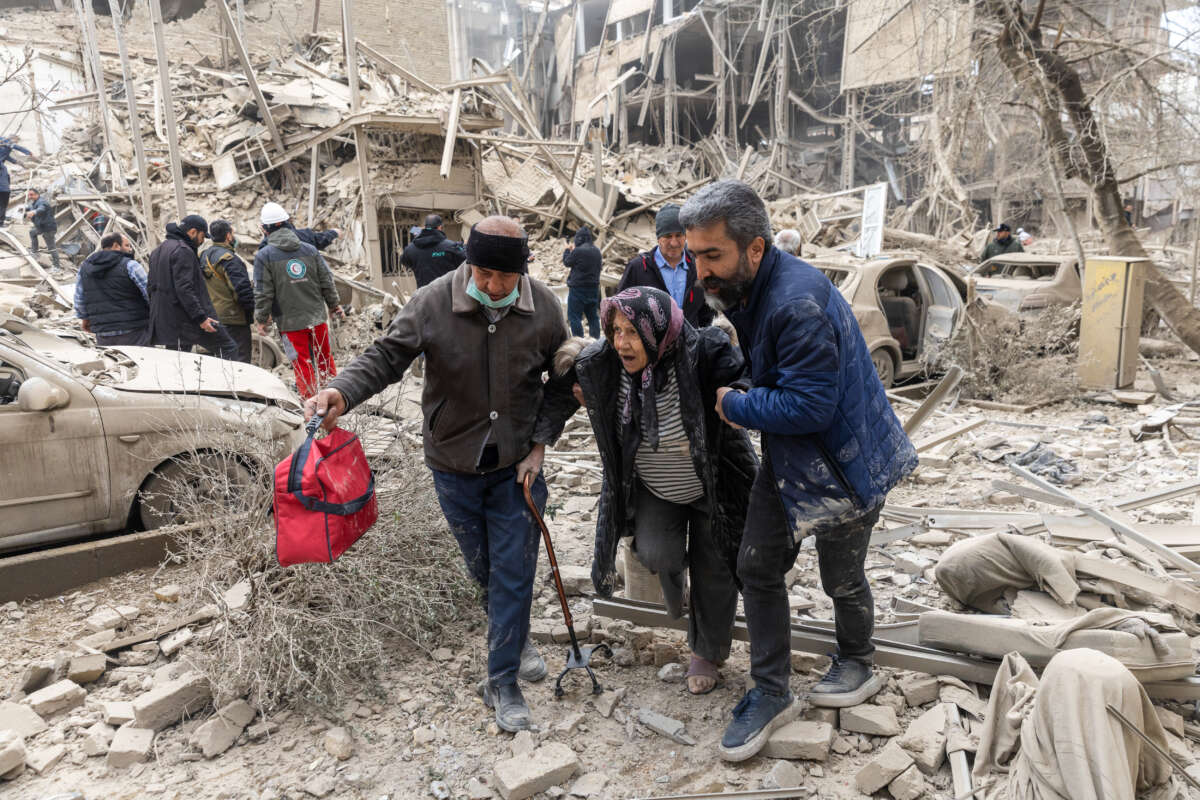
That is a two-front squeeze on the community — an authoritarian Iranian government repressing Iranians in their homeland and a U.S. government arresting and deporting them, while carpet bombing their families, hospitals, cultural heritage sites, and elementary schools. This constant state of pain defines what it means to be Iranian in the U.S. right now. And it demands to be said plainly: the targeted, coordinated assault on Iranian American civil rights is an emergency right here in the United States.
How Has Trump Assaulted the Civil Rights of Iranians?
The administration’s legal assault on Iranian Americans predates the illegal, unprovoked February 2026 bombing campaign by nearly a year. In June 2025, President Trump signed a proclamation placing a full travel ban on nationals of 12 countries, including Iran. In December 2025, that ban was expanded under a new proclamation effective January 1, 2026. Under the expanded ban, the State Department paused all immigrant visa processing for 75 countries, with Iran among those most severely affected. Over 100,000 visas had been revoked since Trump returned to the presidency — a record for a single year.
The more war we have with Iran, the more we dehumanize and abuse Iranians here.
In December 2025, U.S. Citizenship and Immigration Services (USCIS) issued guidance suspending the adjudication of all immigration benefit requests — green cards, naturalizations, and asylum cases — for nationals of travel ban countries. The practical result is that an Iranian permanent resident who has lived here for decades, raised children, paid taxes, and passed a citizenship exam cannot currently apply to become a U.S. citizen. Avideh Moussavian, the former chief of the Office of Policy and Strategy at USCIS, described the purpose plainly: “The goal is to send a message of invoking fear, to make people afraid and to deter people. So, you have people who think they should be going through the process, they should be fine, and then they are being pulled out of the line for their oath ceremonies. What message does that send to other people?”
Then, in February 2026, with no press conference or public announcement, the administration eliminated the refugee pathway for Iranian religious minorities entirely — abandoning thousands of Baha’is, Christians, Jews, and others who had relied on that channel as a lifeline out of a country where they could face repression.
The Deportation Flights
Since September 2025, the Trump administration has conducted at least three rounds of deportation flights returning Iranian dissidents and asylum seekers to Iran. These flights were made possible through a deal struck directly with the Iranian government — the same government Trump routinely describes as “brutal” and “terrible,” but with which his administration has apparently had no trouble coordinating when the goal is kidnapping and removing Iranians from U.S. soil. There are no formal diplomatic relations between the United States and Iran, which makes the existence of this repatriation arrangement all the more unique.
Among those on the first deportation flight in late September 2025 was an Iranian political dissident who had been detained in Houston; his immigration attorney, Ali Herischi, says his client was forced onto the plane against his will, a claim echoed by the man’s wife.
In November 2025, after submitting a Freedom of Information Act request for data on the deportations and receiving no response, the National Iranian American Council filed a lawsuit against ICE to force the agency to disclose how and why it was deporting Iranians — including people with credible fears of reprisal from a government known to torture and execute dissidents. When secrecy puts lives at risk, it is unlawful — and the council intends to force the full record into the light.
A second charter flight carrying Iranian nationals under the same U.S.-Iran deportation arrangement departed in December 2025. A third removal flight followed in January 2026, as Iranian security forces were carrying out an unprecedentedly lethal crackdown on nationwide protests under an extended internet blackout that left thousands of demonstrators dead and obscured the full scale of the killings. The National Iranian American Council called urgently for that flight to be halted, noting that forcing people back to Iran under those conditions “shocks the conscience and violates basic principles of human rights and non-refoulement.”
Faces Behind These Policies
Reza Zavvar came to the United States legally at age 12, in 1985. He built a life here over four decades — asylum, green card, family in Maryland. On June 28, 2025, ICE agents arrested him outside his home while he was walking his dog. He was transferred from Baltimore to Ohio, then back to Baltimore and to Louisiana, spending 77 days in detention before his release. He described the experience as “unnecessary, inhumane, corrupt.” The government’s stated basis was a marijuana misdemeanor from the 1990s, effectively resolved by a court in 2007. Forty years in America. Seventy-seven days in a cage.
Sharareh Moghadam is 55 years old, a Baha’i who fled Iran after facing religious persecution. She spent more than 10 years in the United States legally, obtained a green card, passed her citizenship exam, and arrived in August 2025 at what she understood to be her naturalization oath ceremony — the culmination of over a decade of compliance and patience. ICE agents were waiting for her. She was transferred to a detention facility in Phoenix. Her husband, Hooshang Aghdassi, who has run a balloon shop with her on Laurel Canyon Boulevard for years, told reporters outside: “Years ago, for us, the dream was the U.S. is a land of opportunity and freedom, and it was, but right now you can see everything changed. You don’t feel secure anymore.”
Sharareh Moghadam arrived in August 2025 at what she understood to be her naturalization oath ceremony — the culmination of over a decade of compliance and patience. ICE agents were waiting for her.
Then there is the woman in California — adopted as a 2-year-old from an Iranian orphanage by a U.S. Air Force veteran who had been a prisoner of war in Germany during World War II and who brought her home from Iran in 1973. She was raised in the United States as a Christian and has no criminal record. Her parents, who never completed her naturalization, are dead. This February, DHS notified her that she is subject to deportation because she overstayed her visa in March 1974 — when she was 4 years old.
And lastly, there is the case of Pejman Karshenas Najafabadi. He was 59 years old and died on March 1, 2026, at Merit Health Hospital in Natchez, Mississippi — the day after U.S. airstrikes resumed under what the administration called “major combat operations.” He was the eleventh person to die in ICE custody since January 1 of this year, the third in a single week. Thirty-two people died in ICE detention in 2025 — the highest annual total in over two decades, nearly triple the 11 recorded the year before. At the pace set in the first 10 weeks of 2026, this year is on track to surpass even that record.
What “Help” Might Look Like
The current policy of war has better diplomatic alternatives, supported by the majority of Iranian Americans, and the administration is deciding to destroy most of those alternatives. The 2015 Joint Comprehensive Plan of Action — the Iran nuclear deal, known as the JCPOA — placed rigorous, internationally verified limits on Iran’s nuclear capabilities and created conditions for expanded diplomatic engagement. Under the JCPOA, the Obama administration was able to significantly expand visa processing and family reunification for Iranian Americans. While the JCPOA did not include immigration or refugee provisions, the atmosphere of diplomatic opening it created gave Iranian civil society slightly more room to breathe — reformers gained modest political space, students found expanded opportunities to study in the United States, and Iranians seeking refuge faced fewer bureaucratic barriers.
As another recent Truthout piece by Stephen Zunes makes clear, Iran’s nuclear program “would not have even been an issue had Trump not unilaterally pulled out of the 2015 nuclear deal.” A deal that keeps diplomacy alive is better for Iranian democracy, Iranian human rights, and the Iranian American community than a war that forecloses all three.
As recently as February 27, 2026, an Omani mediator reported that a new nuclear agreement was “within reach.” The next day, the bombs fell on Iran. The diplomatic pathway was scrapped for a military one that cannot deliver what it promises — and history is unambiguous on this point. As Kourosh Ziabari has reported from Los Angeles, even many in the Iranian diaspora who initially celebrated the military action have grown quietly ambivalent as the civilian toll mounts and immigration raids continue to target their neighbors, family members, and fellow community members at home.
“Years ago, for us, the dream was the U.S. is a land of opportunity and freedom, and it was, but right now you can see everything changed. You don’t feel secure anymore.”
What real solidarity with the Iranian people would actually require is this: Restore basic visa processing for Iranians’ asylum access. Restore the refugee pathway for religious minorities. Halt the deportation flights. Drop the USCIS processing freeze. Restore visa processing for Iranian families separated by the travel ban. And — above all — work toward the preservation of life and dignity, for the protection of civil society in Iran, and for the preservation of the legal pathways that allow Iranians fleeing persecution to reach safety here, the way my dad did. Iranians do not want to live under bombardment. They have not been asking for deportation flights to Tehran. They have not been asking for their neighbors to be arrested in their front yards. None of those things are compatible with a democratic space — not in Iran, and not in the United States.
How Do We Move Forward?
The oldest and largest grassroots Iranian American civil society organization in the country, the National Iranian American Council (also where I work) has been tracking what is being done to this community in real time — the council maintains an active ICE community tracker, an immigrant justice resource center, runs frequent know your rights trainings, deportation defense workshops, and direct legal support for families facing removal. This is all the more crucial as Iranian Americans are systematically targeted by ICE.
Our communities are being squeezed from both sides — by a government in Tehran that has repressed and brutalized them for decades, and a government in Washington that has conscripted their suffering into the justification for an ongoing brutal, illegal, aimless war while treating Iranian Americans as an expendable class of residents on American soil.
Roozbeh Farahanipour, a dissident who fled Iran in 1999 and sought asylum in the United States a year later, put it to Kourosh Ziabari this way: “Of course, the Islamic Republic Foreign Ministry loves to take everyone back. They are happy to pay you for the airfare to take these people back and prosecute them over there.”
Sharareh Moghadam passed her citizenship exam and was then detained at what she believed was her oath-swearing ceremony. Reza Zavvar spent 77 days in detention for a misdemeanor from the Clinton era. Planeloads of Iranians dissidents and asylum seekers have been sent back to Iran. And still, the president of the United States has told reporters, “All I want is freedom for the people.”
An urgent appeal for your support: 5 Days to raise $34,000
Truthout relies on individual donations to publish independent journalism, free from political and corporate influence. In fact, we’re almost entirely funded by readers like you.
Unfortunately, donations are down. At a moment when independent journalism is urgently needed, we are struggling to meet our operational costs due to increasing political censorship.
Truthout may end this month in the red without additional help, so we’ve launched a fundraiser. We have 5 days to hit our $34,000 goal. Please make a tax-deductible one-time or monthly donation if you can.