Honest, paywall-free news is rare. Please support our boldly independent journalism with a donation of any size.
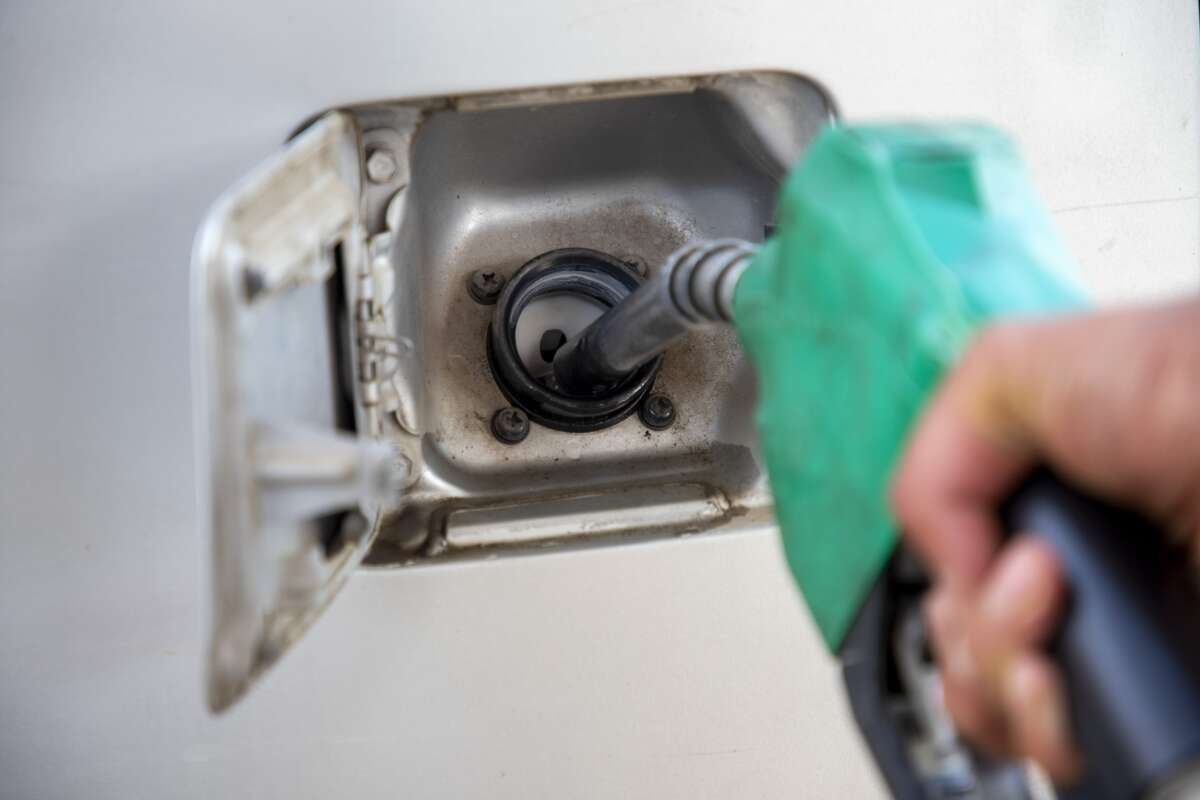
As Americans struggle to afford rising prices at gas pumps across the U.S., President Donald Trump is promoting the idea of a federal gas tax “holiday” — but experts widely agree that the best way to lower gas prices is to end the war on Iran.
As of Wednesday, prices for regular grade gasoline stood at $4.511 per gallon, on average, across the country. That number is nearly 54 percent higher than where prices were one week before the U.S. and Israel launched a joint military offensive against Iran.
Prices have gone up due to blockades of the Strait of Hormuz, through which one-fifth of the world’s oil usually travels.
Trump has spent the past several weeks dismissing Americans’ concerns about higher gas prices, at one point saying they were “not very high” after they passed the $4 per gallon mark. But in an interview with CBS News on Monday, Trump acknowledged that prices were on people’s minds, and suggested that he might be in favor of a federal gas tax holiday.
“I think it’s a great idea. We’re going to take off the gas tax for a period of time, and when gas goes down, we’ll let it phase back in,” Trump said during the interview.
The suspension of the gas tax would require passage of a bill through both houses of Congress, and bipartisan support to defeat a Senate filibuster. It’s unclear if Trump could secure the votes for such a measure, as members of his own party have expressed skepticism over the idea.
“We’ll see where our members are, and if the president wants to make an argument in support of that, I’m sure everybody will give him a chance and hear him out,” Senate Majority Leader John Thune (R-South Dakota) said.
Importantly, suspending the gas tax for just five months would result in the loss of $17 billion in revenues for the Highway Trust Fund, which provides money to localities and states for the repair and construction of roads and bridges. Without such repairs, bumpier roads, too, could make matters worse — as road conditions deteriorate, gas mileage also decreases, which would mean consumers would end up buying more gas and paying more anyway.
The suspension of the gas tax wouldn’t do much to counter the brunt of the price increases, either, as it would only reduce the price of regular grade gasoline by about 18.3 cents and diesel by about 24.3 cents. For regular grade gasoline, that reduction amounts to just 4 percent of the total costs of a gallon of gas, and just under 12 percent of the total cost increases since February.
Democratic Senate Leader Chuck Schumer (D-New York) didn’t outright say he’d oppose the move, but also indicated that it wasn’t a better option than ending the war.
“Americans don’t need just a few cents back. They need an end to the chaos that sent gas prices soaring in the first place,” he said.
Patrick De Haan, head of petroleum analysis at price-tracking website GasBuddy, also said that ending the conditions that led to higher gas prices is the best solution.
“It’s going to continue going up until either global demand comes down to better match the level of supply that we have, or until the strait reopens,” De Haan told HuffPost.
However, even if the Strait of Hormuz were to be reopened, it wouldn’t result in immediate price reductions.
“It might take the better part of a year for global inventories to catch up to the [months] of oil being blocked by the strait,” De Haan explained.
Trump has said otherwise.
“The gas will go down as soon as the war is over. It will drop like a rock,” Trump said in late April.
That claim is contradicted by the Trump administration’s own reports. An Energy Information Administration (EIA) report this week suggested that, even if the Strait of Hormuz was reopened by late May with normal oil shipments going through it, prices might not go down to pre-war levels for months, perhaps even until 2028.
Per that EIA report, the administration predicts that regular grade gas will remain around $3.88 per gallon, on average, through the rest of 2026. For 2027, the agency said that gas will likely remain around $3.62 per gallon throughout the year, on average.
While those are higher costs than what was seen previously, the alternative — higher prices than currently exist — is also possible, if the war in Iran continues.
An important fundraising appeal: 6 Days to raise $39,000
Thank you for reading Truthout today. We have a brief message before you go.
Unfortunately, donations are down for Truthout at a time when media faces immense pressure. Yet, grassroots media is vital in the fight against Trump’s authoritarian reign. Our mandate to tell the truth, share strategies for resistance, and speak against fascism grows more urgent each day. We must appeal for your support.
If you can support Truthout with a one-time or monthly donation, you will make a significant impact on our work. Please donate during our fundraiser.