Part of the Series
Struggle and Solidarity: Writing Toward Palestinian Liberation
Did you know that Truthout is a nonprofit and independently funded by readers like you? If you value what we do, please support our work with a donation.
Ramallah — While the world’s attention is on the U.S.-Israel-Iran war, the Israeli military has placed the West Bank under a functional lockdown.
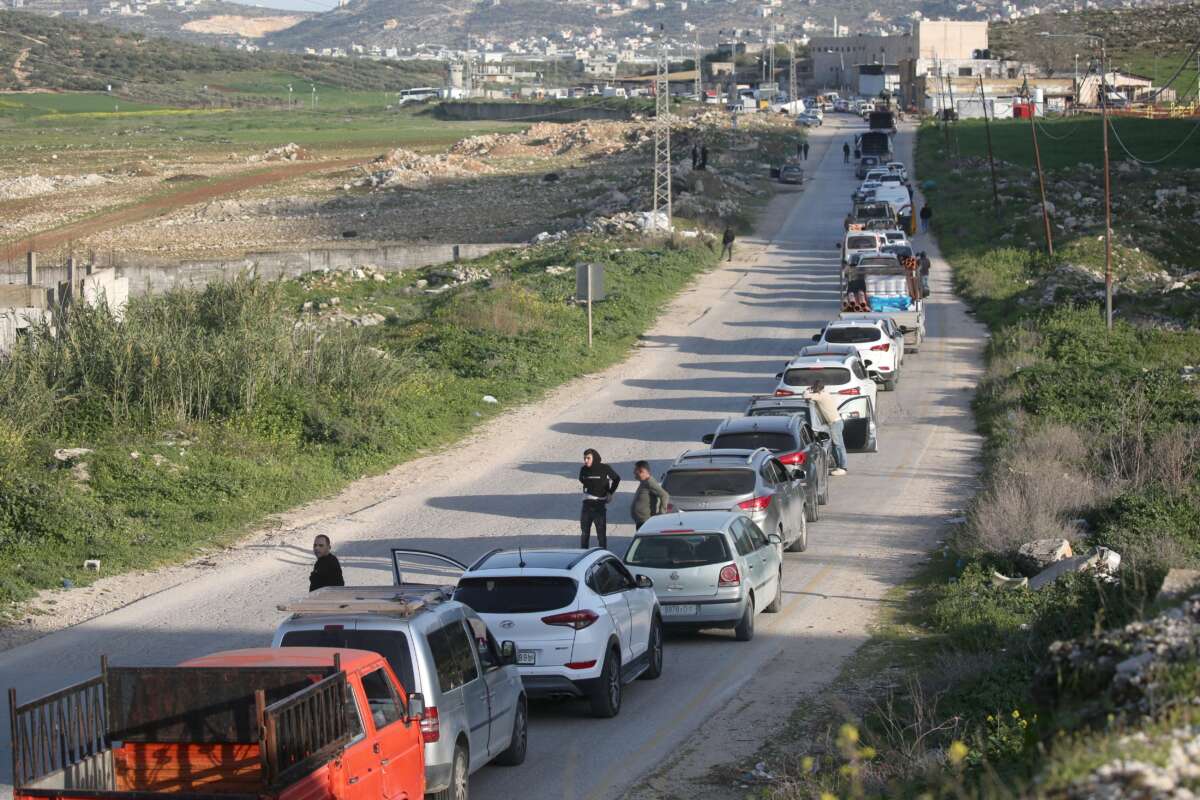
Checkpoints in and out of most major cities are closed, and Palestinians have been left to look for other travel arrangements. Some residents who spoke with Truthout said they traveled for hours through village back roads in an attempt to reach their destinations.
At 12:00 pm on March 2, at the Qalandia checkpoint into Jerusalem from Ramallah, Israel’s air alert system began to ring out, and Palestinians were pushed back from the checkpoint and onto the street, where there is no bomb shelter to protect them.
Explosions continued for the next 15 minutes, with Palestinians gazing up at the sky. The day before, an Iranian missile landed just a few kilometers from the crossing, injuring at least six people, according to a statement from the Magen David Adom, Israel’s national emergency service.
The Palestinian Authority (PA) has alerted West Bank residents to incoming missile strikes, deploying a service similar to Home Front Command in Israel, which alerts Israeli residents with real-time updates, including when to seek shelter.
Checkpoints in and out of most major cities are closed, and Palestinians have been left to look for other travel arrangements.
Shrapnel frequently falls on the West Bank after missile interceptions, and has injured and even killed Palestinians in the past, which has led the PA to declare a state of emergency, shifting schooling to remote learning and issuing a stern statement.
The U.S. and Israeli attack on Iran, which has quickly spiraled into a regional conflict after joint U.S.-Israeli headhunting strikes eliminated the upper echelons of the Islamic Revolutionary Guard Corps leadership, has created a fog of war that has allowed Israel to further cement control of the West Bank.
Khaled Abu Ahmed, who is from Ramallah but has family in Miami, told Truthout, “Trump and Netanyahu have both ruined their countries. Look at what we are living through here; someone has to stop them.”
According to the United Nations Office for the Coordination of Humanitarian Affairs, as of May 2025, there were 849 checkpoints across the occupied West Bank, with yellow gates blocking roads comprising about a third of the total checkpoints. Many have been installed in the wake of October 7, further restricting Palestinians’ freedom of movement in the occupied territory.
Human rights activist Issa Amro told Truthout that many of the gates had been closed since the first alert sounded Saturday morning.
Footage obtained by Truthout, courtesy of Sami Huraini — a human rights activist based in Hebron who founded the grassroots nonviolent resistance group known as Youth of Sumud — showed Palestinians forced to walk under closed yellow military gates on the way to the hospital, with Palestine Red Crescent Society vehicles waiting on both sides.
The U.S. and Israeli attack on Iran has created a fog of war that has allowed Israel to further cement control of the West Bank.
Yellow military gates, which allow the military to control movement in and out of villages and along main thoroughfares, are ubiquitous throughout the West Bank. They are used by both settlers and the Israeli military to close access in response to attacks from armed groups in the West Bank, or at their discretion.
Yotam Wiseman, a human rights activist with Torat Tzedek, an Israeli human rights organization working to document and prevent settler attacks in the West Bank, told Truthout, “Meanwhile, one of the exits from Mukhmas was blocked with concrete blocks, at a spot that was blocked by settlers many times in the past. This time we don’t even know if this was done by the army or by settlers.”
Settler attacks continue daily undisturbed. “A Palestinian I know was injured from stone-throwing near his business in Mukhmas,” Wiseman said. “At the same time, three other activists, Palestinian residents and I were assaulted in Duma. One of us was choked, two were pepper-sprayed and kicked, a Palestinian received a head injury, and an elderly Palestinian woman was pepper-sprayed.”
Despite the terms of the ceasefire agreed to by Hamas and the Israeli government, all land crossings into Gaza have been closed indefinitely.
Despite the terms of the ceasefire agreed to by Hamas and the Israeli government, all land crossings into Gaza have been closed indefinitely. Many in the West Bank worry that the Israeli government, as it is doing here, will use the war as justification — with the international spotlight elsewhere — “to finish the job in Gaza,” as one resident described it.
Settler violence continues under the cover of war. The Israeli military recently authorized a call-up of more than 100,000 reserve soldiers due to the conflict with Iran and authorized public transportation on Shabbat for the first time since October 7, 2023.
The Jewish holiday of Purim fell on March 3, and has often correlated with attacks on Palestinian villages, which have been characterized as “pogroms.” This year on Purim, Wiseman told Truthout that the Israeli military forced him and other activists to leave Duma, the Palestinian village where they were staying, declaring it a closed military zone.
Shortly thereafter, according to footage Wiseman shared with Truthout, Israeli settlers invaded the village, destroying residents’ homes and other property — shattering solar panels and tearing down building walls.
In Hebron, in the southern West Bank, Palestinians lined up to purchase gas, fearing shortages due to a prolonged conflict. Israel has imposed import restrictions on gas heading to the West Bank.
The West Bank is not the target of missiles sent by the Iranian Revolutionary Guard Corps. However, during the 12-day war last year, the Houthis launched a missile that landed in the occupied West Bank, injuring five Palestinians.
In the wake of Ayatollah Ali Khamenei’s killing by joint Israel-U.S. strikes launched Saturday morning, Iran has fired dozens of missiles at targets in Israel and at U.S. military installations across the Middle East, setting off a U.S.-backed regional war.
President Trump said in a piece published in The Atlantic that he would be looking to return to the negotiating table with Iranian leadership, but until then, the strikes have continued.
Even if they are not the target, Palestinians are at risk of injury or death from shrapnel and falling debris. Even a small, centimeter-long piece of shrapnel is enough to kill someone, and Iran has been sending smaller but more frequent barrages that can send shrapnel miles into the air.
There isn’t anywhere for Palestinians to hide. In the West Bank, there are few, if any, bomb shelters. Even in Israel, according to the Association for Civil Rights in Israel, half of the Palestinian population lives in buildings without a bomb shelter.
Even if they did want to respond with alarm, Palestinians in the West Bank lack access to the infrastructure they would need to take the precautions deemed standard in Israel, where there is widespread adherence to safety guidelines issued by the Home Front Command amid the missile attacks.
In Masyoun, a diplomatic neighborhood in southern Ramallah overlooking Jerusalem, residents can hear air raid sirens from the settlement of Psagot, which lies on a hill overlooking Ramallah and from which settlers often come to attack Palestinians.
“We hear it, and we know they [Israelis in the settlement] can go to their shelters, but all we can do is watch the missiles from our balconies,” Fatme Zarour, a Masyoun resident, said.
Media that fights fascism
Truthout is funded almost entirely by readers — that’s why we can speak truth to power and cut against the mainstream narrative. But independent journalists at Truthout face mounting political repression under Trump.
We rely on your support to survive McCarthyist censorship. Please make a tax-deductible one-time or monthly donation.