Honest, paywall-free news is rare. Please support our boldly independent journalism with a donation of any size.
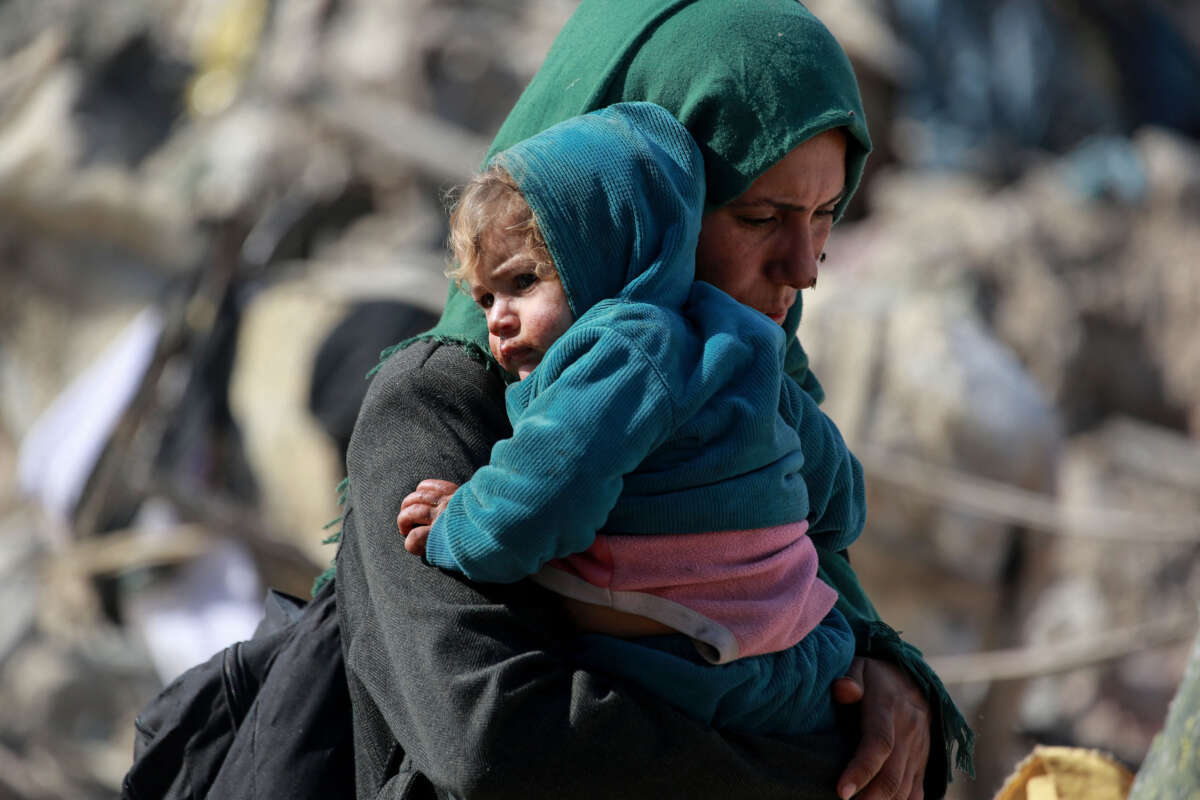
Thousands of babies in Gaza will be put at imminent risk of death if Israel does not lift its near-total humanitarian aid blockade and allow the entry of a flood of food and other basic necessities in the next two days, the UN’s humanitarian chief warned on Tuesday.
“There are 14,000 babies that will die in the next 48 hours unless we can reach them,” said Tom Fletcher, the UN’s under-secretary-general for humanitarian affairs, in an interview on the BBC.
“This is not food that Hamas is going to steal,” Fletcher went on, contradicting Israel’s narrative about humanitarian aid. “We run the risk of looting, we run the risk of being hit as part of the Israeli military offensive, we run all sorts of risks trying to get that baby food to those mothers who cannot feed their children right now because they’re malnourished.”
The interview came after Israel allowed the entry of just five aid trucks into Gaza on Monday — a “drop in the ocean” of what Palestinians need. But any small measure of relief those supplies may bring is moot as even those trucks haven’t reached any Palestinians so far, Fletcher said.
“Let’s be clear, those five trucks are just sat on the other side of the border right now, they’ve not reached the communities they need to reach,” Fletcher said.
Meanwhile, the UN has said that there are thousands of trucks carrying crucial goods like baby food lined up and ready for entry at Gaza’s border, just miles away from the babies Israel is starving.
The UN said that Israel has cleared 100 trucks to enter Gaza on Tuesday — still a far cry from the hundreds of trucks per day that humanitarian groups say are needed to fulfill basic needs and relieve starvation for millions of Palestinians in the Strip.
Though the trucks have theoretically been approved for entry, Israel may still block the trucks from entering the region; indeed, though Fletcher said on Monday that Israel had approved the entry of nine trucks, only five were ultimately allowed in.
The starvation crisis in Gaza is dire, with food insecurity experts warning that the entire region is on the brink of or experiencing famine after nearly three months of Israel’s total aid blockade. It has been over a month since the UN said that its agencies had given out its last food stores in the region, with community kitchens forced to shutter their operations in recent weeks as a result.
Many Palestinians say that the starvation is even worse than Israel’s bombardments, having been starved by varying levels of Israel’s blockade for 19 months and with food costs constantly on the rise. The total aid blockade ushered in the worst conditions of the genocide so far; one Palestinian reporter said in March that children in the region are so hungry that they’re drawing pictures of food in the sand.
The World Food Programme has estimated that there are 14,000 children in Gaza with severe acute malnutrition, a deadly condition marked by a skeletal appearance and extreme weight loss, causing damage that can last a lifetime if untreated. According to an assessment by the UN-backed Integrated Food Security Phase Classification, nearly 71,000 children are expected to experience acute malnutrition in the next year due to Israel’s blockade.
Update: This story has been updated after the UN Office for the Coordination of Humanitarian Affairs clarified Fletcher’s statements after the interview, saying: “We are pointing to the imperative of getting supplies in to save an estimated 14,000 babies suffering from severe acute malnutrition in Gaza, as the IPC partnership has warned about. We need to get the supplies in as soon as possible, ideally within the next 48 hours.”
Important Message: Please Read
For 25 years, Truthout has survived by publishing impactful investigative journalism and analysis; distributing full editions 365 days a year; and building a community of readers who support us with small, hard-earned donations.
Eighty percent of our $3 million yearly budget comes from small donors alone. Of those, 8,000 readers support us with monthly donations. Back in 2018, when Facebook decided to suppress the circulation of posts made by organizations, thereby cutting readers off from seeing many articles shared by the news organizations they had intentionally decided to follow, Truthout’s total traffic declined by 40 percent, as nearly all of our traffic from that platform disappeared.
Now, Google has recently rolled out its AI search bar, providing AI summaries instead of directing readers to our site. Google Search is our single largest source of traffic; it’s the route by which nearly one third of our readers find us. Much like in 2018, a shocking 40 percent of our Google traffic has disappeared overnight.
It will not be easy for Truthout to shoulder this blow. Nor will it be easy for our peers and collaborators — news sites that depend on traffic and aren’t bankrolled by large corporations.
If you can support Truthout with a donation today, you can help us resist the AI onslaught. Please give today.