Honest, paywall-free news is rare. Please support our boldly independent journalism with a donation of any size.
The punishment of John Cheney-Lippold, a University of Michigan professor who declined to write a letter of recommendation for a student who wished to study in Israel, has grown in a particularly ugly and disturbing manner.
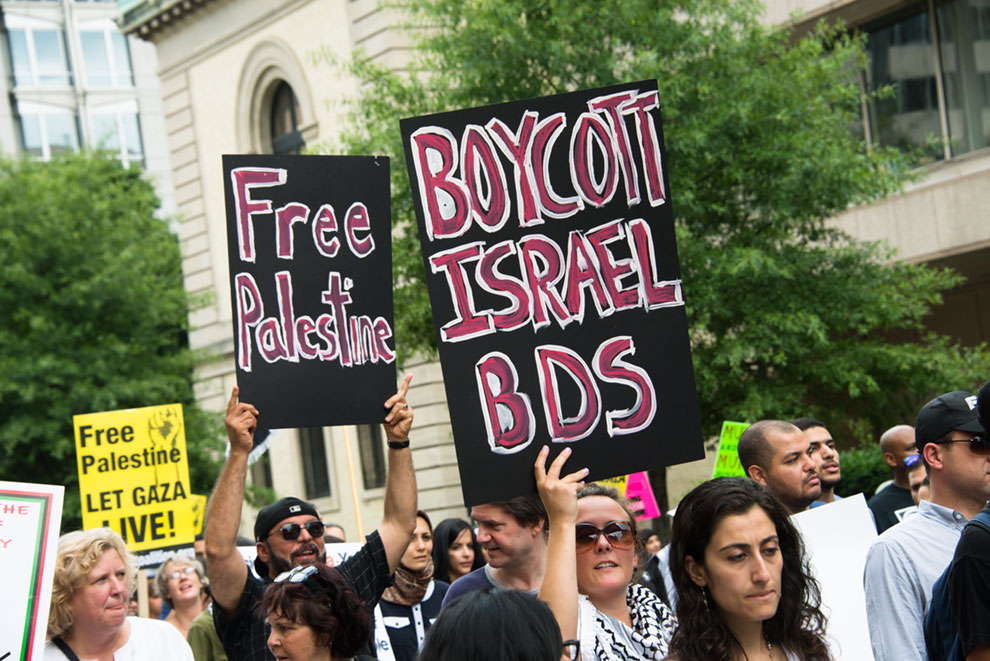
Cheney-Lippold is a supporter of the Boycott, Divestment, and Sanctions movement (BDS) that argues these actions be taken against Israel until it restores full human rights to Palestinians living in Israel, those living in the Occupied Palestinian Territories, and those who were driven from their homes in Palestine in 1948. BDS has been targeted by the State of Israel as a “strategic threat.” Israel is particularly nervous about the gains BDS is making on college campuses.
As I noted in The Washington Post, at the time of Cheney-Lippold’s refusal, the University of Michigan had no rule mandating professors write such letters. I argued that Cheney-Lippold was actually being punished for upholding the non-discrimination policies of his university; it is indeed the case that Israel discriminates against Palestinians and others—among other things, they are refused admission to the kinds of Study Abroad programs Cheney-Lippold’s student wished to attend. This professor’s act of conscience, consistent with not only the University of Michigan’s non-discrimination policies but also with the right to education as enshrined in the Universal Declaration of Human Rights, and his exercise of free speech, which is what the Supreme Court has determined a boycott to be, is nonetheless being attacked in the most outrageous and clumsy manners possible.
To begin with, in order to legitimize their punishment of Cheney-Lippold (he was denied sabbaticals and a merit raise in pay, and is subject to his classrooms being monitored), the University of Michigan mischaracterized policies recommended by the AAUP. The AAUP protested this misrepresentation in a letter to the President of the University of Michigan. They also criticized UM’s lack of due process.
The situation gets even more Kafkaesque.
Seeking the cover of a policy, the UM administration has now convened a committee to invent a policy—while at the very same moment declaring the outcome. Part of its charge is to “recommend how to clarify current policy or create new policy that clearly articulates institutional principles and expectations at the intersection of faculty members’ responsibilities to students and their own personal views.” But if the “principles and expectations” have already been established, why go through the charade of “gather[ing] and review[ing] relevant policy statements of peer institutions, and “gather[ing] input from stakeholders across the university”? The administration has already decided in advance that refusing to write a recommendation is “not a matter of free speech,” that it is categorically wrong, and that it is punishable. All the administration is doing is trying to create the illusion of faculty governance.
Unfortunately the heavy-handed repression of Cheney-Lippold, and anyone who dares to follow suit, is spreading beyond his home institution. An invitation extended to him to speak on his specialty, digital media, has been retracted by Colgate University. It seems that the parent of a Colgate undergraduate got wind of Cheney-Lippold’s lecture (one wonders how he discovered this) and wrote the University to protest.
In another depressingly transparent and ham-fisted instance of bureaucratic mendacity, the chair of the department that invited him issued this contrite statement: “We’ve realized that in order to ensure that Professor Cheney-Lippold’s visit is as productive as possible for our students, we need to take a bit more time to have open discussions about his scholarship, as well as what Colgate’s commitment to academic freedom means in a situation like this,” director of the Film and Media Studies program Mary Simonson said. This from a person who in the same article states: “The invitation was extended to Professor Cheney-Lippold after he published a much acclaimed book in 2017 with NYU Press titled ‘We Are Data: Algorithms and the Making of our Digital Selves.’”
So if this is the case, why now the need to “have a bit more time to have open discussions about his scholarship”? I believe it means, “think of a way to backtrack, deny the value of the scholarship we evaluated with our own eyes, and contrive another narrative to fall in line with the administration.” I have rarely witnessed such a craven act of submission before an administration. It puts the lie to the Program’s attested mission: “We will challenge our students to engage in the critical study of film and visual mass media. We will examine how these media serve as powerful determinants of ideology, identity, and historical consciousness.”
It is clear that Colgate has bought into the notion that criticism of Israel is the same as anti-Semitism. This false equation has been employed cynically. In the same article, senior and CJU/ Hillel President Emily Kahn is quoted as saying, “Chenney [sic]-Lippold’s actions and Saturday’s shooting [at the Tree of Life synagogue in Pittsburgh, Pa.] respectively show the continual rise of anti-Zionism and anti-Semitism in America.” How did the principled decision not to write a letter of recommendation become equal to the murder of 11 people?
The article ends: “Colgate aspires to a shared commitment to learning, inquiry, and community that encourages individuals to listen and speak with care, so that all voices among us are heard.” Apparently “all voices” do not include those who use their voices to draw attention to Israel’s declared goal of being an ethno-nationalist state, one based on discrimination and unequal rights. That is not a message that the administrators of Colgate University and the University of Michigan want to hear.
Important Message: Please Read
For 25 years, Truthout has survived by publishing impactful investigative journalism and analysis; distributing full editions 365 days a year; and building a community of readers who support us with small, hard-earned donations.
Eighty percent of our $3 million yearly budget comes from small donors alone. Of those, 8,000 readers support us with monthly donations. Back in 2018, when Facebook decided to suppress the circulation of posts made by organizations, thereby cutting readers off from seeing many articles shared by the news organizations they had intentionally decided to follow, Truthout’s total traffic declined by 40 percent, as nearly all of our traffic from that platform disappeared.
Now, Google has recently rolled out its AI search bar, providing AI summaries instead of directing readers to our site. Google Search is our single largest source of traffic; it’s the route by which nearly one third of our readers find us. Much like in 2018, a shocking 40 percent of our Google traffic has disappeared overnight.
It will not be easy for Truthout to shoulder this blow. Nor will it be easy for our peers and collaborators — news sites that depend on traffic and aren’t bankrolled by large corporations.
If you can support Truthout with a donation today, you can help us resist the AI onslaught. Please give today.