Support justice-driven, accurate and transparent news — make a quick donation to Truthout today!
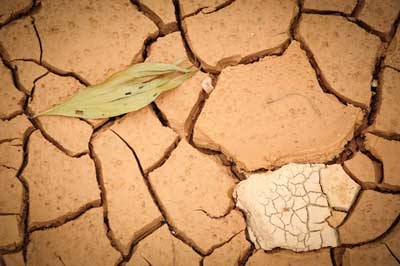 (Image: Food crisis via Shutterstock)The dangers of climate change aren’t down the road; they’re already here. And they’re fueling a global food crisis.
This week, more than 60 scientists from around the world are meeting in Japan, to finish writing a comprehensive report on the impacts and dangers of climate change and global warming.
The report, which is being written at a meeting of the Intergovernmental Panel on Climate Change – the IPCC – seeks to tell global leaders just how bad the climate change problem is right now.
And it’s very bad.
While the report hasn’t been released yet, leaked drafts have been, and they are painting a pretty frightening and disturbing picture.
According to the leaked drafts, the major risks and effects of climate change and global warming are far more immediate then was first thought. And those effects go beyond melting ice, rising temperatures, and threatened species of animals and plants.
Right now, climate change is driving everything from droughts and flooding, to war, disease, and hunger.
In fact, global-climate-change-driven food problems are behind most of the upheavals in the Middle East, from Egypt to Syria.
And, as climate change continues to worsen, those food problems and conflicts will become more widespread, and extend well beyond the Middle East.
That, according to the leaks we’re hearing from this IPCC meeting this week in Japan, should cause the entire world to rethink how we produce our food.
Right now, much of America’s – and the world’s – food is produced by giant agribusiness companies.
Corporations like Cargill, ConAgra, Kraft, and PepsiCo dominate global food distribution, using large-scale homogenous single-product operations.
But as you can imagine, with just a few massive agribusiness corporations controlling food distribution for nearly the entire planet, the process is extremely inefficient, unsustainable, and fragile.
That’s why there are 842 million people struggling with hunger worldwide.
In the face of global climate change and global food crises, common-sense – and now, apparently, the IPCC – tell us that in order to build a more resilient food system and future, we must decentralize global agriculture, break up the big agribusiness giants, and move towards local agriculture systems.
Cities like Detroit have already realized that.
Yes, the same city where the economy is in pieces and where people are struggling to make ends meet, has turned into one of the biggest success stories in local agriculture and community gardening.
Entire blocks of run-down and abandoned homes have been knocked down, and turned into community gardens.
In fact, there are now over 300 community gardens across Detroit, and that number is climbing by the day.
And city schools are getting in on the “urban farming” action too. Eighteen schools in Detroit have built school gardens.
In the face of economic despair, Detroiters have found a way to keep food local, to keep money in the local economy, and to remove the influences of giant agribusiness corporations.
And they’re being environmentally friendly, too.
Our current food system, driven by giant agribusiness corporations, is incredibly destructive to our environment. It relies on toxic fertilizers and pesticides, not to mention all the fossil fuels used to grow, fertilize, and transport the food.
But local and organic agriculture doesn’t rely on dangerous pesticides and herbicides, and sequesters carbon in the soil, rather than releasing it into our atmosphere.
And, local, organic agriculture produces higher yields and higher quality food too, which simply can’t be matched by giant agribusiness corporations.
Climate change is making it abundantly clear that we need to rethink and reinvent our global food systems. The age of a few giant agribiz corporations controlling most of the world’s food supply should come to an end.
Here in America, we can use the Sherman Act to break up giant agribusiness corporations, and the giant banks whose speculation is constantly increasing food prices. A few companies shouldn’t hold the fate of billions of people in their hands.
And we need to encourage more local agriculture across America and around the globe.
Put control over food production and distribution back in the hands of the people.
Every home in America should have a garden, so that entire neighborhoods and communities can become more resilient and self-sustainable.
It’s time to break the corporate stranglehold on our food system, and in the process help combat global warming.
We lost 15 percent of our traffic overnight.
We now have three full months of data since Google changed its search to feature AI results. The numbers are worse than we anticipated. Overall readership that comes to Truthout through Google is down 54 percent against last year. The number of new readers who discover Truthout via Google searches is down 49 percent, and returning users from Google are down 51 percent.
We lost 15 percent of our readership overnight. This was a readership we painstakingly built over decades, and it vanished because Google chose corporate greed over a healthy democracy.
We anticipate a loss of roughly $500,000 in online revenue as a result of this massive traffic plunge in the next year alone.
The only way we can keep publishing is with strong reader support. We are asking you to start a monthly donation to Truthout today — anything you can do, whether $5 or $25, makes a difference.