
Support justice-driven, accurate and transparent news — make a quick donation to Truthout today!
On Tuesday, New Yorkers will take part in a presidential primary that’s getting an unusual amount of attention, both from candidates and media.
A combination of state party rules and an antiquated New York law governing ballot design has led to the following potentially confusing ballot in New York City for those voting in the Democratic primary (this issue does not exist on the Republican primary ballot, and the Democratic ballots outside of New York City have a different layout):
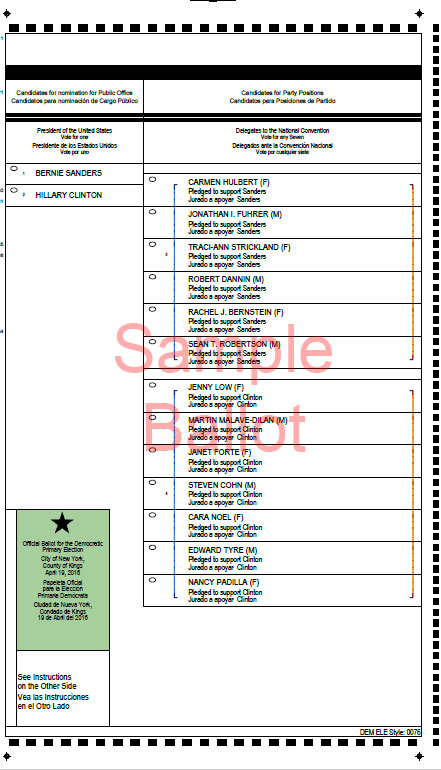
If you read nothing else, know this: the winner of the primary will be determined by the votes in the left column, for the candidates themselves. The column on the right is to help determine which delegates will attend the party convention.
At first glance, it’s not necessarily clear what voting for a candidate versus for a delegate accomplishes — and unfortunately, the ballot’s instructions do not provide much guidance.
Let’s break down how it works: the left column is easy enough — you vote for the presidential candidate of your choice. The outcome of the Democratic primary will be determined by this column.
The right side is where it gets tricky. Voters are asked to choose who, among a candidates pledged delegates, will attend the party’s convention. Voters may select up to a certain number of delegates in their district (in the above sample, a voter may select up to seven).
Within each district, the delegate spots will be allocated proportionally between the candidates. So if six delegates are available in a district, and it turns out that each candidate gets three delegates each, the top three delegates pledged to each candidate would go to the convention. This is what the delegate vote determines — choosing a delegate or delegates pledged to a candidate does not cast a vote for that candidate.
Setting aside the merits of such a system, it is presented on the above ballot with little explanation and laid out in an unclear way. This is not a new problem, but rather the latest in a series of unclear New York ballots, like those with candidates from different parties in the same column, which in the past have led to lost votes.
Legislation that implements best practices for ballot and machine design (like New York’s proposed Voter Friendly Ballot Act) could go a long way toward preventing future confusing ballots and lost votes.
But that won’t be happen in time for Tuesday’s primary — so Democratic voters should take note before heading to the polls, and lawmakers across the political spectrum should keep this and other examples in mind when thinking about reforming New York’s elections.
And again, on the Democratic ballot, it’s the left column — the one with the candidates themselves — that will determine the outcome of that party’s primary.
Media that fights fascism
Truthout is funded almost entirely by readers — that’s why we can speak truth to power and cut against the mainstream narrative. But independent journalists at Truthout face mounting political repression under Trump.
We rely on your support to survive McCarthyist censorship. Please make a tax-deductible one-time or monthly donation.