Part of the Series
Struggle and Solidarity: Writing Toward Palestinian Liberation
Support justice-driven, accurate and transparent news — make a quick donation to Truthout today!
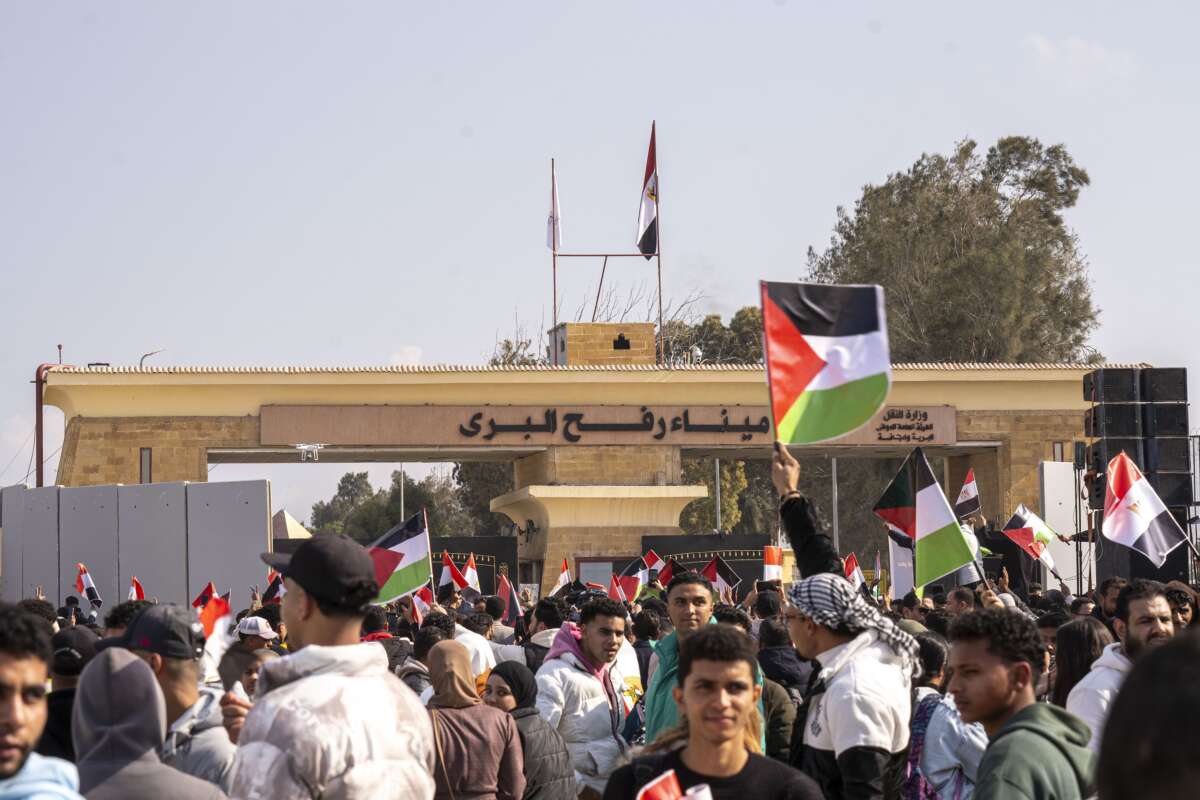
Since the beginning of the Israeli war on the Gaza Strip on October 7, 2023, and until the closure of the Rafah border crossing in May 2024, around 100,000 Palestinians — approximately 4 percent of Gaza’s population — have been displaced to Egypt. Some were forced to leave to receive medical treatment or continue their education after the Israeli war destroyed most schools and hospitals in the Strip, while others left in search of safety. Most of those families thought that their stay in Egypt wouldn’t last for too long; however, the war lasted for two years, and during that period, the future of returning to Gaza remained unknown for those families.
The ceasefire that came into effect in October 2025 included, in its first phase, reopening the Rafah crossing in both directions and allowing Gazans stranded in Egypt to return. However, Israeli Prime Minister Benjamin Netanyahu halted the implementation of this step, citing delays in the return of hostages. He agreed only to open the Rafah crossing in one direction — allowing Gaza residents to leave the Strip while preventing those stranded in Egypt from entering Gaza. Egypt rejected this proposal, considering it a clear violation of the ceasefire plan brokered by Donald Trump.
Following Netanyahu’s visit to the U.S. on December 29, which included talks focused on the next phase of the ceasefire agreement in the Gaza Strip, a U.S. official told The Times of Israel that the Trump administration expects Israel to reopen the Rafah crossing in the coming days, allowing Gaza residents to enter and exit. The official added that the U.S. president and his aides raised the issue during their meetings with Netanyahu.
Talks about the anticipated reopening of the Rafah crossing have divided Gazans in Egypt into two groups regarding returning to Gaza. The first includes families that want to go back to reunite with their relatives, assess the destruction in their neighborhoods, and resume their lives in their homeland, as they cannot afford life in Egypt — especially rent, after their savings have run out — and have been unable to obtain temporary residency permits that would allow their children to attend Egyptian public schools, work, or open bank accounts. The second group consists of families who believe returning to Gaza is impossible given the scale of destruction affecting homes, infrastructure, schools, and hospitals, as well as the lack of basic necessities such as water, cooking gas, and electricity.
Donnya Younis, 23, told me on the phone that the main reason she and her family left for Egypt was the destruction of their home in January 2024 in the western part of Gaza City, combined with the exhausting experience of repeated displacement. “We never imagined the situation in Gaza would escalate to the point where our survival would depend on leaving, but eventually, it did,” she said.
“We had no clear plan for what would happen once we reached Egypt. We were fleeing genocide into the unknown.”
“I had lived in Gaza my entire life. Leaving felt like being torn away from everything I knew: my family, my friends, my university. We had no clear plan for what would happen once we reached Egypt. We were fleeing genocide into the unknown, carrying both fear for the uncertain future and guilt for those we left behind. There isn’t a day that passes without thinking about the life I once had, longingfor places and people I will never see again. Gaza was the only place I ever felt at home,” she added.
Younis expressed a strong desire to return to Gaza, but the main obstacle is that her family no longer has a home. “Reopening the Rafah border must be accompanied by the entry of construction materials so families inside and outside Gaza can rebuild their homes and gradually restore their lives,” she said.
Emad Hamouda, 41, told me on the phone that he and his family evacuated to Egypt in February 2024 so he could secure medical treatment for his mother, who suffers from several illnesses, including diabetes and severe eye infections, and so his eldest son could continue his high school education. “Staying in Gaza meant my mother’s health would continue to deteriorate because medical treatment and medicines were inaccessible, and it would destroy my son’s dream of finishing high school successfully and enrolling in the faculty of dentistry,” he said.
Hamouda continued, “I have never felt like a stranger in Egypt. People there are kind and welcoming, and they always express their solidarity with our cause. In addition, many well-known shop owners from Gaza have reopened their businesses in Egypt, including falafel, shawarma, ice cream, and Arabic dessert shops. This has made me feel as though I am still living in Gaza before the war.”
“Reopening the Rafah border must be accompanied by the entry of construction materials so families inside and outside Gaza can rebuild their homes.”
Regarding his return to Gaza, Hamouda said that before the war began, he owned a luxury car, lived in a home near the beach, and had a stable job. However, the Israeli war destroyed all of that. “If I return to Gaza,” he explained, “I will be forced to live in a tent that offers no protection from the summer heat or the winter cold, and I would struggle daily to secure even the most basic necessities. Returning back is entirely impossible for me at this stage.”
Kamal Al-Kateeb, 50, told me on video chat that he and his family would be among the first to return to Gaza. He explained that life in Egypt has become prohibitively expensive and that he can no longer afford to stay. “I pay $800 a month in rent and about $300 for food and other basic necessities, in addition to my children’s school expenses, which amount to nearly $2,000 per year,” he said.
Al-Kateeb added that his home in the Tel al-Hawa neighborhood is still standing, and that both he and his wife have jobs in Gaza they cannot abandon. “I cannot wait for the moment I am able to return,” he said. “I miss my home, my friends, my family, and everything about Gaza. I fully understand that returning will not be easy, especially with the shortage of even the most basic necessities, but I truly believe that no place in the world can replace Gaza. I hold on to the hope that together we can rebuild Gaza and make it more beautiful than before,” he concluded.
25 Years of Truthout: An important fundraising appeal
This September, Truthout is celebrating 25 years of publication. For over two decades, we have been a trusted source for fiercely independent journalism thanks to readers like you.
As we look to the next 25 years, we have launched a special fundraising campaign. Looking to a sustainable future for our publication, we have a fundraising goal of $71,000 in the next 5 days.
We are asking for your support at this juncture because we face greater threats than ever before in our organizational history. Trump and his MAGA allies are determined to control the information ecosystem, and movement-based organizations are subject to dangerous censorship and scrutiny.
If you can support Truthout with a one-time or monthly donation, you will make a significant impact on our work and our legacy. Anything you can do makes a difference!