Support justice-driven, accurate and transparent news — make a quick donation to Truthout today!
It was 129 years ago last month that the Supreme Court issued its infamous decision that corporations were “people” for purposes of the 14th amendment. And with one fell swoop, “without argument or opinion,” as the late Justice Douglas put it, Santa Clara County v. Southern Pacific Railroad Co., arguably changed the course of our history, for good and for ill.
Today, it is mostly the ill we feel as the rhetoric of corporate personhood bears fruit in deeply unpopular decisions like Citizens United (on corporate political spending) or controversial ones like Hobby Lobby (on religious exemptions for corporations from the duty to provide some contraception coverage for employees).
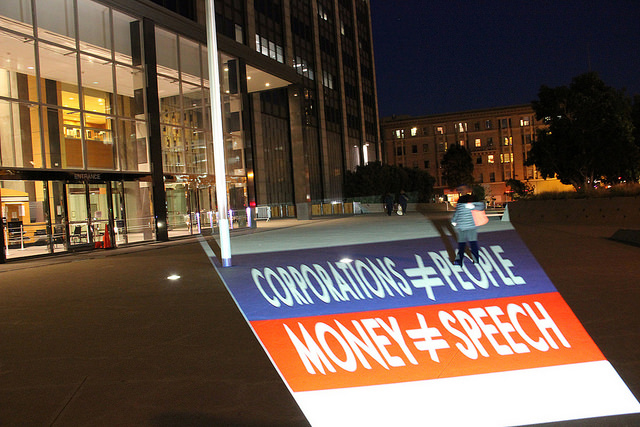
Since public disapproval of decisions like Citizens United and Hobby Lobby rest in large part on the perception that the Supreme Court has held that corporations are entitled to the same rights as human beings, this seems the right moment to ask whether the court may have gone wrong back in 1886: Are corporations just people too?
Mitt Romney may think so, but a majority of the public – from both parties – disagrees. As Linda Greenhouse has observed, Citizens United is “widely disliked … across the ideological spectrum.”
Yet respected legal commentators tell us we should stop “fussing about” corporate personhood. Corporations have been legal “persons” for far too long to go back now. So fixation on corporate personhood is a dead end, it wastes resources and betrays a lack of legal sophistication. If you think personhood is the problem, you are probably just a “naïve metaphysician.”
Moreover, many of these critics claim, a constitutional amendment to “reverse” Citizen United would do more harm than good because it would do away with the parts of corporate personhood that are beneficial – such as being able to sue a corporation if it injures you.
In short, the pushback on the personhood problem is so dismissive and so emphatic that it begins to sound a bit like The Wizard of Oz: “Pay no attention to that man behind the curtain!”
Yet, as in the movie, that is exactly where we need to look because that is where the sleight-of-hand is. Put another way, looking closely at the legal justifications (or lack thereof) for using corporate personhood as a foundation for fundamental rights helps expose that there isn’t really any theory there to answer the questions cases like Citizens United raise. Are corporations really speakers like any other? What public good is accomplished by treating corporations like human beings?
Instead of answering these questions, the Supreme Court has relied on one or more of the following gambits: (1) the Santa Clara approach, just announcing, without justification or guidelines for future cases, that in this particular case, fundamental rights should extend to corporations; (2) the Hobby Lobby approach, asserting that corporations are made up of people who should not “lose” their rights just because they incorporate; or (3) as in Citizens United, arguing that freedom for corporations is really about the public’s freedom to make up our own minds.
The first gambit is not an argument and the other two do not stand up to close inspection.
Yes, corporations are made up of people, but that doesn’t tell us which of these people count for purposes of constitutional rights when, as in Hobby Lobby, the rights of the various people in the corporation are in conflict. And describing corporate speech as a public “benefit” is a stretch when the speech in question (for example, tobacco advertising) may harm the public.
Corporate “personhood” is a metaphor. Metaphors help us to conceptualize difficult, abstract ideas. But they can be dangerous if we forget they are just metaphors, not descriptions. Corporate personhood makes the Supreme Court’s pronouncement that the First Amendment does not tolerate categories of “disfavored” speakers seem self-evidently correct. Yet it is not.
We condemn discrimination against people because it offends human dignity. By contrast, concern for human dignity does not require us to treat all businesses alike: to the contrary, hard experience teaches us that some businesses – drugs, banks, securities, common carriers – require more regulation than others. The tax code “discriminates” between for-profit and charitable organizations without offending anyone’s dignity.
Yet the Supreme Court’s new “corporate civil rights movement” obscures that fact. And it leads to absurd results, as when a judge in Missouri describes a proposed regulation of business as an affront to equal protection comparable to Romer v. Evans (law discriminating against gays).
Voters do not need to be legal sophisticates to know that something is wrong when corporations have more rights than people do. Santa Clara laid the foundation for this “corporate civil rights movement,” which in turn facilitates “oligarchic capture,” a situation in which government serves the interests of money over people. That is bad for democracy. It may ultimately be bad for business as well. The time has come to reassert common sense in the treatment of corporate “persons.” That may require more focus on the personhood concept, not less.
Press freedom is under attack
As Trump cracks down on political speech, independent media is increasingly necessary.
Truthout produces reporting you won’t see in the mainstream: journalism from the frontlines of global conflict, interviews with grassroots movement leaders, high-quality legal analysis and more.
Our work is possible thanks to reader support. Help Truthout catalyze change and social justice — make a tax-deductible monthly or one-time donation today.