Truthout is an indispensable resource for activists, movement leaders and workers everywhere. Please make this work possible with a quick donation.
I was recently alerted to a remarkably stupid attack (and I use that term advisedly) directed at me from the Council on Foreign Relations on the subject of Iceland.
The C.F.R. people take me to task in a blog post titled “ ‘Iceland’s Post-Crisis Miracle’ Revisited” for measuring economic performance in Iceland and the Baltics relative to the pre-crisis peak, which they suggest is some kind of scam. Why not measure relative to the post-crisis trough, under which the Baltics look better?
Oh, boy. Economists have been studying business cycles for something like 90 years, and done comparisons to previous peaks all that time; apparently these guys don’t know about any of that. So let’s try this slowly.
First of all, we think of a recession as a period in which the economy falls below its potential; the natural way to gauge a recovery is to see how much of the lost ground has been regained.
Better yet, compare two hypothetical countries — call them country I and country L. Both suffer from a severe economic setback, but country I does a better job of responding to the shock, so that output falls only 10 percent in I but 20 percent in L. Then both economies recover. In that recovery, output in L grows more from the trough than output in I — but only because the country did so badly in the first place. Yet the C.F.R. people would have us believe that L, not I, is the success story.
Or do a bit of history. The economy in the United States grew 10.9 percent — yes, 10.9 percent — in 1934. The New Deal triumphant! Or maybe not. Real gross domestic product was still about 20 percent below its 1929 level.
So by comparing output to the previous peak I’m doing the obvious, natural thing; the C.F.R. alternative makes no sense.
Oh, and Ryan Avent, the economics correspondent at The Economist, took on in his own blog post another, earlier C.F.R. argument that the Baltics have grown more since 2000. This is a different kind of confusion: mixing up long-run growth in potential with shortfalls below potential. Iceland was and is a rich country; the Baltics were poor countries playing catch-up, which isn’t relevant either way to the crisis story.
One place where I do disagree with Mr. Avent is in his desire to stop talking about Iceland. Yes, it’s a small island exporting mainly fish and aluminum. But you take your natural experiments where you find them. (The economist Milton Friedman made his original case for floating exchange rates in part by invoking the example of, believe it or not, Tangier). Iceland was the only European-periphery country that received huge capital inflows, then responded to the crisis not with a grim determination to stay on or pegged to the euro, but by devaluing. In the process it demonstrated that devaluation is a lot easier than “internal devaluation,” the attempt to regain competitiveness with a fixed exchange rate, which is actually the main point.
Defining Success Down in the Baltics
I still get comments and mail from people claiming that the experience of Latvia and/or Estonia proves that I’m all wrong, or something. Most of the people saying this don’t know anything beyond one or two good numbers they’ve heard. So, here’s what you need to know. Look at the charts on this page on gross domestic product and unemployment.
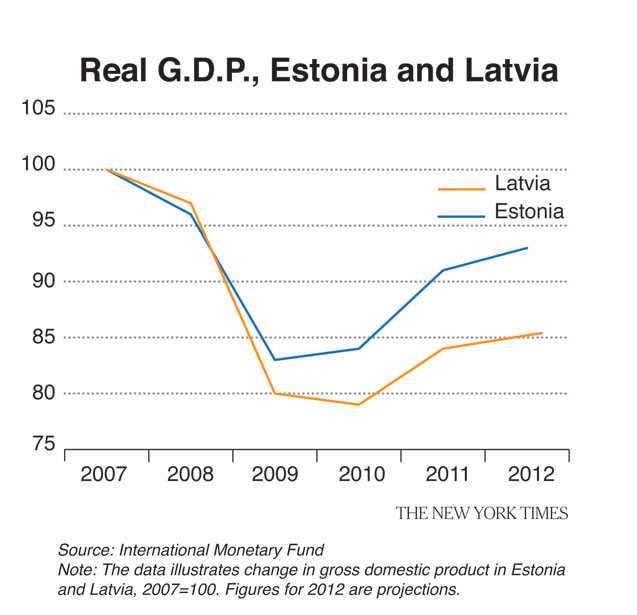
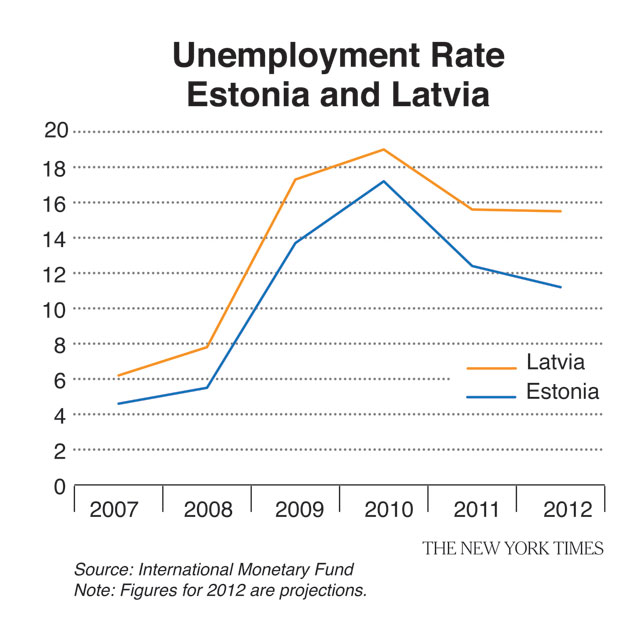
We’re talking about two economies that suffered severe, Depression-level slumps, and have since made up some but not all of the lost ground. You could, by the way, have said exactly the same thing about the United States in 1935.
I mean, obviously it’s good that some ground has been regained. But this is the best people can do to demonstrate the wonders of austerity?
Important Message: Please Read
For 25 years, Truthout has survived by publishing impactful investigative journalism and analysis; distributing full editions 365 days a year; and building a community of readers who support us with small, hard-earned donations.
Eighty percent of our $3 million yearly budget comes from small donors alone. Of those, 8,000 readers support us with monthly donations. Back in 2018, when Facebook decided to suppress the circulation of posts made by organizations, thereby cutting readers off from seeing many articles shared by the news organizations they had intentionally decided to follow, Truthout’s total traffic declined by 40 percent, as nearly all of our traffic from that platform disappeared.
Now, Google has recently rolled out its AI search bar, providing AI summaries instead of directing readers to our site. Google Search is our single largest source of traffic; it’s the route by which nearly one third of our readers find us. Much like in 2018, a shocking 40 percent of our Google traffic has disappeared overnight.
It will not be easy for Truthout to shoulder this blow. Nor will it be easy for our peers and collaborators — news sites that depend on traffic and aren’t bankrolled by large corporations.
If you can support Truthout with a donation today, you can help us resist the AI onslaught. Please give today.