
Support justice-driven, accurate and transparent news — make a quick donation to Truthout today!
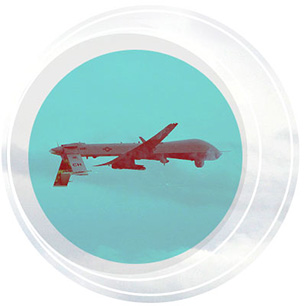 (Image: drsmith7383 / Flickr; Edited: JR / Truthout)The disclosure last week that Obama administration officials are “debating whether to authorize a lethal strike against an American citizen living in Pakistan” makes it more urgent than ever for citizens to ask themselves whether such attacks – in Pakistan, Yemen and elsewhere – are in America’s interest.
Clearly, the drones offer an easy out for military and intelligence agencies. No boots on the ground, no thorny logistic constraints and, if secrecy is maintained, no public outcry. Our Game Boy soldiers can remain safely out of harm’s way.
Yet the case against armed drones is overwhelming. Here are three huge reasons why Americans should strongly oppose drone strikes.
1. They violate international and domestic law. In no way do the drone strikes in Pakistan and Yemen qualify for the self-defense exception to non-aggression. Article 51 of the UN Charter, incorporated into US law by Senate ratification in 1945, authorizes military action only when a country is responding to an “armed attack.” Further, US drone strikes run afoul several provisions of the international humanitarian law. When the United States openly violates international law, it lowers the standard for other countries. The targeting of Americans denies them of their constitutionally-protected due process. Are we ready to abandon our commitment to the rule of law?
2. They kill and otherwise harm innocent civilians. Although the Obama administration would have us believe that the “collateral damage” from drones has been minimal, independent observers have documented more than 2,500 killed in Pakistan alone. Moreover, drones that hover over remote communities 24/7 terrorize the villagers, causing fear and mental distress. Imagine how it would be to live under such a constant threat? What would we think about a country that inflicted such undeserved punishment? To put the question another way: Is resorting to terrorist tactics a morally just way to fight terrorism?
3. They don’t work. Only 2 percent of those killed by the drones have been senior members of al-Qaeda or the Taliban. The short-term successes of the drone strikes (i.e. the taking out a high-profile militant) are far outweighed by the program’s long-term liabilities. We know from first-hand reports of drone survivors that the attacks engender a deep hatred of America. At a Senate hearing in April 2013, Farea Al-Muslimi described a drone attack on his village in Yemen. “The drone strikes,” he said, “are the face of America to many Yemenis.” The September 2012 “Living Under Drones” study by a team from Stanford and New York University law schools concluded that drone attacks help terrorist groups attract new recruits.
When investigative journalists in Pakistan and Yemen report on drone strikes that kill and injure innocent civilians, they risk government retribution. On February 5, 2014, Kareem Khan, a Pakistani known for his vocal opposition to the US drone program, was abducted from his home. Nine days later he was returned with tales of torture and the marks on his body. After investigating a drone strike on a wedding party that killed 12 people in Yemen in December 2013, Baraa Shiban, a local peace activist, received a death threat. Four years earlier, the journalist Abdulelah Haider Shaye discovered a US cruise missile strike that killed 41 people. After his arrest, President Obama reportedly intervened personally with Yemeni President Salah to keep him detained. He was released in July 2013 after serving three years in prison. It’s not difficult to suspect CIA or other American sources for the intimidation of local investigators.
That remote killing is bad policy is further evidenced by the invitation it gives other governments to follow America’s lead. As Medea Benjamin said in a recent Truthout piece, “Drones are dangerous because they are fueling a new arms race.” She reports that “between 10 and 15 nations are working on weaponizing their drones.” Who is to say that America might not someday find itself under al-Qaeda drones that were US-inspired?
That the drone program continues under CIA, rather than Department of Defense, control ensures its continued secrecy and official obfuscation regarding attacks and civilian casualties. How can American citizens evaluate and express sound opinions on the expanding use of military drones if they don’t know the real impact of the program on the ground? President Obama should remove the CIA’s veil and expose the serious harm that drone strikes inflict on America’s interests.
An urgent fundraising appeal: 5 Days to raise $34,000
Thank you for reading Truthout today. We have a brief message before you go —
Unfortunately, donations are down for Truthout at a time when media is under immense pressure. Trump is arresting journalists, Big Tech is censoring independent news, and economic conditions for media have been worsening for years.
Simultaneously, movement media is vital in the fight against Trump’s authoritarian reign. Our mandate to tell the truth, share strategies for resistance, and speak against fascism is ever more urgent in this deluge of political censorship. Yet, we are struggling to meet our publishing costs when our work is so urgently needed.
If you can support Truthout with a one-time or monthly donation, you will make a significant impact on our work. Please give today during our fundraiser (5 days left).