Truthout is a vital news source and a living history of political struggle. If you think our work is valuable, support us with a donation of any size.
The unemployment rate fell to 8.5 percent in December, the lowest level since the 8.3 percent rate reported for February of 2009, the month that Congress approved the stimulus package. The drop was driven primarily by a 0.3 percentage point decline in the unemployment rate for men to 8.0 percent. The unemployment rate for women edged up slightly to 7.9 percent. Over the last year, the gap in unemployment rates between the sexes has virtually disappeared as the unemployment rate for men fell by 1.4 percentage points, while the rate for women only dropped by 0.2 percentage points. The employment-to-population ratio (EPOP) for women has actually fallen by 0.4 percentage points over this period, while it has risen by 0.8 percentage points for men. Overall, the EPOP stands at 58.5 percent, 0.2 percentage points above its year-ago level and 0.4 percentage points above the lows hit in the summer.
White men have gained much more than black men over the last year, with a 1.4 percentage point drop in their unemployment rate to 7.1 percent. For black men, the decline has been 1.1 percentage points to 15.7 percent. The unemployment rate for black women has risen by 0.9 percentage points over the year to 13.9 percent, while their EPOP has fallen 1.6 percentage points.
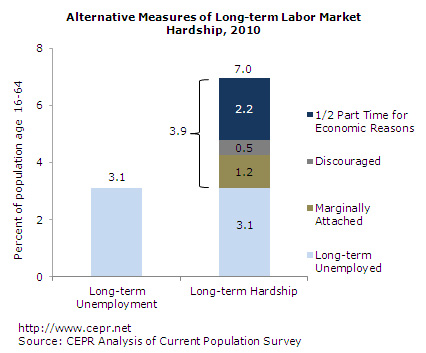
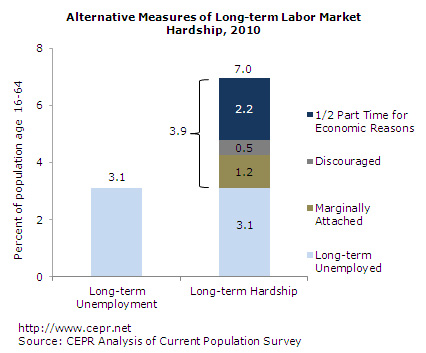
Other news in the survey is mixed. The number of people involuntarily working part-time fell by 406,000, the third consecutive month of sharp declines. On the other side, the unemployment rate due to job leavers fell by 0.4 percentage points, suggesting workers lack confidence in their job prospects. The unemployment duration measures edged down slightly, but did not completely reverse the jump seen in October. The percentage of workers experiencing long-term hardship, a fuller measure that includes people who have left the labor force, is near 7.0 percent, roughly twice the share of workers experiencing long-term unemployment.
The sharp drop in the unemployment rate over the last four months (from 9.1 percent to 8.5 percent) is not consistent with the job growth reported in the establishment survey. The survey reported 200,000 jobs in December; however, this figure is skewed by the 42,200 job gain reported for couriers. There was a similar gain in this category reported for last December, which was completely reversed the next month. Clearly this is a problem of seasonal adjustment, not an issue of real job growth. Pulling out these jobs, the economy created 158,000 jobs in December, in line with expectations.
Pulling out the courier jobs, growth has averaged 145,000 per month over the last four months. This is somewhat better than the 90,000-100,000 a month needed to keep pace with the growth of the labor force, but certainly not rapid enough to explain a 0.6 percentage point drop in unemployment. At this pace, we would not get back to pre-recession levels of unemployment until 2027.
Among the sectors showing good job growth were durable manufacturing, which added 23,000 jobs; retail—27,900 jobs; health care — 22,600 jobs; and restaurants — 24,000 jobs. The manufacturing number is encouraging, but may be a blip as there was almost no growth reported in November. Retail has been adding jobs at a healthy pace over the last four months. Some of this may be the result of more emphasis on the holiday shopping season than in prior years, but growth in the sector is likely to continue. Government employment fell by 12,000, driven by a loss of 14,000 jobs at the local level. This is somewhat slower than the 23,000 rate of job loss over the last year.
Construction added 17,000 jobs in December, but this follows a loss of 27,000 in the prior two months. Most of this movement is likely the result of weather against a backdrop of near flat employment. One discouraging sign is the loss of 7,500 jobs in the temp sector, this does not indicate that employers are about to start hiring in a big way any time soon.
The pattern of weak job growth in the establishment survey suggests that the drop in unemployment reported in recent months is a fluke. We can expect to see rising unemployment in the months ahead.
Important Message: Please Read
For 25 years, Truthout has survived by publishing impactful investigative journalism and analysis; distributing full editions 365 days a year; and building a community of readers who support us with small, hard-earned donations.
Eighty percent of our $3 million yearly budget comes from small donors alone. Of those, 8,000 readers support us with monthly donations. Back in 2018, when Facebook decided to suppress the circulation of posts made by organizations, thereby cutting readers off from seeing many articles shared by the news organizations they had intentionally decided to follow, Truthout’s total traffic declined by 40 percent, as nearly all of our traffic from that platform disappeared.
Now, Google has recently rolled out its AI search bar, providing AI summaries instead of directing readers to our site. Google Search is our single largest source of traffic; it’s the route by which nearly one third of our readers find us. Much like in 2018, a shocking 40 percent of our Google traffic has disappeared overnight.
It will not be easy for Truthout to shoulder this blow. Nor will it be easy for our peers and collaborators — news sites that depend on traffic and aren’t bankrolled by large corporations.
If you can support Truthout with a donation today, you can help us resist the AI onslaught. Please give today.