Support justice-driven, accurate and transparent news — make a quick donation to Truthout today!
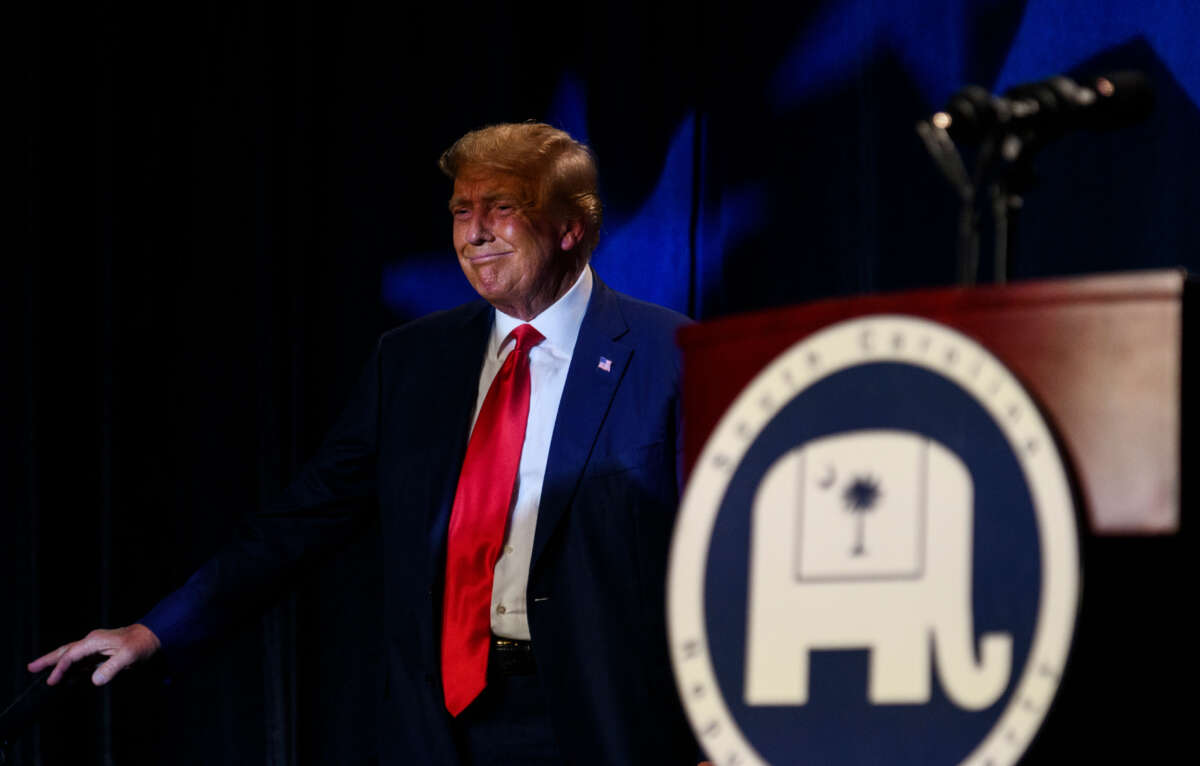
Former president and current presidential contender Donald Trump is refusing to sign the loyalty pledge that is required to take part in the Republican Party’s first 2024 primary debate.
The Republican National Committee (RNC) announced in June requirements for candidates to take part in the debate, which is set to be held on August 24 in Milwaukee, Wisconsin. In addition to reaching polling and fundraising goals, candidates must promise to support the nominee who is chosen by Republican voters in the primary election next year.
Since the RNC announcement, Trump hasn’t indicated whether or not he will abide by the rules — and he’s also failed to definitively state whether he plans to attend the debate at all.
In an interview with Newsmax’s Eric Bolling on Wednesday, Trump suggested that he had no intention of signing the pledge, but left open the possibility that he’d still attend the event.
Trump — by far the frontrunner in the GOP race for the presidential nomination — said that he wouldn’t back certain candidates who are qualified for the debate stage in the unlikely event that they become the Republican nominee.
“I wouldn’t sign the pledge. Why would I sign a pledge if there are people on there that I wouldn’t have?” he said, noting there were about “three or four people” who he wouldn’t back.
Trump also argued that his lead in the polls should allow him to forgo the loyalty pledge altogether.
“Why would you do that when you’re leading by so much?” he said.
When asked about candidates he wouldn’t support, Trump mentioned former Arkansas Gov. Asa Hutchinson and former New Jersey Gov. Chris Christie, who Trump asserted would “ask me nasty questions” at the debate.
The former president also said he was still considering participating in the debates. “I haven’t totally ruled it out,” he said.
Trump was similarly reluctant to sign a GOP loyalty pledge during his first presidential run in 2016. Although he ultimately relented, he later retracted his promise to support the eventual nominee.
That year’s loyalty pledge was not a prerequisite for candidates to be permitted on the debate stage, though they were pushed by party leaders to sign the pledge regardless.
It’s unclear what the RNC will do if Trump refuses to sign the now-required loyalty pledge. If a leading contender for the nomination doesn’t attend the debates, it would likely be viewed as an embarrassment for the RNC, as it would demonstrate Trump’s authoritarian hold over the party if he can win the nomination without abiding by the rules.
An aggregate of polling data shows that Trump leads his nearest Republican contender, Florida Gov. Ron DeSantis, by an average of around 40 points. But if Trump secures the GOP nomination for what would be the third time in a row, he would likely have a difficult time garnering enough support from the American public to win the general election.
Trump’s favorability ratings are low among voters overall, and have dropped slightly since he was indicted in two Department of Justice (DOJ) cases — the Mar-a-Lago government documents case and the investigation into his attempts to overturn his loss in the 2020 presidential election.
According to an Economist/YouGov poll, Trump’s favorability rating was 46 percent in May, with 49 percent of voters viewing him unfavorably. Since the two recent indictments, Trump’s favorability has dropped to 41 percent, with a majority of voters (56 percent) saying they now view him unfavorably.
25 Years of Truthout: An important fundraising appeal
This September, Truthout is celebrating 25 years of publication. For over two decades, we have been a trusted source for fiercely independent journalism thanks to readers like you.
Looking to the next 25 years, we launched a special fundraising campaign. We still need to raise $16,000.
We are asking for your support at this juncture because we face greater threats than ever before in our organizational history. Trump and his MAGA allies are determined to control the information ecosystem, and movement-based organizations are subject to dangerous censorship and scrutiny.
If you can support Truthout with a one-time or monthly donation, you will make a significant impact on our work and our legacy. Anything you can do makes a difference!