Truthout is an indispensable resource for activists, movement leaders and workers everywhere. Please make this work possible with a quick donation.
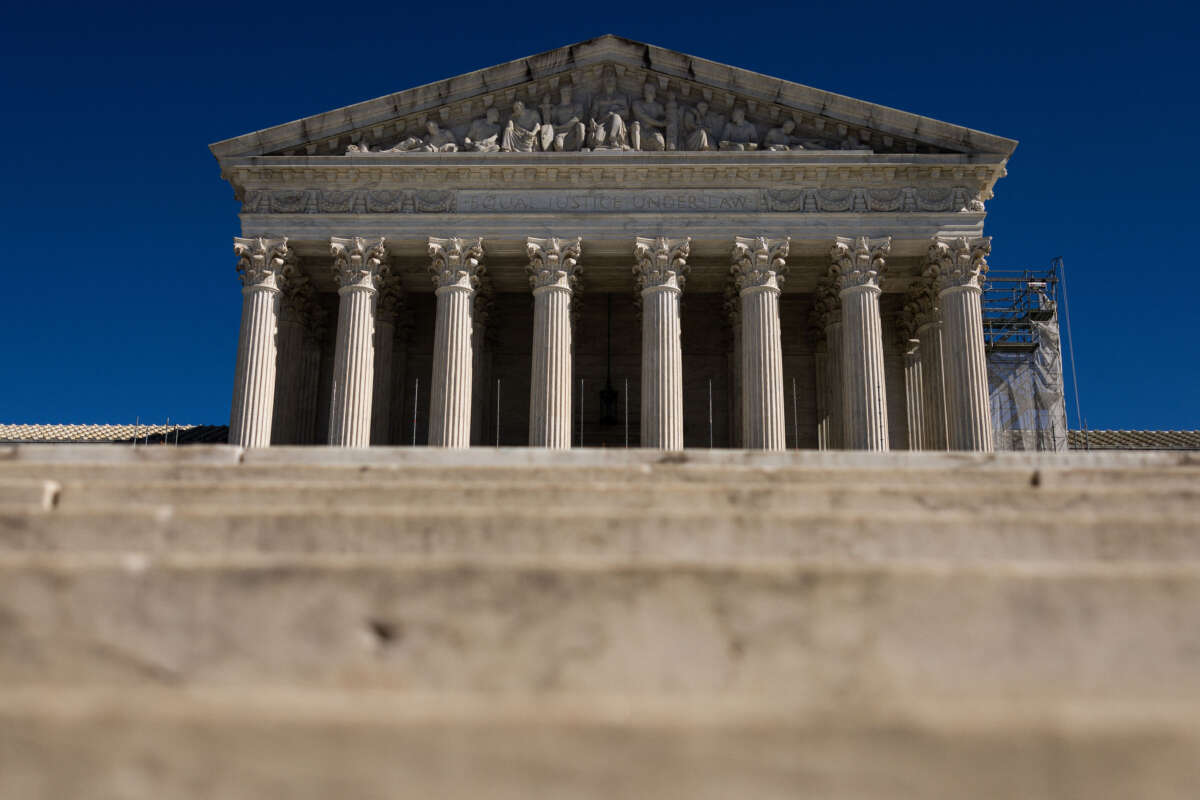
The White House has filed a request to the U.S. Supreme Court for justices to block several stays issued by federal court judges relating to President Donald Trump’s executive order seeking to redefine the birthright citizenship clause of the 14th Amendment to the U.S. Constitution.
Three cases in total have blocked Trump’s order, which aims to end the practice of automatically granting people citizenship if they are born in the U.S. — a right that is recognized by dozens of countries around the globe in their own laws (including nearly every country in the Western Hemisphere). While the filing (officially submitted by acting Solicitor General Sarah Harris) admits that the cases “raise important constitutional questions,” it states that the administration is making a “modest” request — that a stay on their current temporary restraining orders be made in the interim period while arguments are discussed and cases are decided in those lower courts.
Such a stay would allow the Trump administration to disrupt more than 125 years of unchanged precedent that recognizes that a person born in the U.S. is conferred citizenship rights.
Harris’s argument rests on disrupting another important precedent, relating to checks and balances in the government — that of a federal judge’s power to block presidential actions or orders if they are blatantly unconstitutional.
“This Court should declare that enough is enough before district courts’ burgeoning reliance on universal injunctions becomes further entrenched,” Harris wrote in the brief. “The Court should stay the district courts’ preliminary injunctions.”
She added:
Years of experience have shown that the Executive Branch cannot properly perform its functions if any judge anywhere can enjoin every presidential action everywhere.
Trump’s executive order, entitled “Protecting the Meaning and Value of American Citizenship,” was issued on his first day in office. It boldly — and errantly — claimed that “the Fourteenth Amendment has never been interpreted to extend citizenship universally to everyone born within the United States.”
Yet, since the late 19th century, with limited exceptions, that’s exactly how courts (including the Supreme Court) have read the 14th Amendment, which reads that, “All persons born or naturalized in the United States, and subject to the jurisdiction thereof, are citizens of the United States and of the state wherein they reside.”
Many legal experts say that Trump’s attempt to usurp the authority of the Constitution is likely to fail. But if the Supreme Court rules against the idea that district court judges can block Trump’s orders, the case could create contentious precedent nonetheless.
“At the very least, they have an indication that they have a better chance on the injunction question than on the [constitutional question] of birthright citizenship,” Ilya Somin, a professor at Antonin Scalia Law School, told NPR.
“The Supreme Court may well limit the injunctions partially, maybe not to the extent that the Trump administration wants, but [to the extent] that will allow the Trump administration to claim a political victory,” said Stephen Yale-Loehr, a retired law professor from Cornell University.
Such a decision, however, “would cause chaos and confusion as to who was included in the court rulings and who is potentially subject to the birthright citizenship ban” if the injunctions are lifted, even temporarily, Yale-Loehr added.
An urgent appeal for your support: 72 Hours to raise $24,000
Truthout relies on individual donations to publish independent journalism, free from political and corporate influence. In fact, we’re almost entirely funded by readers like you.
Unfortunately, donations are down. At a moment when independent journalism is urgently needed, we are struggling to meet our operational costs due to increasing political censorship.
Truthout may end this month in the red without additional help, so we’ve launched a fundraiser. We have 72 hours to hit our $24,000 goal. Please make a tax-deductible one-time or monthly donation if you can.