Support justice-driven, accurate and transparent news — make a quick donation to Truthout today!
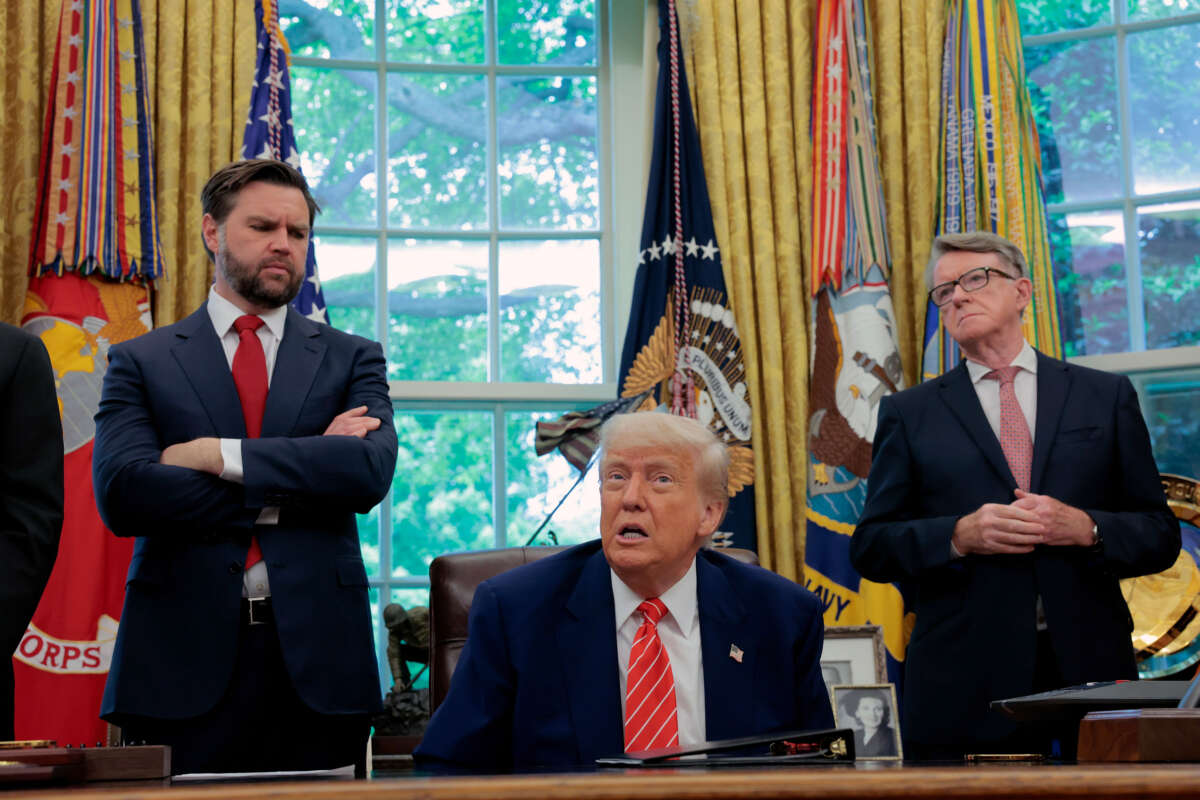
During his announcement of a trade deal with the United Kingdom on Thursday, President Donald Trump dismissed the idea that American consumers will face higher prices on goods still subject to his tariffs.
Several companies have repeatedly indicated (even before Trump was elected in 2024) that any tariffs implemented by Trump would likely prompt them to raise prices. During a press briefing at the White House, Trump was asked by a reporter about two specific companies that have recently expressed similar outlooks.
“With companies like Ford and Mattel recently saying they’re going to raise prices on certain products, how long do you think the American public is gonna be patient?” the reporter asked.
Trump took an incredulous tone in his response. “I think they’re saying that just to negotiate deals with me,” he said.
The president then described tariffs as “the most misunderstood thing” in the world of business, wrongly asserting that consumers wouldn’t see higher prices because of them.
“Oftentimes, the country picks them up. Oftentimes, the company picks it up. The people don’t pick it up,” Trump said, ignoring scores of economists’ predictions on how tariffs will affect the costs of imported goods.
Trump then appeared to threaten companies, telling Ford that they “wouldn’t sell any cars” if prices were raised, and threatening to place a “100 percent tariff” on Mattel if the company moved out of the U.S.
Economists largely disagree with Trump’s views on tariffs, noting that the costs of fees placed on imported goods often get passed onto the consumer, essentially becoming a sales tax for Americans rather than the countries they’re targeting.
Trump’s comments on Thursday contradict his own statement last week, when he told reporters that parents may have to buy fewer toys for their kids for holidays or their birthdays.
“Maybe the children will have two dolls instead of 30 dolls,” Trump said in his remarks just over a week ago. “So maybe the two dolls will cost a couple bucks more than they would normally.”
Most Americans aren’t buying Trump’s claims that the tariffs won’t raise prices.
According to an Economist/YouGov poll published earlier this week, 78 percent of Americans believe tariffs will increase prices for things they buy, with nearly 1 in 2 respondents (48 percent) saying costs will “increase a lot.” Just 8 percent believe tariffs will not affect costs, while 5 percent believe prices will somehow go down as a result of Trump’s tariffs scheme.
Press freedom is under attack
As Trump cracks down on political speech, independent media is increasingly necessary.
Truthout produces reporting you won’t see in the mainstream: journalism from the frontlines of global conflict, interviews with grassroots movement leaders, high-quality legal analysis and more.
Our work is possible thanks to reader support. Help Truthout catalyze change and social justice — make a tax-deductible monthly or one-time donation today.