Support justice-driven, accurate and transparent news — make a quick donation to Truthout today!
The U.S. State Department is facing heavy criticism after it announced on Thursday it is imposing sanctions on three major Palestinian human rights groups over their participation in the International Criminal Court’s case (ICC) against top Israeli officials.
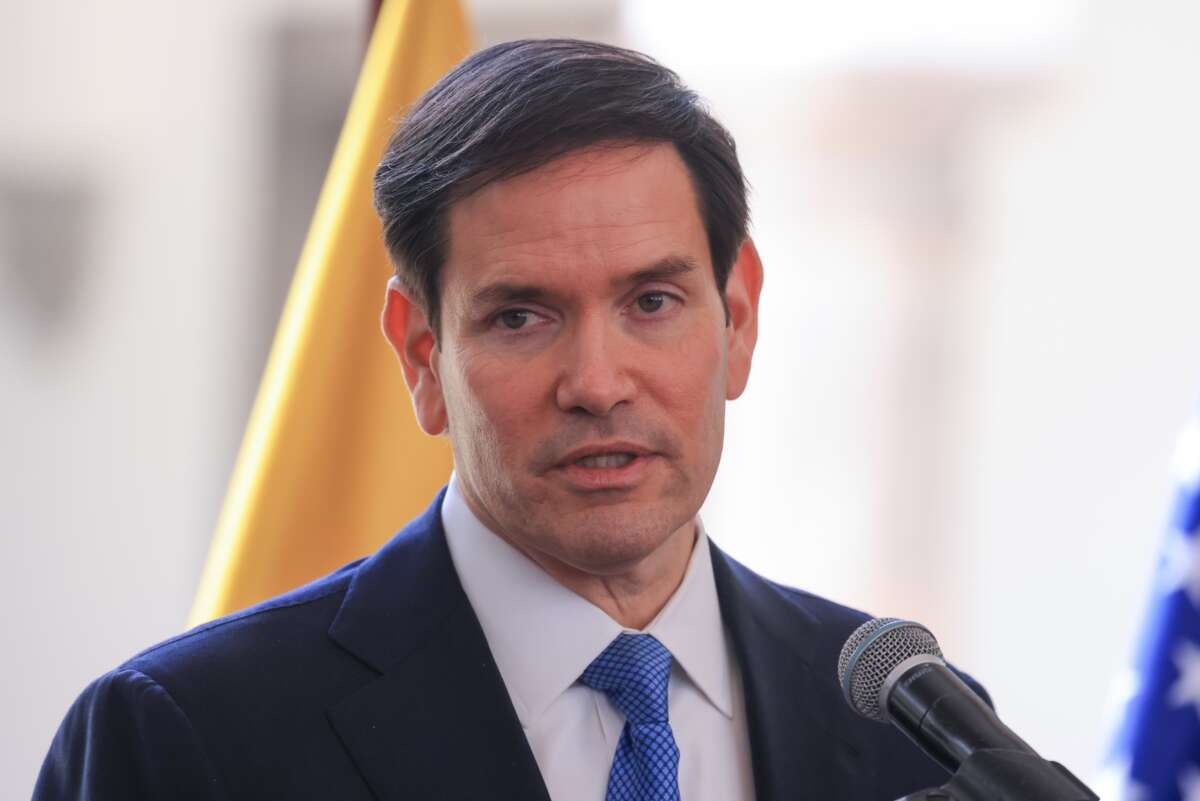
Secretary of State Marco Rubio announced he’s adding Al-Haq, Al Mezan Center for Human Rights, and the Palestinian Centre for Human Rights (PCHR) to the list of “Specially Designated Nationals and Blocked Persons List,” as part of President Donald Trump’s executive order sanctioning the ICC.
The three groups are leading human rights organizations in the occupied Palestinian territories, operating out of the West Bank and Gaza. They have been instrumental in monitoring Israel’s genocide in Gaza and annexation of the West Bank, serving as a key voice of Palestinians amid Israel’s assaults. Sanctions could have a vast chilling effect on their work.
“These entities have directly engaged in efforts by the International Criminal Court (ICC) to investigate, arrest, detain, or prosecute Israeli nationals, without Israel’s consent,” Rubio said. “We oppose the ICC’s politicized agenda, overreach, and disregard for the sovereignty of the United States and that of our allies.”
The groups decried the sanctions in a joint statement calling on states to pressure the U.S. to lift the sanctions. They noted that this is part of a longtime effort by Israel to silence Palestinian voices, by law or by force.
“Threatened by the impact and role of our advocacy, legal research, and documentation in exposing Israel’s ongoing international crimes, the United States has resorted to punishing individuals and organisations seeking to uphold the legal system upon which the international community was founded,” the groups said.
“The implications go beyond Palestine: by protecting Israel from accountability, they are dismantling the international legal order and undermining the possibility of justice for victims of grave crimes anywhere,” the groups went on. “But we will not give up nor be silenced. We will not bend to any State apparatus or system fuelled by violence and oppression.”
The sanctions come after the U.S. sanctioned another Palestinian human rights group, Addameer, which focuses on Palestinian prisoners’ rights, and UN Special Rapporteur for the occupied Palestinian territories, Francesca Albanese.
Rubio’s announcement was widely condemned. UN human rights chief Volker Türk said in a statement that the sanctions are “completely unacceptable.”
“For decades now, these NGOs have been performing vital human rights work, particularly on accountability for human rights violations,” said Türk. “The work of civil society in documenting violations and engaging with international accountability mechanisms is all the more important when international humanitarian and human rights laws are being violated systematically in Gaza and the West Bank, including East Jerusalem.”
A coalition of Israeli and Palestinian human rights groups, including major organizations like B’Tselem, called the sanctions “violent.”
“This is yet another move aimed at erasing fundamental norms of protecting human beings, designed to enable Israel to continue harming Palestinians without restraint,” the coalition said.
Other major international human rights organizations like Human Rights Watch and Amnesty International also denounced the Trump administration.
“The Trump administration’s decision to impose sanctions against three prominent Palestinian human rights organizations is a deeply troubling and shameful assault on human rights and the global pursuit of justice,” said Erika Guevara-Rosas, Amnesty International’s senior director for Research, Advocacy, Policy and Campaigns. “This appalling move constitutes a brazen attack on the entire Palestinian human rights movement, and a callous attempt to fracture and weaken the whole global human rights community.”
We lost 15 percent of our traffic overnight.
We now have three full months of data since Google changed its search to feature AI results. The numbers are worse than we anticipated. Overall readership that comes to Truthout through Google is down 54 percent against last year. The number of new readers who discover Truthout via Google searches is down 49 percent, and returning users from Google are down 51 percent.
We lost 15 percent of our readership overnight. This was a readership we painstakingly built over decades, and it vanished because Google chose corporate greed over a healthy democracy.
We anticipate a loss of roughly $500,000 in online revenue as a result of this massive traffic plunge in the next year alone.
The only way we can keep publishing is with strong reader support. We are asking you to start a monthly donation to Truthout today — anything you can do, whether $5 or $25, makes a difference.