Support justice-driven, accurate and transparent news — make a quick donation to Truthout today!
One June day I wound my way up a lush hillside in Simi Valley, California, where the fortieth president of the United States sat grinning at me from atop a horse. Ronald Reagan looked dapper and relaxed, his toned body a leathered green-brown. Somehow, his teeth gleamed white. How can a statue’s teeth look white? I wondered as I pulled my rental car into the packed parking lot. But if anyone’s teeth could remain white in death, it was the handsome actor-president’s. Vultures circled above the dead president’s head. Perhaps they sensed the legacy of bloodshed here at the Ronald Reagan Presidential Library and Museum.
I made my way through the lush courtyard of a Spanish-style estate and grabbed an audio guide from a woman dressed in a red blazer like an old-time movie-theater usher. Then I learned that the first exhibit I would be subjected to in this cursed place was a hologram of Ronald Reagan himself. Sweat beaded on the audio guide in my hand. I remembered, too late, the warnings of the abortion opponents I’d already spoken to as part of my investigation into the death of abortion rights for my book, Killers of Roe. Hell was real after all. It was right here, in an air-conditioned mansion in the hills of Southern California.
It happened to be the week of Juneteenth, the federal holiday marking the end of slavery, so I tried to distract myself from the impending apparition by taking note of the people around me — Asian tourists, German tourists. What kind of person, I wondered, chose this time of year to visit a museum dedicated to a man who ran his first campaign for governor in 1966 after coming out against fair housing and the Civil Rights Act, praised the formerly segregated Bob Jones University as a “great institution” when it still had an interracial dating ban, promoted the sole holdout in the Supreme Court decision against Bob Jones University’s tax-exempt status to chief justice, called African delegates to the United Nations “monkeys,” used the racist stereotype of the “welfare queen” to distort how we think about Black and poor women forever, and alienated Black people to such an extent that he won only 9 percent of African American voters upon his second election in 1984?
Who else was here in hell, besides a feminist reporter trying to force herself to take deep breaths in case there was a special room for Commie sympathizers? The answer was: A lot of people. The place felt packed, even by the standards of an institution that, at least before the pandemic, saw up to 1,500 visitors on an average day. Parents had brought their kids to see the “Star Wars” exhibit — a mash-up of memorabilia from the movies and Reagan’s nuclear missile defense system. Tourists were getting their pictures taken outside the 1980s-era Air Force One with its startling military aide mannequin. But as I was about to discover, plenty of people came because they just loved Reagan. The Reagan Museum was the most frequently visited presidential library in the country, a docent wearing a watch with Reagan’s face on it who called herself a “Reagan groupie” told me as I contemplated hurling myself off the hillside. These days everyone seemed to be a Reagan groupie. Liberal Democrats like my parents longed for the normalcy of a time when the gutting of the federal government was at least done with a degree of respect for due process. Even the process-smasher-in-chief, Donald Trump, had co-opted the late president’s slogan, “Make America Great Again,” and favorably compared his position on abortion to Reagan’s in 2024.
In fact, when you looked at the forces behind Trump’s reelection, Reagan turned out to be the man behind the curtain. The notorious Project 2025 blueprint for Trump’s second term, written by the conservative think tank the Heritage Foundation, mentioned the word “Reagan” seventy times. Three of its coauthors were Reagan administration veterans. The foreword explained that this plan to dismantle much of the federal government and ban abortion nationwide was modeled on the inaugural “Mandate for Leadership” presented to Reagan, who, it boasted, turned more than 60 percent of its recommendations into policy in the next year. Reagan embodied the two grand contradictions that defined the antiabortion movement’s alliance with the Republican Party. But the first contradiction was his own flip on the issue. As governor of California in 1967, he signed a reform bill making abortion legal for victims of rape, statutory rape, and incest or when someone’s physical or mental health was threatened. As he set his sights on national office, he would express his regret for signing the legislation, and then become widely known as the first pro-life president.
One of Reagan’s first actions after he was inaugurated in 1981 was to sign legislation removing the rape exception to the ban on federal funding of abortion known as the Hyde Amendment. He voiced support for a constitutional amendment to ban abortion. He hosted a screening of the antiabortion movie, The Silent Scream, next to the White House, mentioned abortion in three of his seven State of the Union addresses, waved to the annual March for Life from the White House balcony and addressed them by phone. In 1984 he instituted the Global Gag Rule, also known as the Mexico City Policy, a global extension of the Hyde Amendment that prevented organizations abroad that received US health aid from so much as offering information about abortion services.
But perhaps his most consequential achievement was the solidification of the antiabortion movement’s alliance with the Republican Party. Before Reagan took office, abortion was still not a strictly partisan issue. In fact, as scholar Prudence Flowers wrote, the loyalty of Catholics to the Democratic Party meant that “well into the 1980s, ordinary Democrats were more likely to be pro-life than ordinary Republicans.” In 1976, the chair of the Republican National Committee and the first lady, Betty Ford, supported abortion rights; yet the party adopted a platform supporting an antiabortion constitutional amendment in an effort to win over Catholics and socially conservative Reagan supporters. The last shot at an antiabortion constitutional amendment in 1983 failed when one-third of Senate Republicans opposed it.
But Reagan would solidify abortion as a conservative issue — in part by vanquishing the leading argument that it could be a progressive one. That argument came from the same entity that had used its political weight to ensure passage of the Hyde Amendment — the Catholic Church. In a speech at Fordham University in 1983, Cardinal Joseph Bernardin called for a “consistent ethic of life” that included opposing not just abortion but nuclear weapons, war, the death penalty, and poverty. Everything except the abortion part ran against Reagan’s agenda. He viewed the Catholic Church as “the political opposition” and sought to cast the antiabortion cause in a way that fit his own conservative frame. When the administration learned that the US Conference of Catholic Bishops was preparing an encyclical that extended the pro-life position to a critique of the nuclear arms race, they rushed to ensure that Reagan’s own antiabortion treatise would publish first.
In Abortion and the Conscience of a Nation, Reagan drew on the tried-and-true strategy of co-opting the language of the civil rights movement, comparing abortion to slavery, and framing it as the civil rights cause of the time. Conveniently, in Reagan’s frame, abortion was a cause so significant that it allowed him to overlook all the issues that actually animated the civil rights movement — like economic, gender, and racial inequality. Here was the civil rights movement for fetuses being touted from the presidential pulpit. Reagan effectively erased issues of structural inequality to focus on what he called “the right without which no other rights have any meaning.”
This singling out of protection from abortion as the right that mattered above all else would allow Reagan to enact the first grand contradiction of the alliance between the Republican Party and the antiabortion movement: He opposed abortion while gutting the public programs that allowed people to afford families. The Supreme Court with its decision to uphold the Hyde Amendment had justified this contradiction by ruling that it wasn’t up to the federal government to fix poverty; that was an individual failing that abortion seekers needed to handle themselves. Reagan would embody a second, defining contradiction of the Republican Party’s alliance with the antiabortion movement: He would claim he was making government smaller while extending the government’s reach over bodily autonomy. After all, if protection from abortion was the right that mattered most, its defense demanded extraordinary measures.
So popular would Reagan’s “small government” ethos become that the Democratic president Bill Clinton would adopt it in the 1990s when he ended “welfare as we know it,” eviscerating the social safety net by giving states control over welfare and imposing work requirements and lifetime caps.
Mainstream abortion rights groups, too, would begin to ape Reagan’s logic. In 1986, a group of pro-choice strategists began to intentionally frame abortion rights as an encroachment of big government on the family, as Will Saletan wrote in his book Bearing Right. Like the Christian right before them, pro-choice strategists began to tap into white resentment over school desegregation to defend abortion rights in conservative states like Arkansas. Harrison Hickman, the consultant whose polling and focus groups steered NARAL toward making abortion sound like a conservative issue, would craft a strategy straight out of the Reagan playbook, harnessing racial resentment and sympathy for rape victims to win narrow victories using conservative rhetoric about government intrusion and crime.
Black feminists like Angela Davis had warned that abortion, if severed from a holistic feminist agenda, would accommodate rather than confront economic inequality. Pro-choice groups in their pivot to Reaganite rhetoric in the 1980s and 1990s would prove her right. Reagan’s shadow loomed over all this history.
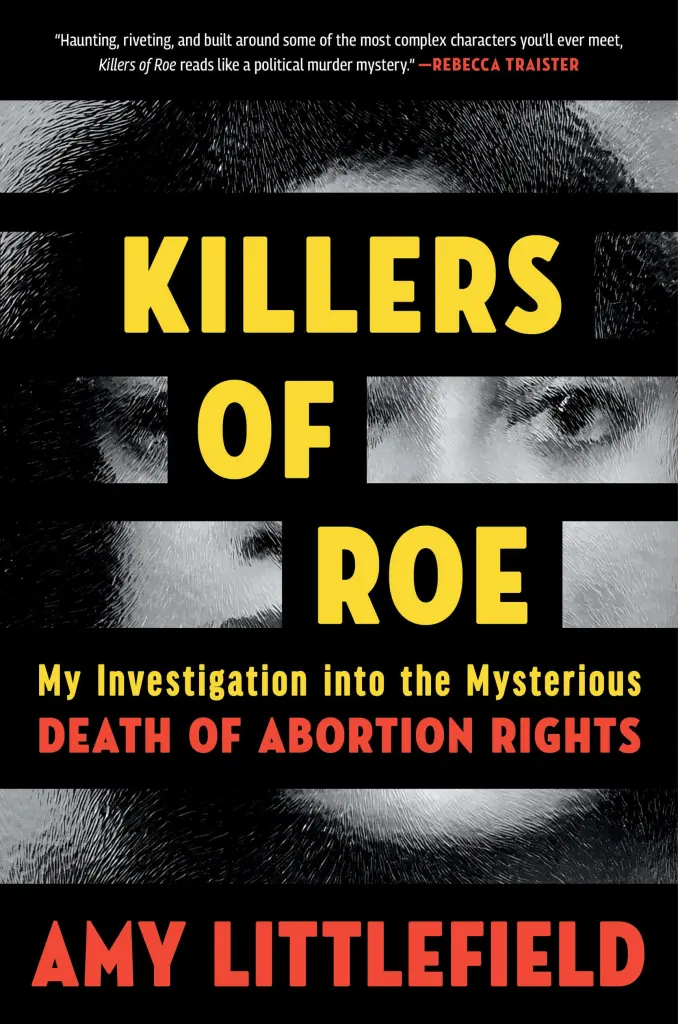
This article is an excerpt from Amy Littlefield’s book Killers of Roe: My Investigation Into the Mysterious Death of Abortion Rights (Hachette, 2026).
An urgent fundraising appeal: 72 Hours to raise $27,000
Thank you for reading Truthout today. We have a brief message before you go —
Unfortunately, donations are down for Truthout at a time when media is under immense pressure. Trump is arresting journalists, Big Tech is censoring independent news, and economic conditions for media have been worsening for years.
Simultaneously, movement media is vital in the fight against Trump’s authoritarian reign. Our mandate to tell the truth, share strategies for resistance, and speak against fascism is ever more urgent in this deluge of political censorship. Yet, we are struggling to meet our publishing costs when our work is so urgently needed.
If you can support Truthout with a one-time or monthly donation, you will make a significant impact on our work. Please give today during our fundraiser (only 72 hours left).