Truthout is an indispensable resource for activists, movement leaders and workers everywhere. Please make this work possible with a quick donation.
The New York Times on Wednesday featured another Casey Mulligan episode of “There Is No Unemployment.” Mulligan's argument is that if we look at employment rates for the older population we see that they have actually risen in the downturn even as employment for people ages 25-55 plummeted. Mulligan interprets this as evidence that highly motivated older workers are able to find jobs, and if younger workers were equally motivated they would find jobs too.
This is an interesting story. The rise in employment rates of older workers is a striking story in this downturn and one that I and others have often noted. However, there are other possible interpretations.
Older workers almost by definition will have more experience than their younger counterparts. Employers tend to fire less experienced workers with less job tenure first. (Just as they tend to fire less-educated workers first.) This could lead to the pattern of lower employment rates among younger workers that we are seeing without having any direct relationship to the commitment of workers to the labor force.
There is a simple way to try to test this story. We can look at patterns in wage growth since the downturn. If Mulligan's story is right then we might expect to see the wages of older workers rise less rapidly than for younger workers. (These are nominal wages.) The idea is that the desperate older workers are willing to take big pay cuts to keep or get a job, while the young whipersnappers would rather lounge around on the couch watching TV.
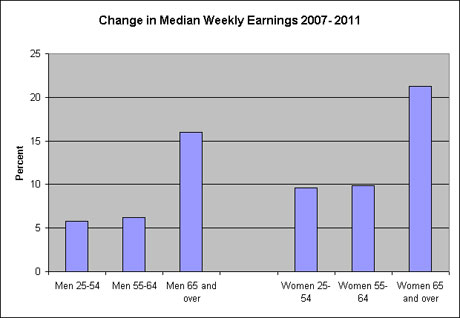
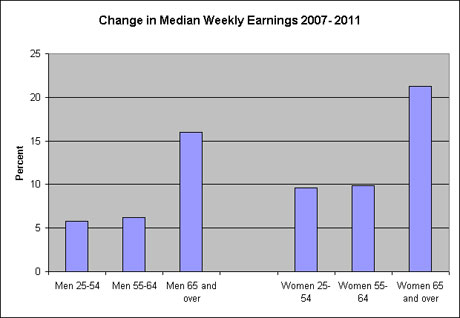
The chart below shows the change in median weekly earnings between 2007 and the average of last four quarters (2010:3-2011:2) for men and women between the ages of 25-54, 55-64, and over age 65.
Source: Bureau of Labor Statistics.
As can be seen, median weekly earnings rose slightly more rapidly for the both men and women in the 55-64 age cohort than in the 25-54 group. They rose much more rapidly for the over-65 age group. There is not much evidence here of older workers who are desperately looking for jobs and willing to make whatever sacrifice is necessary. In other words, this is consistent with the demand side story, in which employers dump their younger workers first while holding on to older workers, so that there are no jobs for the under-55 set.
It is the same story as with more highly educated workers. College-educated workers saw less of a fall in employment than less educated workers. However, this does not mean that less-educated workers could find jobs if they really want them, nor that there are even jobs for every college educated worker who wants them.
An important fundraising appeal: We still need to raise $9,000
Truthout is one of only a few platforms for justice-oriented, grassroots journalism. Today, as political censorship from the right intensifies, we have no choice but to ask for your help.
We are fundraising right now to cover our basic operating expenses. If you can support Truthout with a one-time or monthly donation, you will make a significant impact on our work. Anything you can do makes a difference — we appreciate your support.