
Truthout is an indispensable resource for activists, movement leaders and workers everywhere. Please make this work possible with a quick donation.
On the heels of the Environmental Protection Agency unveiling its proposed carbon pollution standard for existing power plants, clean-energy supporters from coast to coast are digging into the details. As we work to understand how the plan will help us tackle climate disruption, deep-pocketed dirty-fuel supporters like the Koch brothers are spreading massive amounts of disinformation.
So I’d like to set the record straight on what the standard actually does.
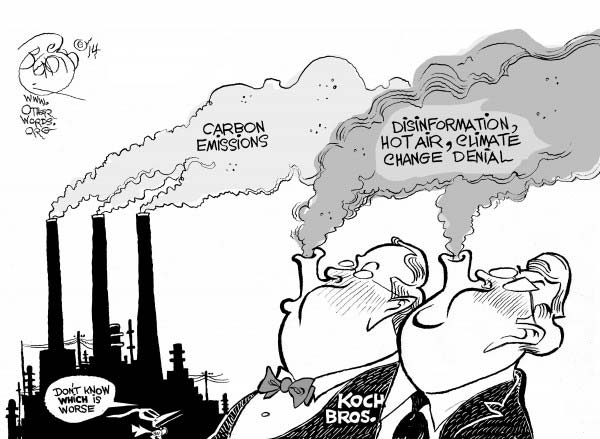 Curbing Carbon Pollution at the Source, an OtherWords cartoon by Khalil Bendib
The EPA’s Clean Power Plan (that’s what the agency named the new standard) calls for the federal government to limit carbon pollution from all power plants for the first time. The plan creates a roadmap that would set our country on a path to reduce carbon pollution (compared to 2005 levels) by 27 percent in 2020, 29 percent in 2025, and 30 percent in 2030.
Carbon pollution is the main contributor to global warming, making extreme weather worse — including more severe floods, wildfires and droughts. It’s also linked to life-threatening air pollution, like the kind of smog that can trigger asthma attacks.
The standard sets carbon reduction goals for every state, and gives them several building blocks to meet those targets, including increasing the use of renewable energy and energy efficiency. Then, it’s up to each state to write a plan that will meet its own goal. While the plan doesn’t solve the problem of climate disruption by itself, it gives the states a great framework to make significant progress.
The standard opens up the opportunity for every state to chart its own energy future. The EPA set each state’s target by taking into account the energy resources available in each state to meet the 30 percent goal.
The plan also requires energy companies to reduce their carbon pollution by harnessing technological innovation as they transition to cleaner alternatives. Done correctly, the undertaking of making America’s power generation more efficient will create thousands of new jobs in construction, manufacturing, and other industries.
Just as critical is that states establish plans that will ensure a fair and just transition if and when power plants are retired. This means directly supporting workers by providing wages, benefits, training, and education. It also means backing communities with resources to re-develop and diversify their economies, creating good-paying jobs along the way.
Buoyed by rapidly declining costs, solar and wind power continue to grow exponentially nationwide and around the world for both small-scale and utility-scale installations. Every state should concentrate its carbon-reduction efforts on truly renewable energy alternatives of that kind. Let’s create more productive jobs in industries that don’t pollute our air and water or disrupt the climate.
Contrary to cries from its well-funded opponents, the Clean Power Plan won’t “raise rates” or “kill jobs.” The Washington Post’s fact-checker has already debunked big polluter attacks about extreme rate hikes and massive job losses bound to result from the EPA’s new policy as “bogus.”
The Republican Party and the Koch brothers are also ignoring the concerns of most Americans when they reject this standard: New polls show that a large majority of us support the EPA’s new approach to curbing pollution released by power plants. Even people in so-called red states think it’s a good idea.
Carbon pollution threatens our health, our economy, and our children’s future. By establishing a pathway toward reductions in carbon pollution, the EPA can clean up and modernize the way we power our country.
Every state will tailor this standard to its distinct energy reality. The EPA intends to finalize its new carbon standard next year and it will hold public hearings across the country, beginning with one on July 29 in Atlanta and Denver.
So get involved and get ready to help shape your state’s energy future.
An urgent appeal for your support: We Have Until Midnight to raise $13,000
Truthout relies on individual donations to publish independent journalism, free from political and corporate influence. In fact, we’re almost entirely funded by readers like you.
Unfortunately, donations are down. At a moment when independent journalism is urgently needed, we are struggling to meet our operational costs due to increasing political censorship.
Truthout may end this month in the red without additional help, so we launched a fundraiser. We have until midnight tonight to hit our $13,000 goal. Please make a tax-deductible one-time or monthly donation if you can.