Truthout is an indispensable resource for activists, movement leaders and workers everywhere. Please make this work possible with a quick donation.
Antonio Fatas, a professor at the Insead business school, in commenting on recent research on deleveraging (or the lack thereof) on his blog, emphasized one of my favorite points: No, debt does not mean that we’re stealing from future generations.
Globally – and for the most part even within countries – a rise in public debt isn’t an indication that we’re living beyond our means, because as Mr. Fatas put it, one person’s debt is another person’s asset. Or, as I have put it before, debt is money we owe to ourselves – an obviously true statement that, I have discovered, has the power to induce blinding rage in many people.
Think about the history shown in the chart here. Britain did not emerge impoverished from the Napoleonic Wars in the early 1800s. The government ended up with a lot of debt, but the counterpart of this debt was that the British propertied classes owned a lot of consols, or government bonds.
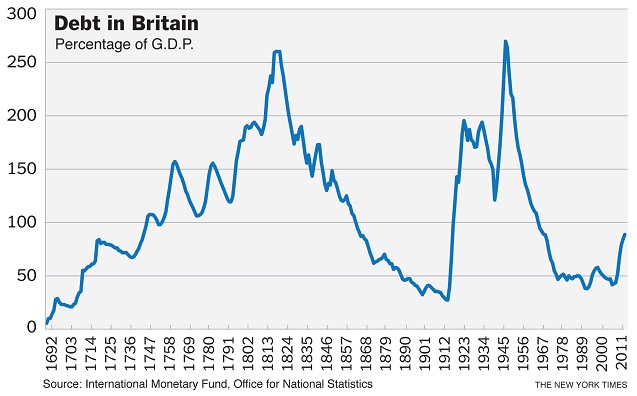
More than that, as Mr. Fatas pointed out on his blog, rising debt can be a good sign. Think of my little two-classes model of debt, where some people are less patient than others – perhaps (to step outside the model a bit) because they have better investment opportunities.
Moving from a very limited financial system that doesn’t allow much debt to a somewhat more open-minded system should, in that case, be good for growth and welfare.
The problem with private debt is that we have good reason to believe that, in very wide open financial systems, people get irrationally exuberant, lending and borrowing to an extent that they eventually realize is excessive – and that there are huge negative externalities when everyone tries to deleverage at the same time. This is a very big concern, but it’s not about generalized excess consumption.
And the problems with public debt are also mainly about possible instability, not that we’re “borrowing from our children.” The rhetoric of fiscal debates has been, for the most part, nonsense.
25 Years of Truthout: An important fundraising appeal
This September, Truthout is celebrating 25 years of publication. For over two decades, we have been a trusted source for fiercely independent journalism thanks to readers like you.
As we look to the next 25 years, we have launched a special fundraising campaign. Looking to a sustainable future for our publication, we have a fundraising goal of $100,000 in the next 10 days.
We are asking for your support at this juncture because we face greater threats than ever before in our organizational history. Trump and his MAGA allies are determined to control the information ecosystem, and movement-based organizations are subject to dangerous censorship and scrutiny.
If you can support Truthout with a one-time or monthly donation, you will make a significant impact on our work and our legacy. Anything you can do makes a difference!