Did you know that Truthout is a nonprofit and independently funded by readers like you? If you value what we do, please support our work with a donation.
I promised recently that I would share some nagging concerns about a paper on redistribution and growth by Jonathan D. Ostry, Andrew Berg and Charalambos G. Tsangarides, researchers at the International Monetary Fund. They conclude that there is no negative effect of redistributionist policies, at least within the range we normally see, and quite possibly a positive effect from the reduction in inequality.
I think I can usefully phrase my concerns in terms of my favorite comparison on these matters, which is between the United States and France.
Why this pair? Because we’re talking about two advanced countries that clearly have similar levels of technological competence but have made very different social policy choices. In particular, France not only does much more redistribution, but has expanded its redistribution over time, limiting the rise in overall inequality, while the United States has not.
So how have the countries’ destinies compared during the New Gilded Age? Growth actually has been somewhat slower in France, although it’s hardly the catastrophe that the incessant bad press about the country might lead you to expect (see the chart on real gross domestic product per capita on this page.)
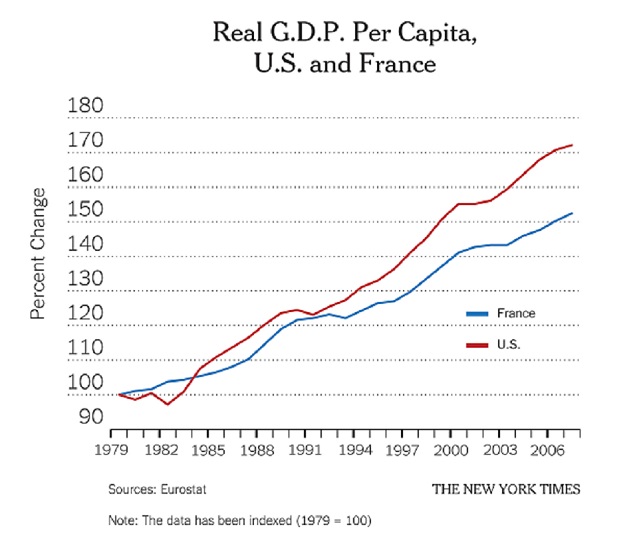
Even more strikingly, however, the level, as opposed to the growth rate, of French G.D.P. per capita is substantially lower than that of the United States.
This is my main concern about Ostry et al. Suppose a person thinks that strong redistributionist policies reduce the level of output – but that it’s a one-time shift, not a permanent depression of growth. Then he could accept their result of a lack of impact on growth while still believing in serious output effects.
Now, the I.M.F. researchers arguably have answered this objection by also including the current level of G.D.P. per capita in their regressions, which indicate that a country with lower G.D.P. per capita than the United States should be growing faster than the United States, other things being equal. So any level-depressing effect of redistribution should show up as a failure of this faster growth to materialize. But I’m uneasy about whether this is good enough.
Interestingly, French underperformance is a matter of low labor input rather than low productivity (see the second chart).
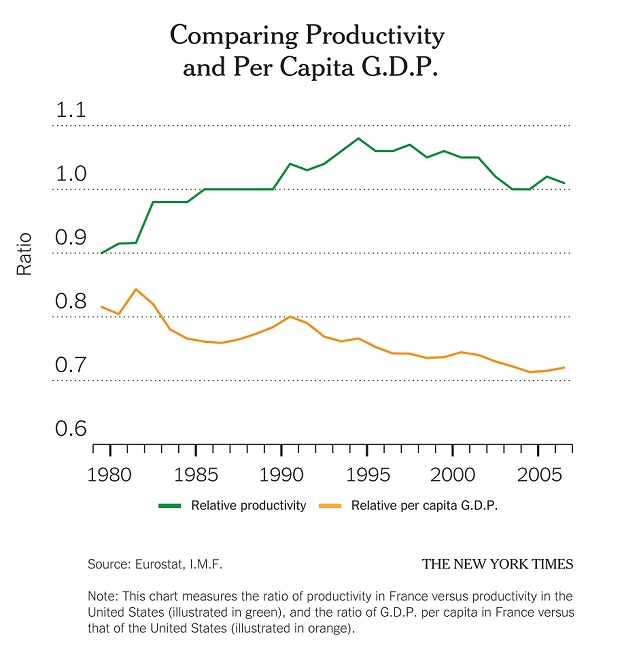
Once you delve into this low labor input, it starts to look like the result of some very specific policies rather than redistribution in general: a pension system that encourages early retirement, regulations that give French people shorter hours and much more vacation time than we get.
Overall, I am still mostly persuaded by the I.M.F. paper, but I think we need to acknowledge that it’s not quite as slam-dunky as liberals might like.
25 Years of Truthout: An important fundraising appeal
This September, Truthout is celebrating 25 years of publication. For over two decades, we have been a trusted source for fiercely independent journalism thanks to readers like you.
As we look to the next 25 years, we have launched a special fundraising campaign. Looking to a sustainable future for our publication, we have a fundraising goal of $52,000 in the next 72 hours.
We are asking for your support at this juncture because we face greater threats than ever before in our organizational history. Trump and his MAGA allies are determined to control the information ecosystem, and movement-based organizations are subject to dangerous censorship and scrutiny.
If you can support Truthout with a one-time or monthly donation, you will make a significant impact on our work and our legacy. Anything you can do makes a difference!