Did you know that Truthout is a nonprofit and independently funded by readers like you? If you value what we do, please support our work with a donation.
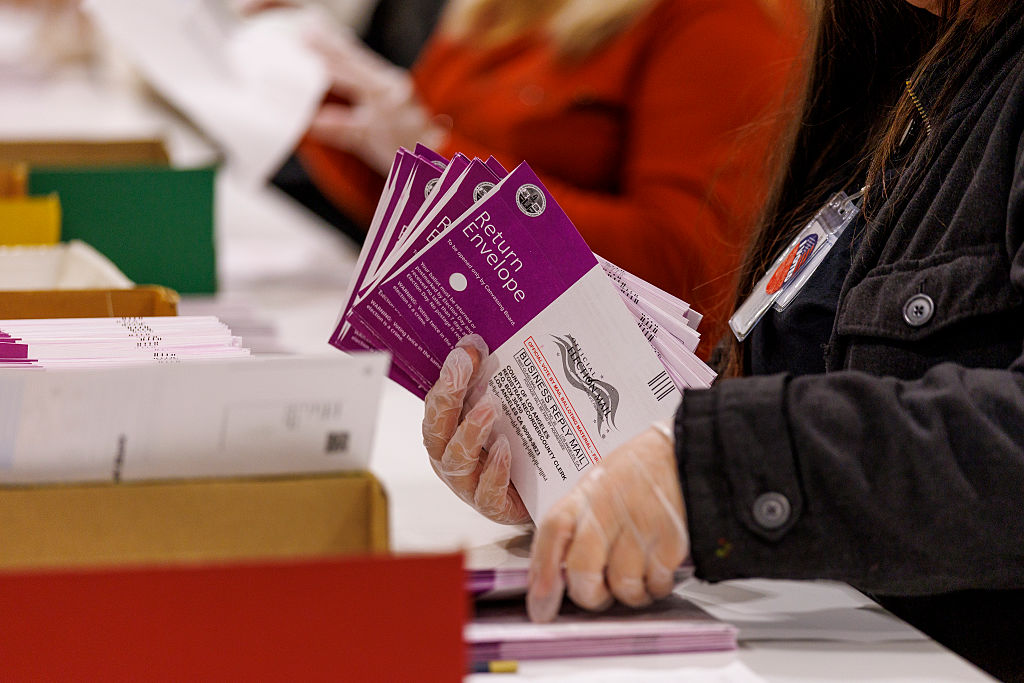
As President Donald Trump on Monday pardoned leaders who tried to overturn his 2020 loss, the US Supreme Court took up the national Republican Party’s argument that counting mailed ballots shortly after Election Day violates federal law.
Voting by mail has long been a target of the GOP president, who has falsely claimed that the practice fuels voter fraud. This case concerns a Mississippi law that allows mailed ballots postmarked by Election Day to be counted as long as they arrive within five business days, which three Trump appointees on the US Court of Appeals for the 5th Circuit struck down last year.
As President Donald Trump on Monday pardoned leaders who tried to overturn his 2020 loss, the US Supreme Court took up the national Republican Party’s argument that counting mailed ballots shortly after Election Day violates federal law.
Voting by mail has long been a target of the GOP president, who has falsely claimed that the practice fuels voter fraud. This case concerns a Mississippi law that allows mailed ballots postmarked by Election Day to be counted as long as they arrive within five business days, which three Trump appointees on the US Court of Appeals for the 5th Circuit struck down last year.
The Associated Press pointed out Monday that “Mississippi is among 18 states and the District of Columbia that accept mailed ballots received after Election Day as long as the ballots are postmarked on or before that date,” and “an additional 14 states allow the counting of late-arriving ballots from some eligible voters, including overseas US service members and their families.”
Legal experts have condemned the appellate decision as “awful” and “bonkers.” The justices are expected to hear arguments early next year and issue a ruling by the end of June, months before the crucial midterm elections.
National Vote At Home Institute executive director Barbara Smith Warner welcomed their decision to take the case and potentially reverse the 5th Circuit’s “upside-down” opinion, telling Democracy Docket: “The idea that a ballot that is postmarked on or by Election Day and received afterwards… is like voting after Election Day? That is ridiculous.”
Alexia Kemerling, director of accessible democracy at the American Association of People with Disabilities, was also hopeful.
“We really hope that the Supreme Court takes the responsibility seriously to make sure that every voter can use their power,” she said. “’The millions of voters with disabilities who cannot vote in person or voters who are overseas who cannot vote in person — this is their only way to participate in the system. They should not be disenfranchised for the ways that our system moves slowly.”
The New York Times noted that Watson v. RNC “is a potential blockbuster and adds to the court’s other elections and voting cases for the term, which include a case about who can sue to challenge Illinois’ mail-in ballot rules and a challenge to the Louisiana congressional district map that could gut a remaining pillar of the Voting Rights Act.”
Trump is silencing political dissent. We appeal for your support.
Progressive nonprofits are the latest target caught in Trump’s crosshairs. With the aim of eliminating political opposition, Trump and his sycophants are working to curb government funding, constrain private foundations, and even cut tax-exempt status from organizations he dislikes.
We’re concerned, because Truthout is not immune to such bad-faith attacks.
We can only resist Trump’s attacks by cultivating a strong base of support. The right-wing mediasphere is funded comfortably by billionaire owners and venture capitalist philanthropists. At Truthout, we have you.
Our fundraising campaign is over, but we fell a bit short and still need your help. Please take a meaningful action in the fight against authoritarianism: make a one-time or monthly donation to Truthout. If you have the means, please dig deep.