Honest, paywall-free news is rare. Please support our boldly independent journalism with a donation of any size.
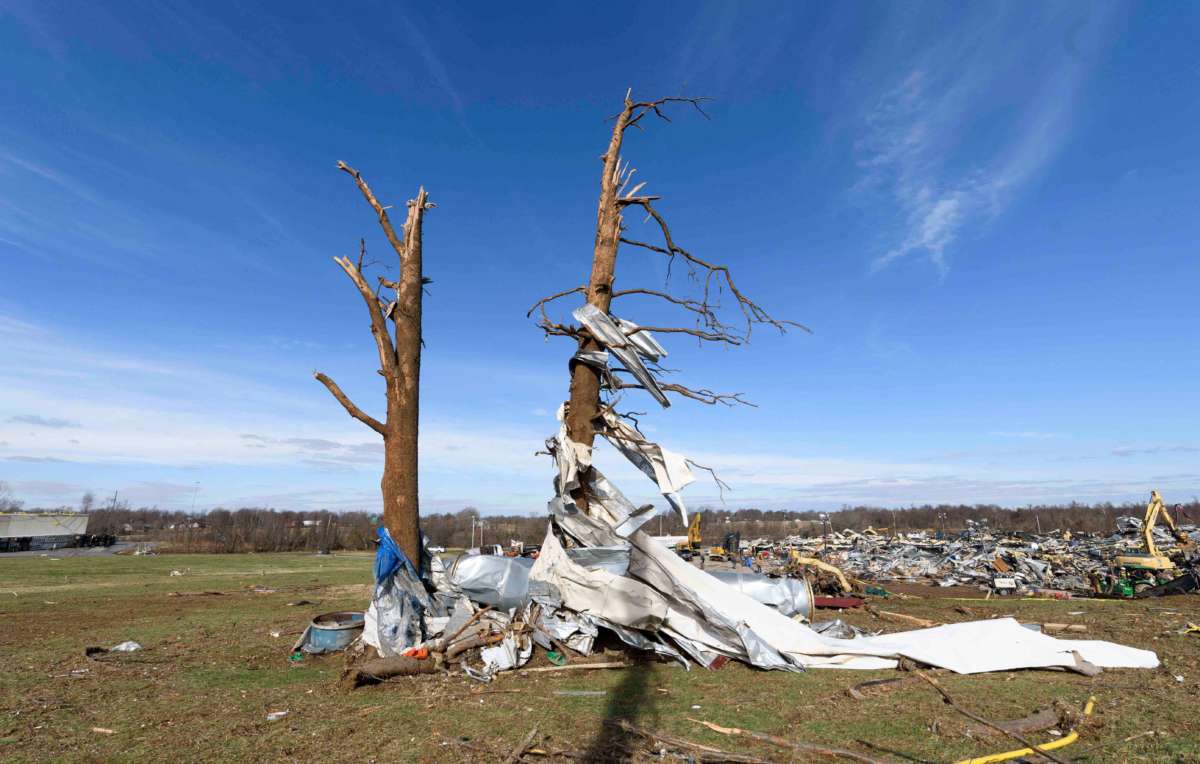
As emergency workers and local residents sifted through the wreckage of towns left devastated by the tornado system that hammered six U.S. states over the weekend, the youth-led Sunrise Movement implored policymakers to “call it what it is: a climate disaster” — and act accordingly.
“People’s homes have been demolished, 40,000 people are without power, and there are so many unanswered questions that the government should have solutions for,” said Rachael Fantasia, hub coordinator of Sunrise Bowling Green, a Kentucky city where more than 500 houses were reportedly destroyed by tornadoes that left dozens dead in the state.
“The greed from elites, politicians, and the wealthy strikes the South to the core — we are again left with no government support, pulling each other out of the rubble to survive,” Fantasia added. “We demand the government’s assistance or they will no longer mean anything to us — we aren’t asking, we demand change. Kentucky needs Build Back Better now.”
Described as among the most severe tornado systems in recorded U.S. history — with at least 36 twisters detected across the South and Midwest — the extreme weather slammed communities across Arkansas, Illinois, Kentucky, Missouri, Mississippi, and Tennessee, leaving a confirmed death toll of close to 100 as local officials continue to survey the damage and attempt to chart the long path to recovery.
While numerous factors have the potential to influence the frequency and severity of extreme weather events, scientists argued in the tornadoes’ wake that rapidly warming temperatures likely propelled the destructive system.
“The models that we’re currently using to diagnose the impacts of climate change on these extreme weather events if anything are actually underestimating the impact that climate change is having,” Michael Mann, distinguished professor of atmospheric science at Penn State, said in an appearance on MSNBC.
“Climate change is changing the jet stream,” Mann continued, “giving us more of these stalled weather patterns and these very large undulations in the jet stream that give us big high pressures, big low pressures, and extreme weather events.”
Even before the swarm of tornadoes ravaged a large swath of the country, the U.S. in 2021 was already on pace for the most billion-dollar extreme weather disasters since records began.
“This is going to be our new normal, and the effects that we’re seeing from climate change are the crisis of our generation,” FEMA Administrator Deanne Criswell said on CNN Sunday morning. “We’ll continue to work on helping to reduce the impacts, but we’re also prepared to respond to any community that gets impacted by one of these severe events.”
“We do see tornadoes in December, that part is not unusual, but at this magnitude, I don’t think we’ve ever seen one this late in the year,” said Criswell. “The severity and the amount of time this tornado, or these tornadoes, spent on the ground is unprecedented.”
On top of grassroots mutual aid efforts and the federal government’s immediate emergency response, the Sunrise Movement stressed that sweeping climate action — including but not limited to the $550 billion in funding for climate programs in Democrats’ Build Back Better Act — is imperative to quickly build out resilient infrastructure and drive down the carbon emissions that are fueling planetary heating.
More than 70 people lost their lives last night in the most severe tornado event in Kentucky history — this is a climate emergency.
We protect our own. If you can, donate your time (or $$$) to community orgs & mutual aid groups in KY: https://t.co/KnIkbvFbDv pic.twitter.com/QhB5PVgqqm
— Sunrise Movement 🌅 (@sunrisemvmt) December 11, 2021
“This climate disaster is about our electeds failing us, choosing to water down and delay climate bills instead of investing in infrastructure that will keep people safe,” said Varshini Prakash, Sunrise’s executive director. “And this suffering is at the expense of working families, who have to make the impossible decision of working to feed their families or fleeing to save their lives.”
“Our politicians must fight for us,” she added. “Kentucky needs direct cash payments and FEMA assistance quickly and to anyone who needs it. BBB must pass. It is the bare minimum.”
Greenpeace USA echoed that message on Twitter.
“Historic warm temperatures fueled the tornadoes,” the group wrote. “Our elected leaders must help these communities now and commit to real climate action.”
A terrifying moment. We appeal for your support.
In the last weeks, we have witnessed an authoritarian assault on communities in Minnesota and across the nation.
The need for truthful, grassroots reporting is urgent at this cataclysmic historical moment. Yet, Trump-aligned billionaires and other allies have taken over many legacy media outlets — the culmination of a decades-long campaign to place control of the narrative into the hands of the political right.
We refuse to let Trump’s blatant propaganda machine go unchecked. Untethered to corporate ownership or advertisers, Truthout remains fearless in our reporting and our determination to use journalism as a tool for justice.
But we need your help just to fund our basic expenses. Over 80 percent of Truthout’s funding comes from small individual donations from our community of readers, and over a third of our total budget is supported by recurring monthly donors.
Truthout’s fundraiser ended last night, and we fell just short of our goal. But your support still matters immensely. Whether you can make a small monthly donation or a larger one-time gift, Truthout only works with your help.