Truthout is an indispensable resource for activists, movement leaders and workers everywhere. Please make this work possible with a quick donation.
A calculated pattern is emerging in Donald Trump’s planned National Guard deployments: After wobbling on sending the military into Chicago earlier this month, his administration has pivoted toward targeting blue cities in deep red states.
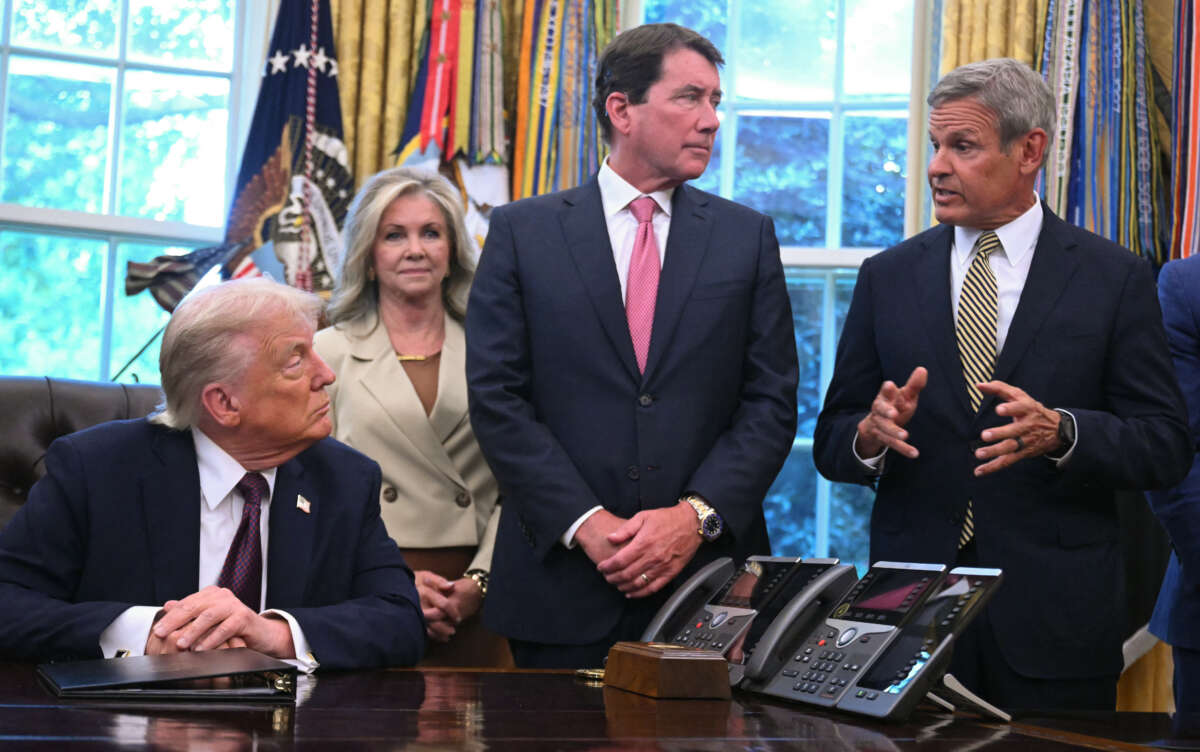
Memphis and New Orleans — the two cities Trump has announced he plans to target next — are both Democratic cities in Republican-controlled states, and both also have Black mayors — a seeming prerequisite thus far for the cities that this hard-right administration is targeting.
Moreover, both cities answer to Republican governors who have indicated their support for Trump’s idea of using military boots on the ground in a domestic law enforcement capacity, despite the fact that crime rates in both cities, while still high, have declined significantly since the peaks of the pandemic years. In New Orleans, murders are down by more than a quarter over the past year, and other violent crimes have also declined by double-digit amounts.
Tennessee’s Gov. Bill Lee says he has been discussing a troop deployment with the Trump administration for months, while Louisiana Gov. Jeff Landry has waxed poetic about sending the military into domestic crime-plagued “war zones.”
By contrast, the leadership of the cities impacted are less than enthused: Memphis Mayor Paul Young has expressed his displeasure with this development, and New Orleans Mayor LaToya Cantrell has maintained a studied silence on the topic. Both mayors know that their political wiggle room is limited in states where solid majorities of voters go Republican and where state legislators have long looked for ways to rein in the power of blue cities to go their own way on economic, social, climate change, and other policy areas.
In Tennessee, GOP legislators have used their super-majority power to create new city and county legislative districts aimed at blunting the power of Democratic elected officials, and state and federal Republicans have accused the mayor of Nashville and other opponents of defending “criminals” because of city policies limiting cooperation with Immigration and Customs Enforcement. In Louisiana, the governor has invoked emergency powers to eat into the autonomy of blue cities on law enforcement and other issues.
The military theater that the administration is planning isn’t limited to these two cities. Trump has also begun musing about sending the National Guard into St. Louis (yet another blue city in a deep red state, though this time one that currently has a white mayor). But so far Trump’s plans for St. Louis seem less developed than his plans for the Big Easy and Memphis. And, of course, Trump continues to harbor ambitions to occupy large blue cities, such as New York and Chicago, in big blue states. In addition, the deployment of the National Guard in Washington, D.C. and in Los Angeles remains ongoing.
Democratic cities’ efforts to raise local minimum wages, to protect access to abortions, to set in place local climate change policies and regulation, and to protect LGBTQ rights are all increasingly being challenged by red state governments.
In blue cities in blue states, however, local opposition to military deployments has been backed up by a strong state response and the threat of litigation. Illinois Gov. JB Pritzker and California’s Gavin Newsom have been relentless in their critiques of Trump’s military rhetoric. By contrast, cities such as Memphis have been hung out to dry by their state leaders.
This GOP effort to neutralize Democratic city control in GOP states predates Trump 2.0, but it has accelerated under the current administration. Democratic cities’ efforts to raise local minimum wages, to protect access to abortions, to set in place local climate change policies and regulation, and to protect LGBTQ rights are all increasingly being challenged by red state governments. So, too, GOP state politicians are leaning into the idea that any city regulation that can be deemed to be preempted by state laws is illegitimate.
The effects of this campaign against local powers are myriad. The National Employment Law Project, a nonprofit advocacy organization, has detailed examples of cities enacting higher minimum wages and better paid sick leave provisions, only to have their states block these reforms. The law project estimates that, in total, 25 states, most of them Republican-led, have passed cookie-cutter legislation, crafted for the most part by the American Legislative Exchange Council, to preempt local minimum wages. And the law project has also found that Republican state officials and legislators back up their preemption policies with threats to defund cities or to prosecute local officials who plow ahead with their reform efforts.
Six years ago, the National Employment Law Project reported that 12 cities and counties (in Alabama, Iowa, Florida, Kentucky, Missouri, and Wisconsin) had passed minimum wage increases only to see them shot down by the state. These actions have real-world consequences for hundreds of thousands of low-income workers. Most of the states with preemption laws hew to the federal minimum wage, which has stayed at $7.25 per hour for more than a decade; in those states, low-income workers, especially in cities with a higher cost of living, face daunting odds of leaving poverty.
In Texas in 2015, legislators banned cities from limiting fracking and fossil fuel drilling and prevented them from mandating landlords to accept Section 8 housing vouchers. In 2023, urged on by Gov. Greg Abbott, legislators passed sweeping legislation to curtail cities’ autonomous power, barring all ordinances that conflicted with more restrictive state measures. What this meant was that cities such as Austin and Dallas, for example, could no longer mandate water breaks for workers during the hot summer months, or impose stringent noise regulations, and would, instead, be obligated to accept looser regulations that don’t benefit their residents as much. The large cities of Texas sued, but this year an appeals court upheld the Texas legislation.
The GOP is playing for keeps, and cities in the red heartland are the poker chips with which it is gambling.
This year, legislators in the Lone Star State have gone even further, proposing freezing cities’ sales tax revenues for 90-day periods if they pursue local laws deemed to conflict with state laws and priorities — for example, laws that uphold diversity, equity, and inclusion programs or decriminalize marijuana. Such a move would essentially destroy the fiscal foundations upon which cities rest and would massively impact services for city residents. Attorney General Ken Paxton has also announced investigations into Dallas city and police leaders for their sanctuary policies on immigration.
Meanwhile, legislators in Florida have voted to curb cities’ ability to limit housing sprawl by disallowing the passage of “more restrictive or burdensome” changes to local land development codes. North Carolina’s gerrymandered conservative legislature has gone down a similar path. North Carolina also severely limits the ability of cities to create any sort of gun control ordinances within their boundaries.
Taken as a whole, these state restrictions, enacted since the Obama years and expanding in the Trump era, represent an extraordinary power grab by conservative legislators against liberal city governments. Add into the mix Trump’s determination to use the military against residents of these cities, and to secure state GOP approval for this action, and the scale of the existential political challenge facing U.S. cities becomes clear. The GOP is playing for keeps, and cities in the red heartland are the poker chips with which it is gambling.
Press freedom is under attack
As Trump cracks down on political speech, independent media is increasingly necessary.
Truthout produces reporting you won’t see in the mainstream: journalism from the frontlines of global conflict, interviews with grassroots movement leaders, high-quality legal analysis and more.
Our work is possible thanks to reader support. Help Truthout catalyze change and social justice — make a tax-deductible monthly or one-time donation today.