Truthout is an indispensable resource for activists, movement leaders and workers everywhere. Please make this work possible with a quick donation.
After President Donald Trump belatedly signed a $900 billion coronavirus relief package into law late Sunday, Democratic lawmakers and Sen. Bernie Sanders turned their attention to an upcoming vote on stand-alone legislation that would increase the one-time direct payments in the aid measure from $600 to $2,000.
The Democrat-controlled House of Representatives will attempt to pass the $2,000 payments bill on Monday; if successful, the onus will be on the Republican-controlled Senate to either block or approve the legislation to send larger checks to millions of struggling Americans. The push for $2,000 checks has been embraced by both Jon Ossoff and Raphael Warnock, Democratic Senate candidates vying to unseat Republican Sens. David Perdue and Kelly Loeffler in the January 5 Georgia runoffs.
Senate Minority Leader Chuck Schumer (D-N.Y.) said late Sunday that he will move to pass the $2,000 payments if the House approves the bill on Monday. Senate Majority Leader Mitch McConnell (R-Ky.) has not publicly committed to allowing a vote on the Democratic measure.
“No Democrats will object,” said Schumer. “Will Senate Republicans?”
In a statement late Sunday, House Speaker Nancy Pelosi (D-Calif.) said that “the president must immediately call on congressional Republicans to end their obstruction and to join him and Democrats in support of our stand-alone legislation to increase direct payment checks to $2,000.”
“Every Republican vote against this bill,” said Pelosi, “is a vote to deny the financial hardship that families face and to deny the American people the relief they need.”
As the Washington Post’s Mike DeBonis pointed out on Twitter, Pelosi is bringing the $2,000 payments bill to the floor via suspension of House rules, which accelerates the process but requires a two-thirds vote for passage.
>@SpeakerPelosi says Trump needs to “immediately call on Congressional Republicans to end their obstruction” — which is true, because Dems are bringing up the $2K checks bill under suspension of the rules — i.e., needs 2/3rds (a lot of R votes) to pass. pic.twitter.com/9b9ejk4Zdp
— Mike DeBonis (@mikedebonis) December 28, 2020
The House vote will come days after the chamber’s Republicans blocked a Democratic attempt to approve the $2,000 direct payments by unanimous consent on Christmas Eve.
Now let’s pass $2,000 survival checks that put money directly in people’s pockets. https://t.co/4DRb7cFFIL
— Rep. Pramila Jayapal (@RepJayapal) December 28, 2020
The proposed $2,000 direct payments would meet one of several demands Trump issued after the relief legislation cleared both the House and Senate last week. The president’s objections to the relief bill — and to the sprawling government funding legislation to which it was attached — held up the package for days, a delay that will likely cost millions of Americans a full week of unemployment benefits.
After signing the package into law on Sunday, Trump said in a statement that he is demanding the removal of “wasteful items” from the legislation as well as the inclusion of larger checks.
“Congress has promised that Section 230, which so unfairly benefits Big Tech at the expense of the American people, will be reviewed and either be terminated or substantially reformed,” Trump claimed. “Likewise, the House and Senate have agreed to focus strongly on the very substantial voter fraud which took place in the November 3 presidential election. The Senate will start the process for a vote that increases checks to $2,000, repeals Section 230, and starts an investigation into voter fraud.”
McConnell applauded Trump for signing the relief legislation but did not comment on the president’s push for significant changes to the bill or his call for a probe into baseless allegations of voter fraud.
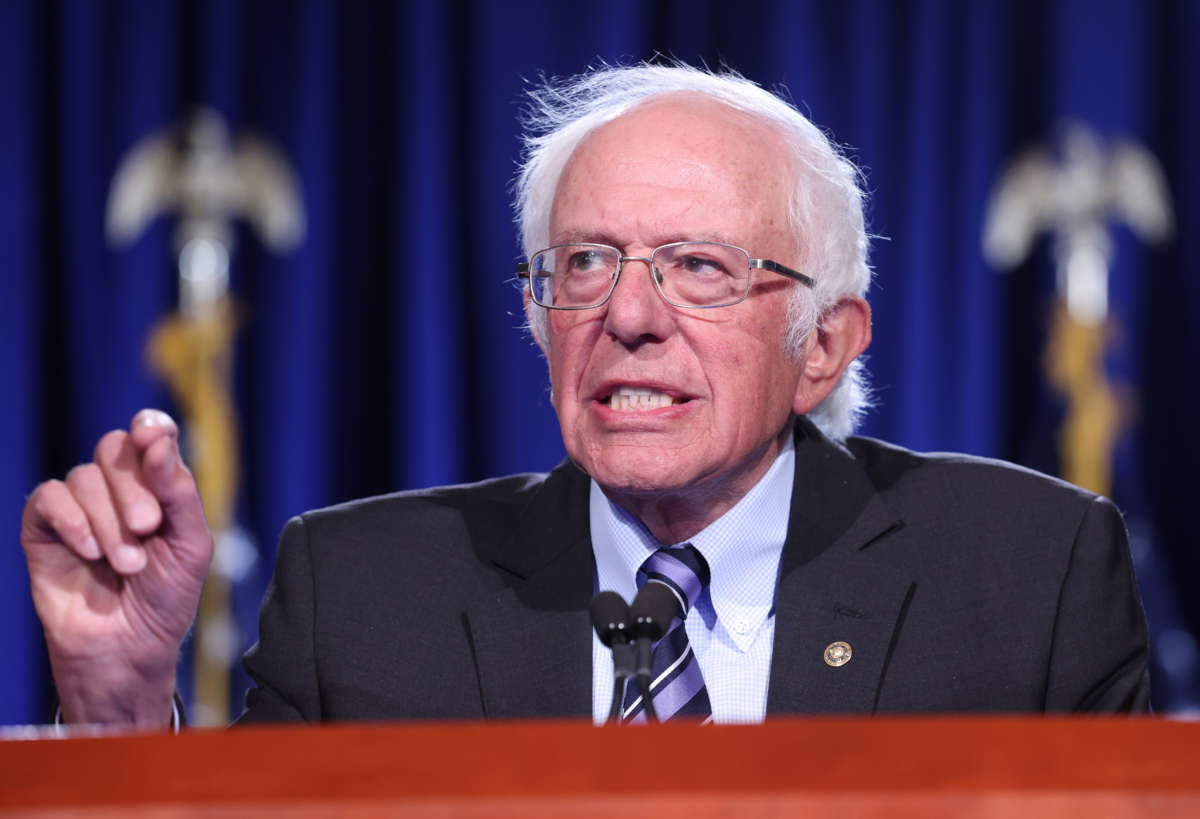
In a tweet late Sunday, Sen. Bernie Sanders (I-Vt.) — who has been campaigning for $2,000 relief checks since March — said that “Trump must get Mitch McConnell and his Republican friends in the Senate to pass legislation to provide $2,000 in direct payments to the working class.”
“The House must pass this legislation tomorrow and the Senate must quickly follow suit,” said the Vermont senator. “Let’s get this done — NOW!”
This story has been updated with procedural details on the upcoming House vote.
Press freedom is under attack
As Trump cracks down on political speech, independent media is increasingly necessary.
Truthout produces reporting you won’t see in the mainstream: journalism from the frontlines of global conflict, interviews with grassroots movement leaders, high-quality legal analysis and more.
Our work is possible thanks to reader support. Help Truthout catalyze change and social justice — make a tax-deductible monthly or one-time donation today.