Truthout is an indispensable resource for activists, movement leaders and workers everywhere. Please make this work possible with a quick donation.
A Russian missile attack on Friday reportedly killed more than 30 people at a train station in the eastern Ukrainian city of Kramatorsk, where civilians gathered to flee escalating violence in the region.
Pavlo Kyrylenko, the regional governor of Donetsk, said in a statement that “thousands of people were at the station during the missile strike, as residents of Donetsk region are being evacuated to safer regions of Ukraine.”
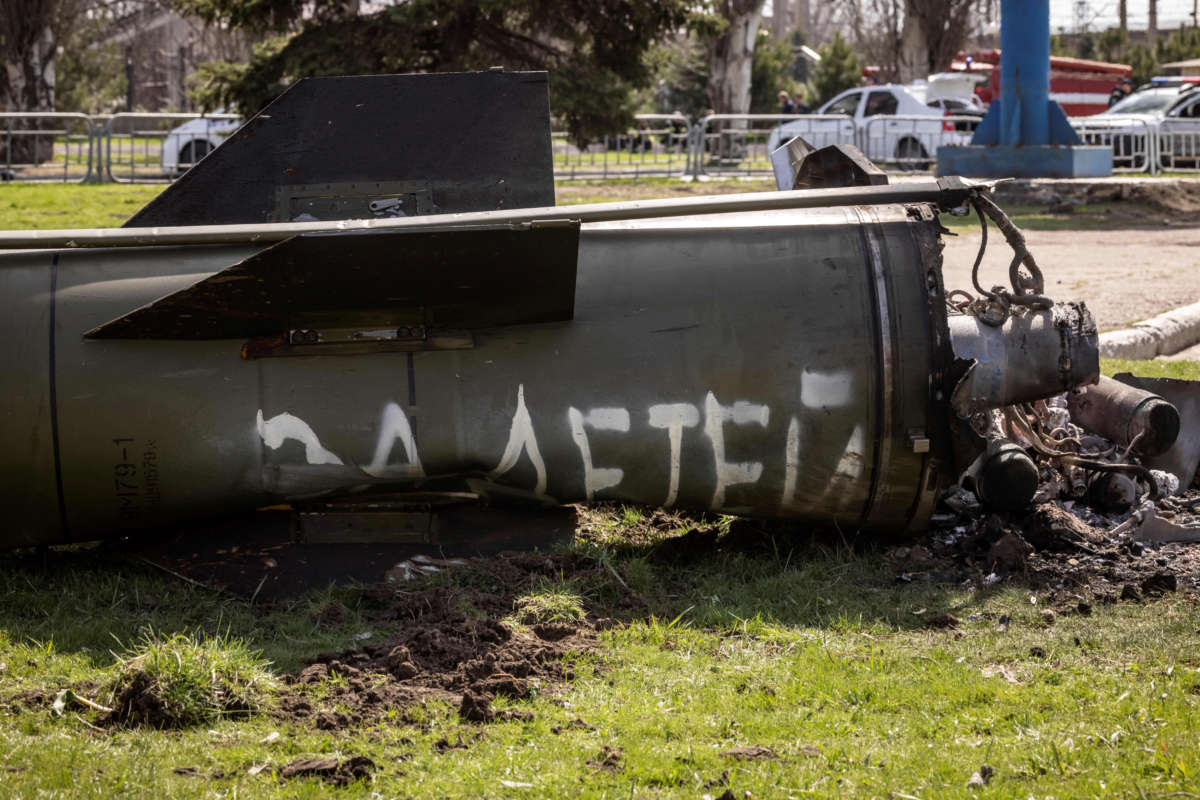
Horrific photos and video footage from the scene show bodies and luggage strewn on the pavement and emergency officials working to transport those wounded by the strike, which came as Russia faced growing accusations of war crimes. One photo appeared to show the missile that landed near the train station.
The Financial Times reported that the Russian Defense Ministry “initially said it had used high-precision rockets to attack three Ukrainian railway stations in the Donbas that it claimed were hosting ‘Ukrainian reserves’ armaments and military equipment.'”
“But after the scale of the civilian casualties became clear, Russia denied any involvement in the attack, which it said was a ‘provocation’ that ‘has nothing to do with reality,'” FT added. “The defense ministry said: ‘Russia’s forces had no plans to fire on targets in Kramatorsk on April 8.’ It claimed that the missiles used in the attack were used solely by Ukrainian forces.”
In the wake of the attack, Ukrainian President Volodymyr Zelenskyy accused Russian forces of “cynically destroying the civilian population” because they are “lacking the strength and courage to stand up to us on the battlefield.”
“This is an evil that has no limits,” he added. “And if it is not punished, it will never stop.”
The latest reported atrocity comes as Western officials say that Russia, having failed to seize Kyiv and other major cities, is shifting its focus to eastern Ukraine, where Moscow-backed separatists and Ukrainian forces have been fighting for years.
In recent days, Ukrainian officials have implored residents in the eastern region to evacuate ahead of potential Russian offensive. According to the Washington Post, local officials on Wednesday “reported renewed Russian shelling in the eastern Donetsk region, killing at least five people, and as many as 10 high-rise apartment buildings on fire in Severodonetsk, in the neighboring Luhansk district.”
Since Russia launched its invasion in late February, more than 11 million Ukrainians — around a quarter of the pre-war population — have been forced to flee their homes to escape airstrikes and ground fighting.
On Thursday, NATO member countries agreed to provide Ukraine with more advanced weaponry despite mounting concerns that Western arms shipments are hampering the ongoing peace talks and potentially prolonging the war. Weeks of tense negotiations between Russian and Ukrainian delegations have yet to produce a lasting ceasefire or a broader breakthrough, despite some reports of progress from both sides.
Vadym Prystaiko, Ukraine’s ambassador to the United Kingdom, told Sky News ahead of the train station attack that “we’re trying to build up a very, very uneasy [and] very, very difficult, compromise.”
“Many Ukrainians are not happy with the attempts of the government to find some ground with Russia,” said Prystaiko. “People, in most of the cases, don’t even understand how can we sit at the table with those who are just killing each and every day our people. But that’s the nature of any war. They will have to come to an end and we will.”
This story has been updated to include new comments from the Russian Defense Ministry.
Important Message: Please Read
For 25 years, Truthout has survived by publishing impactful investigative journalism and analysis; distributing full editions 365 days a year; and building a community of readers who support us with small, hard-earned donations.
Eighty percent of our $3 million yearly budget comes from small donors alone. Of those, 8,000 readers support us with monthly donations. Back in 2018, when Facebook decided to suppress the circulation of posts made by organizations, thereby cutting readers off from seeing many articles shared by the news organizations they had intentionally decided to follow, Truthout’s total traffic declined by 40 percent, as nearly all of our traffic from that platform disappeared.
Now, Google has recently rolled out its AI search bar, providing AI summaries instead of directing readers to our site. Google Search is our single largest source of traffic; it’s the route by which nearly one third of our readers find us. Much like in 2018, a shocking 40 percent of our Google traffic has disappeared overnight.
It will not be easy for Truthout to shoulder this blow. Nor will it be easy for our peers and collaborators — news sites that depend on traffic and aren’t bankrolled by large corporations.
If you can support Truthout with a donation today, you can help us resist the AI onslaught. Please give today.