Did you know that Truthout is a nonprofit and independently funded by readers like you? If you value what we do, please support our work with a donation.
A key GOP lawmaker made clear in an interview published Thursday that Republicans plan to push for a pair of their voting-related bills when they take control of both chambers of Congress and the White House next month.
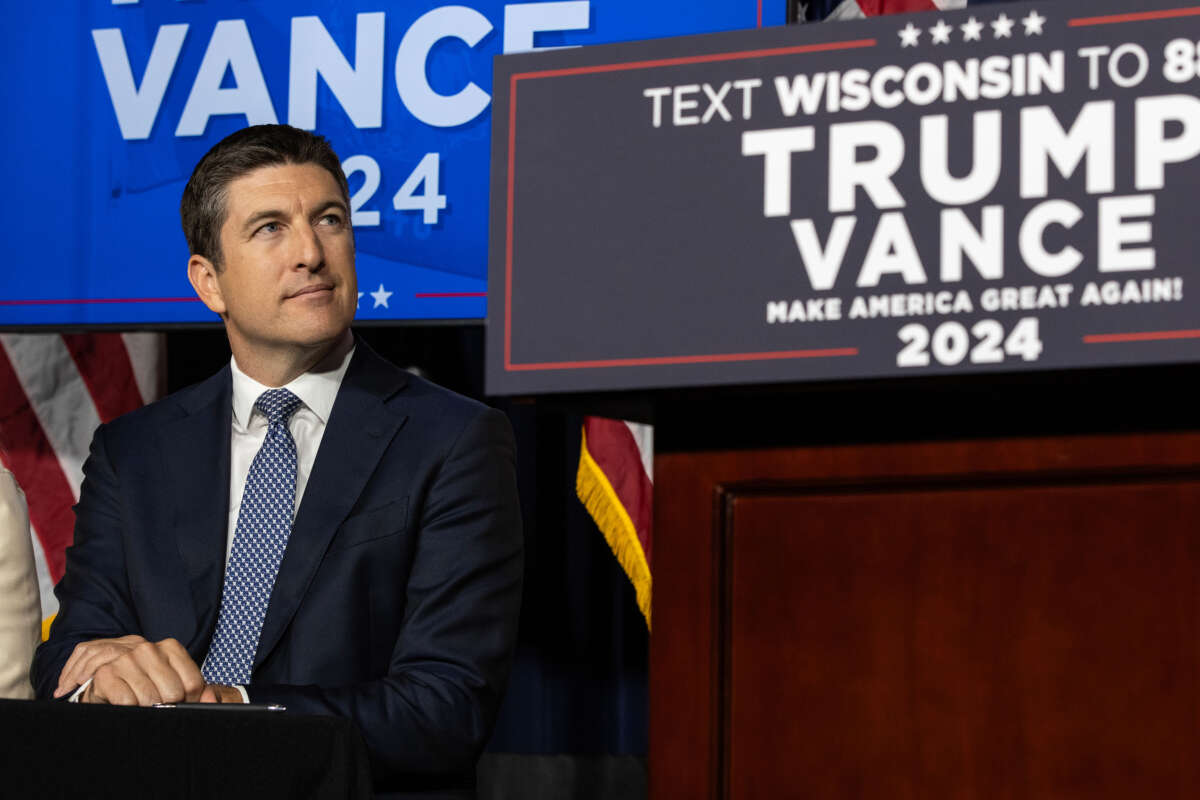
Congressman Bryan Steil (R-Wis.), who campaigned for U.S. President-elect Donald Trump and his running mate, Sen. J.D. Vance (R-Ohio), chairs the Committee on House Administration. He shared the GOP’s plans for the American Confidence in Elections (ACE) Act and the Safeguard American Voter Eligibility (SAVE) Act in comments to The Associated Press.
“As we look to the new year with unified Republican government, we have a real opportunity to move these pieces of legislation not only out of committee, but across the House floor and into law,” he said. “We need to improve Americans’ confidence in elections.”
The AP pointed out that “Republicans are likely to face opposition from Democrats and have little wiggle room with their narrow majorities in both the House and Senate. Steil said he expects there will be ‘some reforms and tweaks’ to the original proposals and hopes Democrats will work with Republicans to refine and ultimately support them.”
Steil’s ACE Act, which “includes nearly 50 standalone bills sponsored by members of the House Republican Conference,” is “the most conservative election integrity bill to be seriously considered in the House in over 20 years,” according to his committee.
Dozens of organizations wrote to Steil and Rep. Joe Morelle (D-N.Y.), the panel’s ranking Democrat, last year that “we believe Congress has an important role to play in safeguarding free and fair elections and ensuring all Americans have the freedom to vote. Rather than furthering this goal, the ACE Act would be a substantial step backwards.”
“The act would nationalize harmful and unnecessary restrictions on voting rights and roll back many of Washington, D.C.’s current pro-voter laws,” the coalition explained. “Instead of proceeding with this legislation, Congress should take actions that will help voters and promote democracy such as passing legislation that will strengthen protections against discrimination in voting and expand access to the ballot for all communities.”
While that bill didn’t get a floor vote in the House this session, Rep. Chip Roy’s (R-Texas) SAVE Act did — it was passed by the House 221-198 in July. Every Republican present voted for the bill and all but five House Democrats rejected it.
However, Democrats narrowly controlled the Senate, so the SAVE Act — which would require proof of U.S. citizenship to vote in federal elections — never went further in Congress, despite GOP attempts to tie it to government funding.
Morelle suggested to the AP there could be bipartisan support for some voting policies — such as federal funding for election offices, restricting foreign money in U.S. races, and possibly even identification requirements with certain protections for voters — but he also called out Republicans for spreading conspiracy theories about widespread voting by noncitizens in November.
“You haven’t heard a word about this since Election Day,” he noted. “It’s an Election Day miracle that suddenly the thing that they had spent an inordinate amount of time describing as a rampant problem, epidemic problem, didn’t exist at all.”
Speaking broadly about voting bills, Morelle told the AP that “our view and the Republicans’ view is very different on this point.”
“They have spent most of the time in the last two years and beyond really restricting the rights of people to get to ballots — and that’s at the state level and the federal level,” he added. “And the SAVE Act and the ACE Act both do that — make it harder for people to vote.”
Responding to the reporting on social media Thursday, lawyer and Democracy Docket founder Marc Elias said that “Trump is an autocrat. The GOP wants these ‘changes’ to spread disinformation, justify election denialism, and gain partisan advantage.”
“Democrats need to oppose this effort,” he warned. “If the GOP enacts new voter suppression laws, I can promise we will sue and win.”
25 Years of Truthout: An important fundraising appeal
This September, Truthout is celebrating 25 years of publication. For over two decades, we have been a trusted source for fiercely independent journalism thanks to readers like you.
As we look to the next 25 years, we have launched a special fundraising campaign. Looking to a sustainable future for our publication, we have a fundraising goal of $44,000 in the next 48 hours.
We are asking for your support at this juncture because we face greater threats than ever before in our organizational history. Trump and his MAGA allies are determined to control the information ecosystem, and movement-based organizations are subject to dangerous censorship and scrutiny.
If you can support Truthout with a one-time or monthly donation, you will make a significant impact on our work and our legacy. Anything you can do makes a difference!